
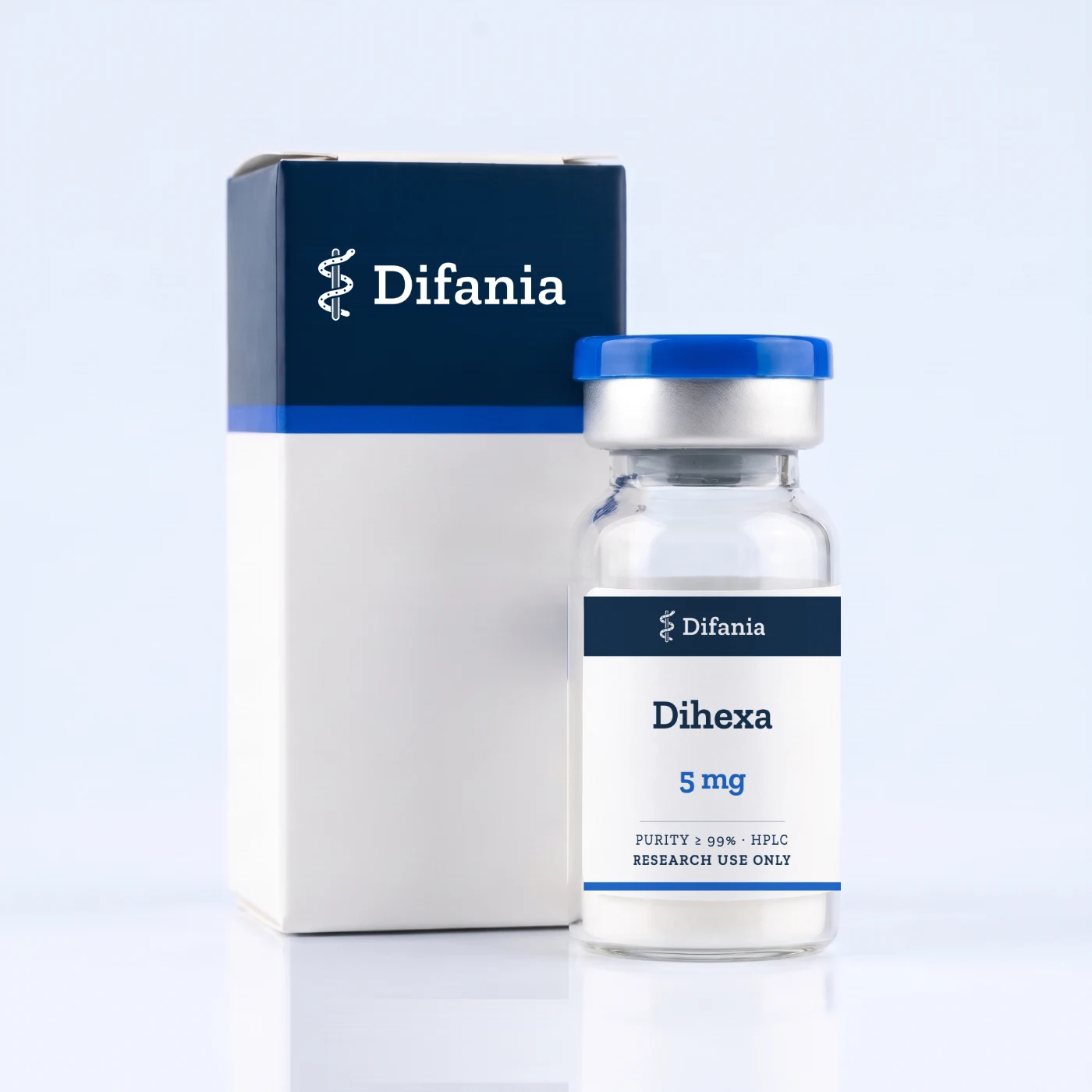
Dihexa in the laboratory
Identification
Dihexa is catalogued by Difania as a compound in the neuropeptides category and supplied as a lyophilised solid. The record gives CAS number 1401708-83-5, the molecular formula C27H44N4O5 and a molar mass of 504.7 g/mol. The formula holds carbon, hydrogen, nitrogen and oxygen only, which places the material as a discrete organic molecule rather than a chain of residues, and it contains no sulphur, so there is no free thiol or disulphide to protect during weighing or dissolution. Two fill sizes are offered, 5 mg and 10 mg of material per vial, each at a purity of 99% or higher.
Analytical control
Purity is established by reversed phase high performance liquid chromatography. The sample is resolved on the column, the main peak is integrated against the full chromatogram, and related substances and process residues are separated from it, so the result can be read against the specification of 99% or higher. Identity is confirmed by mass spectrometry, where the measured mass is compared with the 504.7 g/mol calculated from the stated formula. Both results are written into the documentation kept for the lot.
Reconstitution and solubility
Leave the sealed vial until the glass has reached room temperature. Add the solvent slowly down the inner wall of the vial, never onto the solid, and swirl or let the vial stand until the material has fully dissolved. A solution that is still cloudy has not finished dissolving, and it should not be sampled until it is clear.
| Vial size | Solvent added | Resulting concentration |
|---|---|---|
| 5 mg | 1 mL | 5 mg/mL |
| 5 mg | 2 mL | 2.5 mg/mL |
| 10 mg | 1 mL | 10 mg/mL |
| 10 mg | 2 mL | 5 mg/mL |
Bacteriostatic water suits a stock that is drawn on across several sessions, sterile water suits a solution used at once, and a dilute acetic acid solution is the alternative where the solid is slow to clear in water.
Storage and stability
Keep the sealed solid at minus 20 degrees Celsius, out of the light, until it is needed. The reconstituted solution goes to 2 to 8 degrees Celsius and is best divided into working portions as soon as it has been made, so that the main stock stays sealed between uses. Let a frozen vial warm to room temperature before the seal is broken, because cold material opened in a humid room gathers moisture.
Use in the laboratory
Dihexa is supplied for in vitro experiments and for use as a reference material. The compound is listed in the neuropeptide research field, and this entry is intended for laboratories working in that field. Difania provides the material and the analytical documentation filed for its lot. It does not advise on experimental design, the selection of assays, or the interpretation of data generated with the reagent.
Safety and handling
Gloves and eye protection should be worn whenever the vial is open or solutions are transferred, and the dry powder should be handled in the containment your laboratory uses for fine solids. Waste, rinses and used consumables are disposed of under the rules of your institution and the local regulations that apply. Dihexa is a laboratory chemical. It is not a medicinal product, a food, a supplement or a cosmetic, it is not for consumption, and it is not for administration to humans or animals.
Lot documentation
Each vial carries a lot number on its label. That number is the key to the analytical records Difania holds, so quote it whenever you request documentation for the material. Record the lot number together with the date the vial was opened, which allows any later result to be matched to the exact batch used.


