
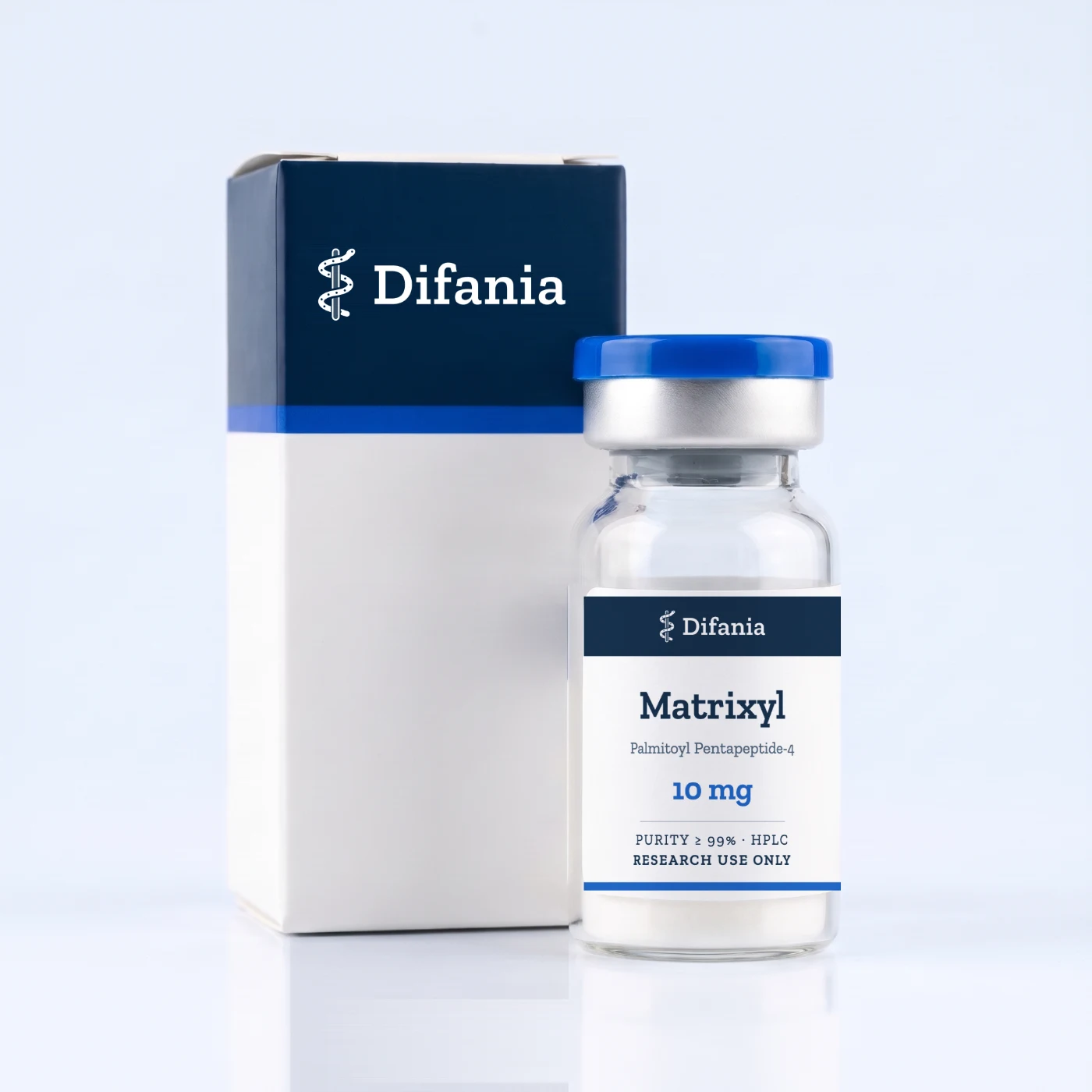
Matrixyl (Palmitoyl Pentapeptide-4) in the laboratory
Identification
Matrixyl is the catalogue name for palmitoyl pentapeptide-4, a pentapeptide carrying a palmitoyl group, which is a fatty acid chain attached to the peptide. Difania lists it under skin peptides as a lyophilised solid in a single 10 mg vial. The record holds CAS number 214047-00-4, the molecular formula C39H75N7O10 and a molar mass of 802.1 g/mol. The lipid chain is what distinguishes the material from an unmodified pentapeptide: it changes how the solid wets and dissolves, and it is the reason the solution may take longer to clear. Purity is specified at 99% or higher. The formula contains no sulphur, so the material has no free thiol to protect during weighing or reconstitution.
Analytical control
Purity is established by reversed phase high performance liquid chromatography, which separates the main peak from related substances and process residues. A lipid-bearing peptide is retained strongly on reversed phase media, so the method is run under conditions that elute the material cleanly, and the main peak is then compared with the specification of 99% or higher. Identity is confirmed by mass spectrometry against the 802.1 g/mol calculated from the formula. Both results are written into the documentation kept for the lot.
Reconstitution and solubility
Let the sealed vial reach room temperature. Add the solvent slowly down the inner wall, never onto the cake, then swirl gently or allow the vial to rest. Because of the palmitoyl chain, do not judge the result after a few seconds: leave the vial until no solid is visible. Bacteriostatic water, sterile water and a dilute acetic acid solution are the usual solvents.
| Vial size | Solvent added | Resulting concentration |
|---|---|---|
| 10 mg | 1 mL | 10 mg/mL |
| 10 mg | 2 mL | 5 mg/mL |
Pick the solvent by how the stock will be used. A stock drawn repeatedly suits bacteriostatic water, a solution used at once suits sterile water, and a dilute acetic acid solution is the option where water alone is slow.
Storage and stability
The sealed solid belongs at minus 20 degrees Celsius, shielded from light, until it is wanted. Once reconstituted, the solution is divided into portions and held at 2 to 8 degrees Celsius, so that the bulk stock is not repeatedly opened. Bring a frozen vial to room temperature before the stopper is disturbed, since cold glass draws condensation onto the contents.
Use in the laboratory
The material is supplied for in vitro experiments and as a reference material. Matrixyl is catalogued under skin peptides, and it is encountered in laboratory research into skin biology, the field this entry serves. Difania supplies the reagent and the analytical documentation for its lot, and does not advise on experimental design or on the reading of results.
Safety and handling
Gloves and eye protection are required whenever the vial is open or solutions are being transferred, and the dry powder is handled inside the containment your laboratory uses for fine solids. Residues, rinses and used labware are disposed of under the rules of your institution and the local regulations that bind it. This is a laboratory chemical, not a medicinal product, food, supplement or cosmetic. It is not for consumption and not for administration to humans or animals.
Lot documentation
Each vial carries a lot number, and quoting it allows Difania to retrieve the analytical documentation held for that lot. Record the number beside the date the vial was opened and the solvent used, so that any later result can be matched to the fill it came from.


