
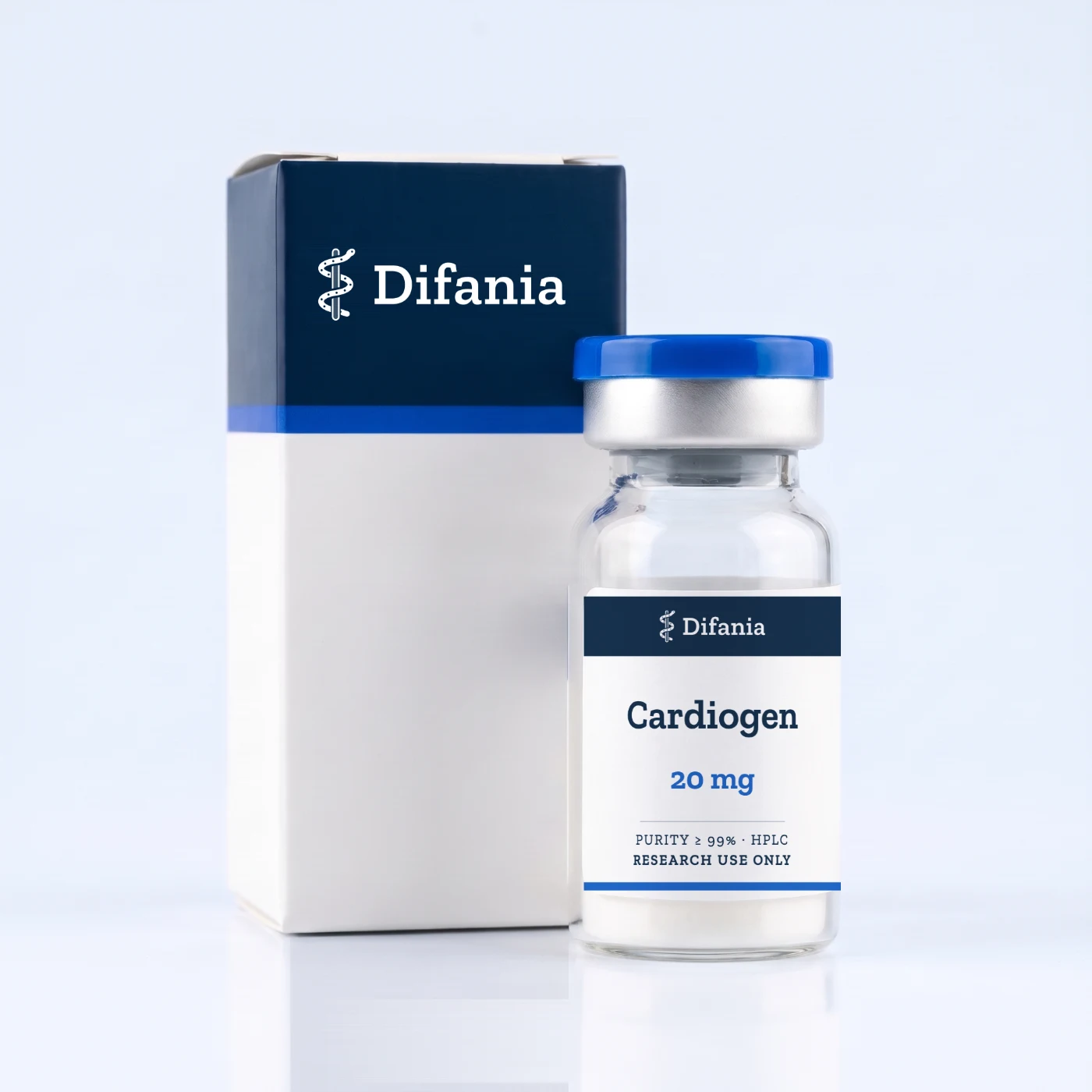
Cardiogen in the laboratory
Identification
Cardiogen is a peptide catalogued by Difania in the bioregulators category and supplied as a lyophilised solid. The catalogue fixes one presentation for it: a single 20 mg vial, with a purity specification of 99% or higher. Because the product is sold on its own and does not appear in any combined vial, the amount printed on the label refers to Cardiogen alone. The peptide is held in its dry form until you dissolve it, and that dry state is the one you should keep sealed, cold and protected from light. Treat the vial as one pure component, with its quantity and lot number on the label serving as the reference points for every record you keep.
Analytical control
Purity is measured by reversed phase high performance liquid chromatography. The main peak is resolved from related substances and process residues, then compared with the specification of 99% or higher. Identity is confirmed by mass spectrometry, which checks the material against the expected mass for the product. Together these two checks make up the analytical record for each lot. The record is kept on file, and the specification is a minimum, so a lot is only described as meeting it when its measured purity is at or above 99%.
Reconstitution and solubility
Warm the sealed vial to room temperature before handling. Add the chosen solvent gently, running it down the inner wall rather than onto the powder, and then allow the vial to stand or swirl it softly until no solid is visible. Bacteriostatic water, sterile water and a dilute acetic acid solution are the solvents usually selected for this material.
| Vial size | Solvent added | Resulting concentration |
|---|---|---|
| 20 mg | 2 mL | 10 mg/mL |
| 20 mg | 8 mL | 2.5 mg/mL |
The larger volume gives the more dilute of the two working solutions, which can be useful where a low concentration is part of the planned work. Choose between them before you break the seal, not after.
Storage and stability
The unopened vial is stored sealed at minus 20 degrees Celsius and kept out of light. Once solvent has been added, the solution should be placed at 2 to 8 degrees Celsius and divided into portions while it is being prepared, so that individual aliquots can be drawn without handling the whole stock. Let the frozen vial come to room temperature before the seal is broken, since moisture condensing on cold material spoils its handling.
Use in the laboratory
Cardiogen is supplied for in vitro work and as a reference material. It appears in laboratory research on peptide bioregulators, which is the field this entry is intended to serve. Difania provides the material together with its analytical documentation. It does not advise on experimental design, and it does not interpret what a laboratory observes when it works with the reagent.
Safety and handling
Gloves and eye protection should be worn whenever the vial is open or solution is being moved between containers. Treat the dry material as a laboratory chemical, and dispose of residues, rinses and labware under the rules of your institution and the local regulations that apply. Cardiogen is not a medicinal product, a food, a supplement or a cosmetic. It is not for consumption and not for administration to humans or animals.
Lot documentation
Each vial is labelled with a lot number. Quote this number in any request, and Difania will retrieve the analytical documentation held for that lot. Record the lot number together with the date the vial was opened, which allows a later result to be traced to the exact fill it came from.


