
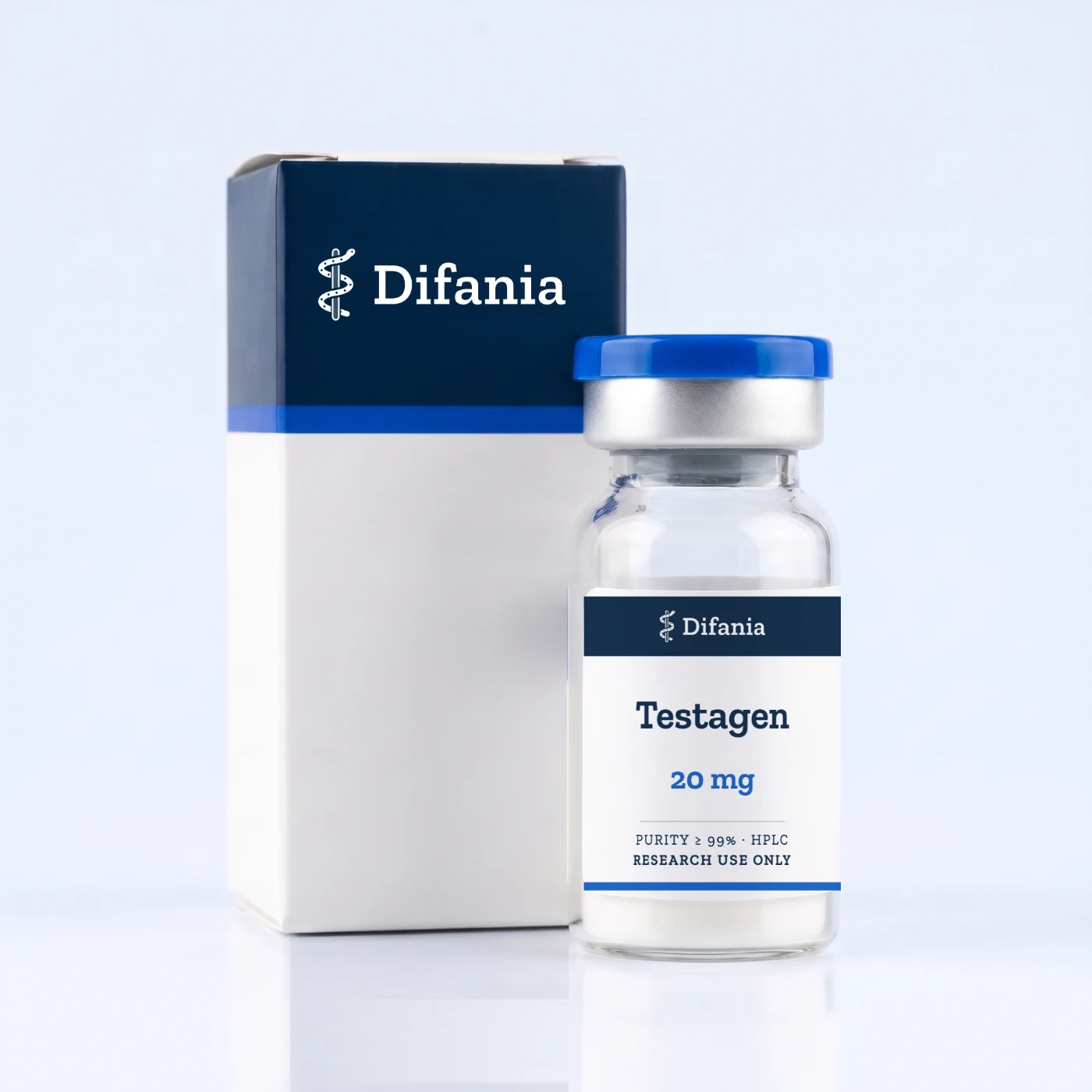
Testagen in the laboratory
Identification
The molecule in this vial is a peptide, a chain of amino acid residues, and it is catalogued by Difania under bioregulators. It is supplied in lyophilised form, which is a solid produced by freezing the peptide in solution and then removing the water under reduced pressure. The vial holds 20 mg, and the specified purity is 99% or higher. There is one peptide in the vial and no blended partner, so the quantity you weigh out is the quantity of that peptide alone.
Analytical control
Purity is assessed by reversed phase high performance liquid chromatography. The sample is dissolved, run through the column, and the main peak is integrated while related substances and process residues are counted separately. The result is compared with the 99% or higher specification. Mass spectrometry is then used to confirm identity, by checking the measured molecular mass against the value expected for the structure. The two results are filed together under the lot.
Reconstitution and solubility
Start by letting the sealed vial reach room temperature. Add solvent gradually down the wall of the vial, not onto the solid, and allow the peptide to dissolve with gentle movement of the vial rather than shaking. The usual solvents are bacteriostatic water, sterile water and a dilute acetic acid solution. The table presents the concentration obtained from each of three volumes in the 20 mg vial.
| Vial size | Solvent added | Resulting concentration |
|---|---|---|
| 20 mg | 4 mL | 5 mg/mL |
| 20 mg | 2 mL | 10 mg/mL |
| 20 mg | 1 mL | 20 mg/mL |
Storage and stability
Sealed solid is kept at minus 20 degrees Celsius and shielded from light until it is required. The reconstituted solution should be stored at 2 to 8 degrees Celsius. Divide it into portions while it is being prepared, so that the main stock is not repeatedly warmed and cooled. The vial must be brought to room temperature before the stopper is removed, because cold surfaces collect condensation that can alter the material.
Use in the laboratory
Testagen is intended for in vitro experiments and for use as a reference material. It appears in the bioregulators field of peptide research, and this entry is offered on that neutral basis. Difania supplies the reagent together with the analytical documentation held for its lot. The company does not advise on experimental design, on the selection of a method for a given study, or on how results obtained with the peptide should be interpreted.
Safety and handling
Testagen is a laboratory chemical and should be handled as one. Put on gloves and eye protection while the vial is open, and handle the dry powder within the containment used for fine solids. Discard residues, rinses and contaminated items under the rules of your institution and the local regulations that apply. The product is not a medicinal product, a food, a supplement or a cosmetic. It is not for consumption and not for administration to humans or animals.
Lot documentation
The lot number printed on each vial identifies the batch it came from. Send that number to Difania and the documentation held for the lot can be retrieved. It is worth recording the lot number together with the date the vial was opened and the solvent you used, which makes it possible to trace any later result back to the exact fill.


