
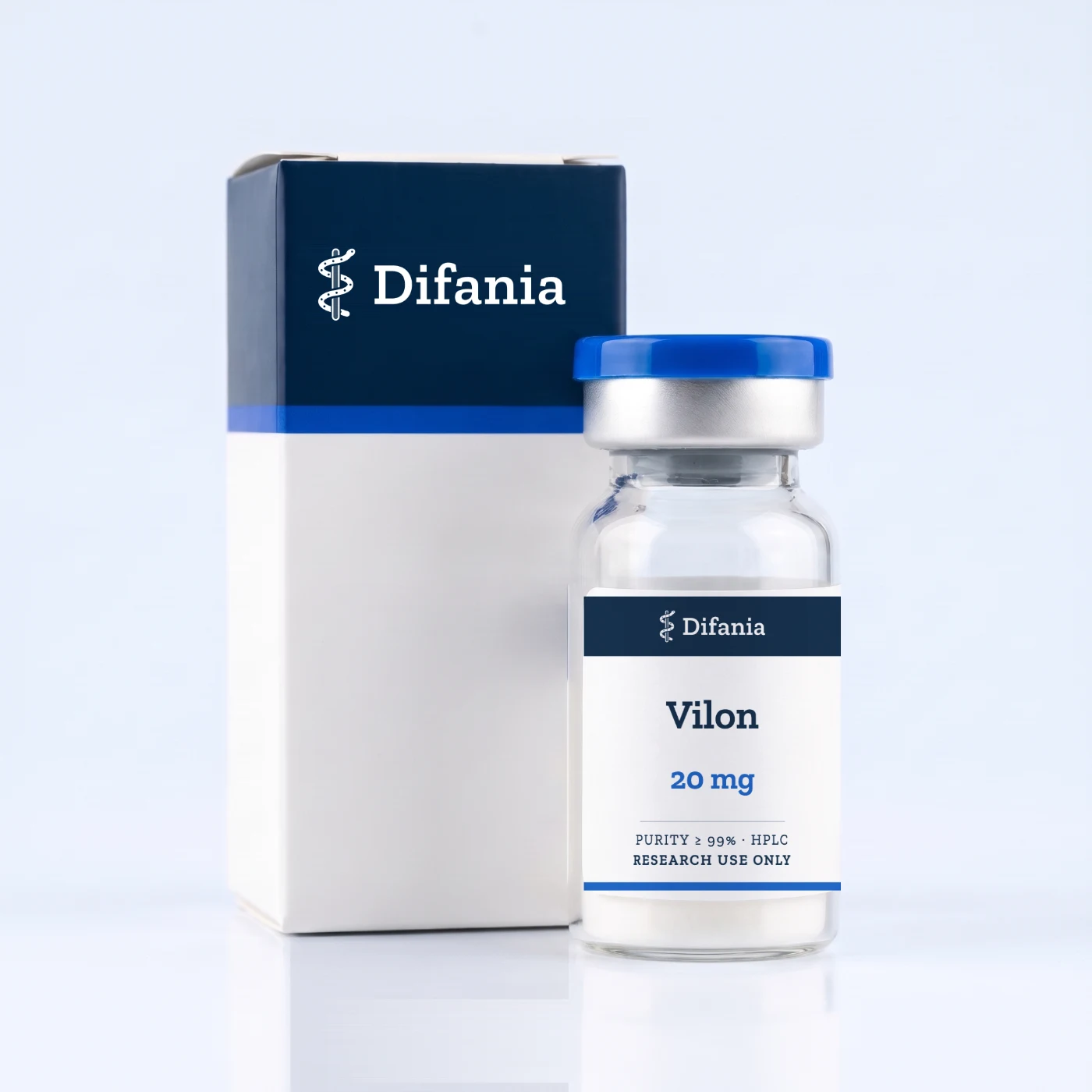
Vilon in the laboratory
Identification
Vilon is a dipeptide, two amino acid residues joined by a single peptide bond, with the sequence Lys-Glu: lysine followed by glutamic acid. Difania lists it among the bioregulators and supplies it as a lyophilised solid. The molecular formula is C11H21N3O5 and the molar mass is 275.3 g/mol. Each vial is specified at a purity of 99% or higher. Only one fill size is catalogued, 20 mg of material per vial, and the product is not presented as a component of any combined vial. The molar mass and formula are the reference values against which identity is judged, so they belong on the record for every lot you hold.
Analytical control
Purity is set by reversed phase high performance liquid chromatography. The sample is run on the column, the main peak is integrated, and its share of the trace is checked against the specification of 99% or higher. Identity is established by mass spectrometry, where the observed mass is compared with the 275.3 g/mol that follows from the formula C11H21N3O5. Results from both methods are written into the documentation for the lot, and the lot number printed on the label is the key for retrieving that documentation.
Reconstitution and solubility
Remove the vial from cold storage and leave it sealed until it is at room temperature. Run the solvent down the wall of the vial, then move the liquid gently over the solid instead of striking the cake directly. Sterile water, bacteriostatic water or a dilute acetic acid solution are the solvents usually chosen for this material, and the choice should reflect how long the stock has to last once it is made up.
| Vial size | Solvent added | Resulting concentration |
|---|---|---|
| 20 mg | 1 mL | 20 mg/mL |
| 20 mg | 4 mL | 5 mg/mL |
The larger volume gives the more dilute stock and suits work that begins from a low working concentration. Whichever you choose, check the solution visually before drawing from it.
Storage and stability
The sealed solid is kept at minus 20 degrees Celsius and protected from light until the day it is needed. Once dissolved, the solution moves to 2 to 8 degrees Celsius and should be divided into portions at the time of preparation, so that a single aliquot can be taken without disturbing the rest. Warm the vial to room temperature before breaking the seal, which prevents condensation forming inside it and wetting the material.
Use in the laboratory
Vilon is supplied for in vitro work and as a reference material. In the laboratory it is encountered in research on peptide bioregulators, and the entry serves groups working in that field. Difania provides the reagent together with the analytical documentation for its lot. It does not advise on how an experiment should be designed, and it does not interpret the outcomes a laboratory records with the material.
Safety and handling
Work with Vilon as you would with any laboratory chemical, with gloves and eye protection in place and the vial opened in a space suited to handling solids. Residues and used consumables are discarded according to your institution’s procedures and the regulations that apply where you work. The material is not a medicinal product, a food, a supplement or a cosmetic. It is not for consumption and not for administration to humans or animals.
Lot documentation
Each vial carries a lot number printed on its label. Quoting that number allows Difania to retrieve the documentation held for the lot, so keep it to hand whenever you make an enquiry. Write the lot number down beside the date the vial was opened, which means that any later observation can be matched to the correct batch.


