
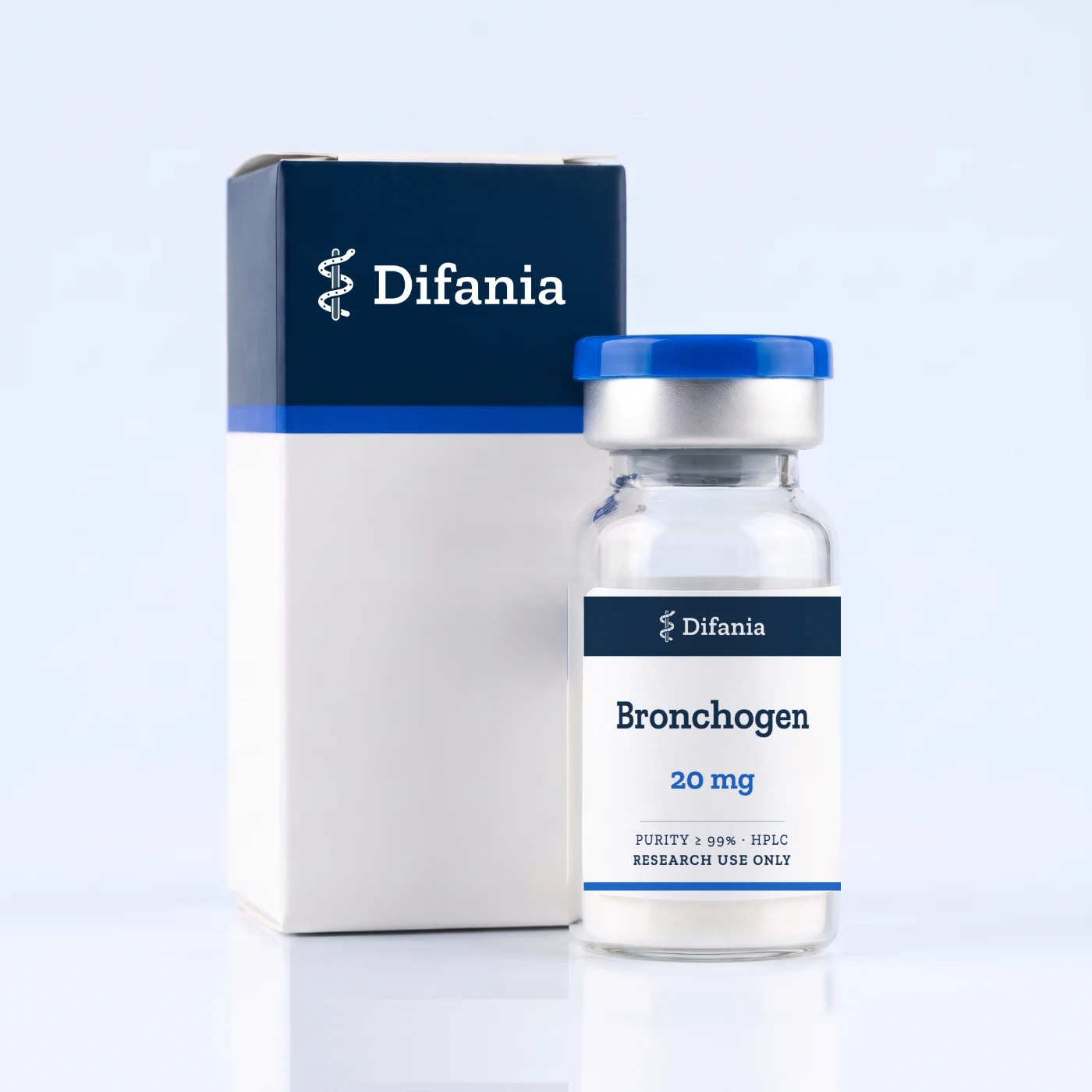
Bronchogen in the laboratory
Identification
Bronchogen is catalogued by Difania as a peptide in the bioregulators category and supplied as a lyophilised solid, a dry cake that has to be taken into solution before any work begins. Each vial contains 20 mg of the material, specified at a purity of 99% or higher. The catalogue offers no other fill size for this product, so the 20 mg vial is the only presentation. Bronchogen is not listed as a component of any combined vial, and the quantity on the label therefore refers to the peptide alone. Keep the material in its dry state until you are ready to dissolve it, since the solution is the form that calls for the storage steps described below.
Analytical control
Two analytical methods underpin the record for each lot. Reversed phase high performance liquid chromatography measures purity: the principal peak is separated from related substances and process residues, and its proportion is read against the specification of 99% or higher. Mass spectrometry confirms identity by checking the mass of the material against the value expected for the product. The results are filed with the batch, so the documentation for any particular vial can be produced on request. These are general techniques used across peptide quality control, and this page does not describe a particular run.
Reconstitution and solubility
Let the sealed vial come up to room temperature first. Introduce the solvent slowly along the inner wall of the vial, avoiding a direct stream onto the solid, and then rock or swirl the vial gently until the cake has dissolved. Sterile water, bacteriostatic water and a dilute acetic acid solution are the usual choices for a peptide of this kind.
| Vial size | Solvent added | Resulting concentration |
|---|---|---|
| 20 mg | 1 mL | 20 mg/mL |
| 20 mg | 4 mL | 5 mg/mL |
Where the stock will be used over several sessions, the 4 mL option gives the more dilute of the two working solutions and is easier to aliquot in small amounts.
Storage and stability
Sealed vials go into storage at minus 20 degrees Celsius, away from light, and stay there until the material is required. Reconstituted solution is transferred to 2 to 8 degrees Celsius and held in working portions, so that the main stock is not opened again and again. Before the stopper is removed, the vial should reach room temperature, which stops water from condensing onto the contents.
Use in the laboratory
Bronchogen is supplied for in vitro research and as a reference material. It is encountered in laboratory investigations of peptide bioregulators, and the product is catalogued for groups working in that field. Difania supplies the reagent together with the analytical documentation for the lot. It offers no guidance on experimental design and does not interpret the data a laboratory generates with the material.
Safety and handling
Handle the vial as a laboratory chemical. Gloves and eye protection are required when the seal is broken and when solution is transferred from one container to another. Dispose of residues, rinses and used labware according to the rules of your institution and the regulations that apply locally. Bronchogen is not a medicinal product, a food, a supplement or a cosmetic. It must not be consumed, and it must not be administered to humans or animals.
Lot documentation
The lot number on each vial’s label identifies its batch. Difania uses that number to retrieve the analytical documentation held for the lot, so include it whenever you request records. Keep a note of the lot number alongside the date the vial was opened and the solvent you used, so that the fill behind any later result is always known.


