
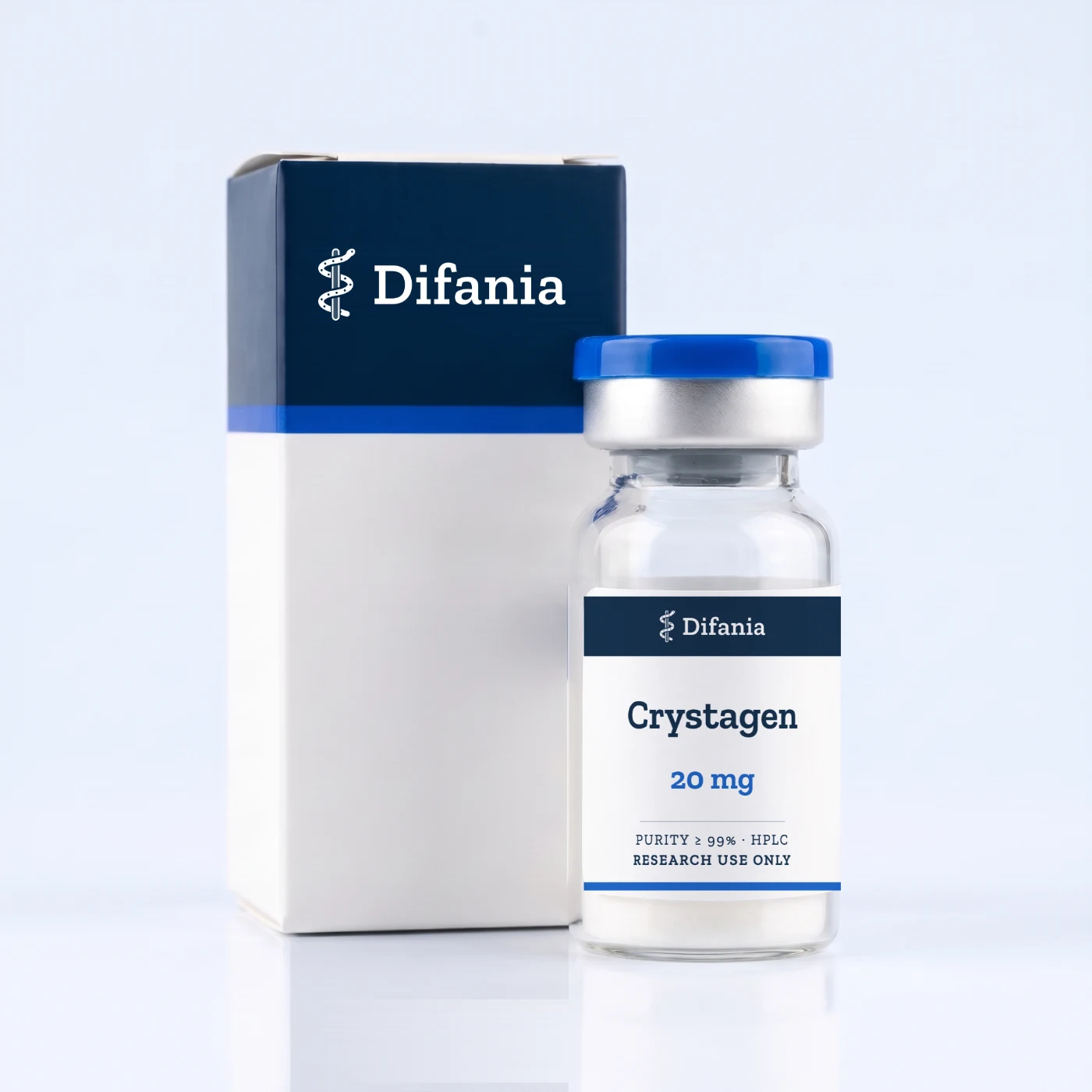
Crystagen in the laboratory
Identification
Crystagen arrives as a lyophilised solid, a dry cake formed by freezing a peptide solution and removing the water under vacuum. The molecule is a peptide, a chain of amino acid residues linked by amide bonds, and Difania catalogues it under bioregulators. Each vial holds 20 mg, and the material is specified at a purity of 99% or higher. Every vial contains a single peptide; this entry is not a blend with any other component.
Analytical control
Purity and identity are assessed as two separate questions. Purity is measured by reversed phase high performance liquid chromatography, which separates the peptide from related substances so that the main peak can be read against the specification of 99% or higher. Identity is established by mass spectrometry, which checks the measured mass of the peptide against the value expected for its structure. The outcome of both checks is kept in the documentation for each lot.
Reconstitution and solubility
Let the sealed vial warm to room temperature before you begin. Run the solvent slowly down the inside wall of the vial and allow the peptide to dissolve with gentle swirling, avoiding vigorous agitation that can foam the solution. The usual solvents are bacteriostatic water, sterile water and a dilute acetic acid solution, chosen according to how the stock will be handled. The concentrations for a 20 mg vial at three solvent volumes are shown below.
| Vial size | Solvent added | Resulting concentration |
|---|---|---|
| 20 mg | 1 mL | 20 mg/mL |
| 20 mg | 2 mL | 10 mg/mL |
| 20 mg | 4 mL | 5 mg/mL |
Storage and stability
The sealed solid is kept at minus 20 degrees Celsius, shielded from light, until it is needed. Solution made from the vial should be held at 2 to 8 degrees Celsius. Splitting the solution into portions at the outset spares the remainder from repeated temperature changes. Before the stopper is lifted, the vial must reach room temperature, because moisture from the air condenses onto a cold solid and alters what you weigh.
Use in the laboratory
Crystagen is supplied for in vitro experiments and as a reference material. It appears in the bioregulators field of peptide research, and this entry is offered on that basis only. Difania provides the material together with the analytical documentation for its lot. The company does not advise on experimental design, on method development for a particular study, or on how data generated with the peptide should be read.
Safety and handling
Crystagen is a laboratory chemical. Wear gloves and eye protection while the vial is open, and weigh the dry solid inside the containment your laboratory uses for fine powders. Residues and contaminated materials are disposed of according to institutional rules and local regulations. Crystagen is not a medicinal product, food, supplement or cosmetic, and it is not for consumption or for administration to humans or animals.
Lot documentation
Every vial is labelled with a lot number. Supply that number to Difania and the analytical documentation held for the lot can be retrieved. Record the lot number together with the date the vial was opened, so that your notes can be matched to the correct batch at any later point.


