
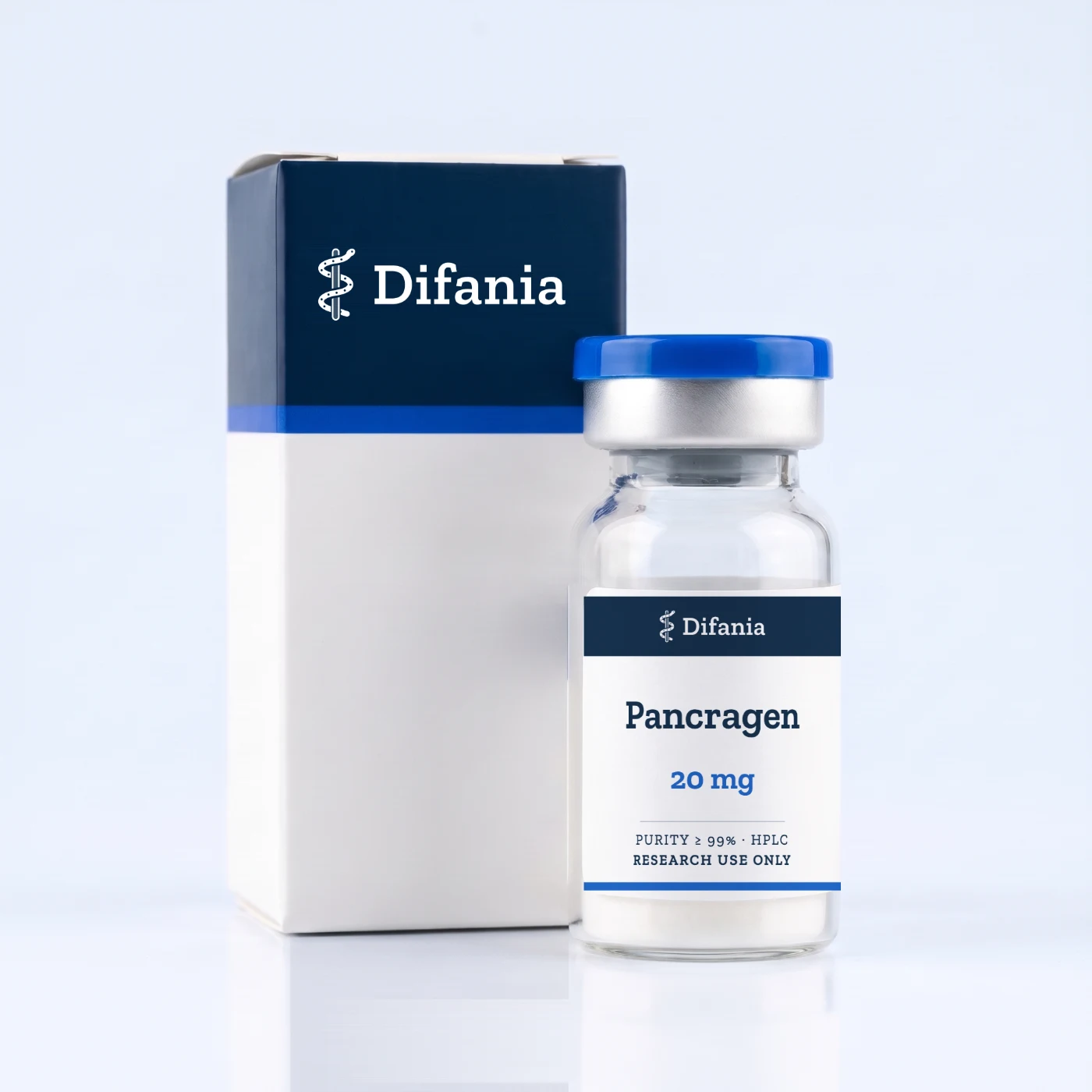
Pancragen in the laboratory
Identification
Pancragen is catalogued by Difania among the bioregulators and offered as a lyophilised solid. The catalogue specifies one vial size, 20 mg of material per vial, and a purity of 99% or higher. Pancragen is sold alone rather than in a combined vial, so the quantity on each label refers to this single material. The dry form is the one held until a solution is prepared, and the handling steps that follow begin from that point. Keep the vial sealed and cold until you are ready to use it, and record the lot number before the first opening so that the material can be traced from the outset.
Analytical control
Purity is established by reversed phase high performance liquid chromatography. The main peak is separated from related substances and process residues, and its share of the trace is compared with the specification of 99% or higher. Identity is established by mass spectrometry. Both results are written into the documentation kept for each lot, and that documentation is available on request for any lot number quoted by the buyer.
Reconstitution and solubility
Bring the sealed vial up to room temperature before you open it. Run the solvent slowly down the inner wall of the vial and keep the stream away from the solid. Once the solvent is in, swirl the vial gently until the powder has dissolved completely. The solvents most often used for this material are sterile water, bacteriostatic water and a dilute acetic acid solution.
| Vial size | Solvent added | Resulting concentration |
|---|---|---|
| 20 mg | 2 mL | 10 mg/mL |
| 20 mg | 10 mL | 2 mg/mL |
The larger volume gives the most dilute stock and suits work that starts from a low working concentration. Decide between the two before you open the vial, because the choice governs how the rest of the stock can be divided.
Storage and stability
Keep unopened vials in a freezer at minus 20 degrees Celsius, out of the light, and return the vial to the freezer promptly after each use. Solutions prepared from the vial should be placed at 2 to 8 degrees Celsius and divided into portions when they are made. A vial moved from the freezer should be allowed to reach room temperature before the seal is broken, which keeps condensation from forming on the solid.
Use in the laboratory
Pancragen is supplied for in vitro research and for use as a reference material. It is encountered in laboratory investigations of peptide bioregulators, which is the field this entry is intended to serve. Difania provides the material together with its analytical documentation. Experimental design and the interpretation of any results are the responsibility of the laboratory, not of the supplier.
Safety and handling
Gloves and eye protection belong on whenever the vial is open or a solution is being transferred. Treat the material as a laboratory chemical, and dispose of residues, rinses and contaminated labware under the rules of your institution and the regulations in your area. Pancragen is not a medicinal product, a food, a supplement or a cosmetic. It is not for consumption, and it is not for administration to humans or animals.
Lot documentation
Each vial is marked with a lot number on its label. That number is the reference Difania uses to retrieve the analytical documentation for the batch. Record it with the date you opened the vial and the solvent you used, so that every later result can be traced back to one fill.


