
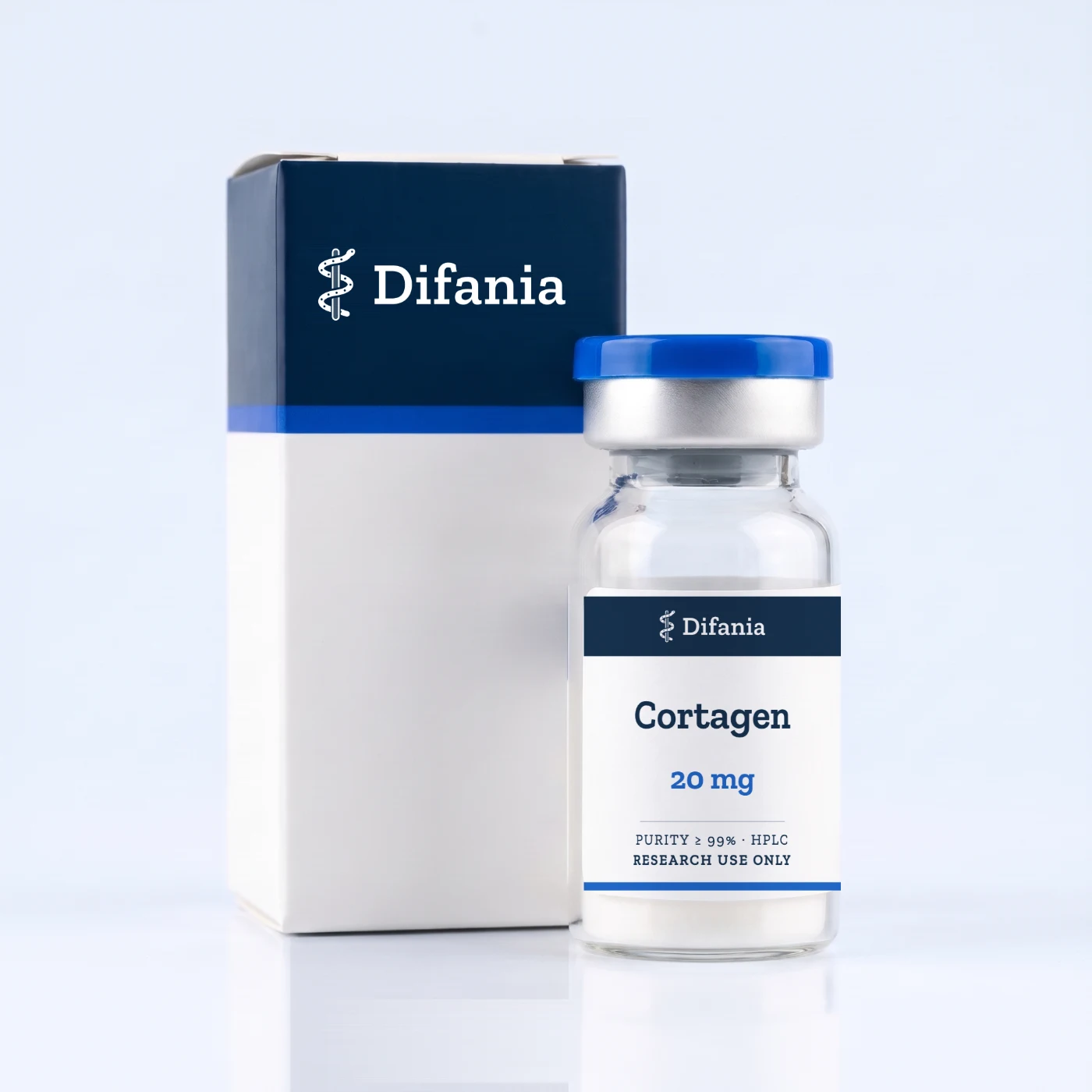
Cortagen in the laboratory
Identification
Cortagen is a bioregulator peptide, catalogued by Difania under the bioregulators heading and supplied as a lyophilised solid. Each vial holds 20 mg of material, which is the only fill offered for this product. The material is specified at a purity of 99% or higher. Cortagen is not catalogued as a component of any combined vial, so the contents of each vial are the peptide on its own. Because the product arrives as a dry solid, the first practical step is to bring it into solution in a controlled way, and the sections below set out how that is done.
Analytical control
The quality record for each batch rests on two techniques. Reversed phase high performance liquid chromatography quantifies purity by resolving the main peak from related substances and process residues, and the result is set against the specification of 99% or higher. Mass spectrometry provides the identity check by measuring the mass of the material and comparing it with the expected value for the structure. The specification is a floor, not a target, so a lot is recorded as conforming only when its measured purity is at or above 99%. Both outcomes are filed under the lot.
Reconstitution and solubility
Start by letting the sealed vial reach room temperature. Introduce the solvent along the inner wall of the vial, then mix the contents by gentle swirling until the solid has gone into solution. Sterile water, bacteriostatic water and a dilute acetic acid solution are the solvents most often chosen for work with this material.
| Vial size | Solvent added | Resulting concentration |
|---|---|---|
| 20 mg | 2 mL | 10 mg/mL |
| 20 mg | 4 mL | 5 mg/mL |
Choosing between the two volumes is a matter of how concentrated the working stock needs to be. Whichever you pick, confirm that the solution is clear before you take the first portion.
Storage and stability
Keep the sealed solid at minus 20 degrees Celsius and away from light until it is needed. A solution prepared from the vial should be moved to 2 to 8 degrees Celsius and split into working portions at the time of preparation, which spares the remaining stock from repeated handling. Warming the vial before opening prevents moisture from condensing onto the material, and that condensation is the most common reason a dry solid loses its condition after the seal has been broken.
Use in the laboratory
Cortagen is supplied for in vitro research and for use as a reference material. It is encountered in laboratory work on peptide bioregulators, and the entry is intended for groups active in that field. Difania supplies the reagent together with the analytical documentation for its lot. It does not advise on experimental design or on the reading of results obtained with the material.
Safety and handling
Wear gloves and eye protection whenever you open a vial or transfer solution. The dry material is a laboratory chemical and should be handled with the containment appropriate to a fine solid. Residues, rinses and used labware must be disposed of under your institution’s rules and the local regulations that apply. Cortagen is not a medicinal product, a food, a supplement or a cosmetic. It is not for consumption and not for administration to humans or animals.
Lot documentation
Every vial bears a lot number on its label. Difania links that number to the analytical records for the batch, so quote it when you ask for documentation. Write the lot number down with the date the vial was opened, which helps any later result be matched to the right fill.


