
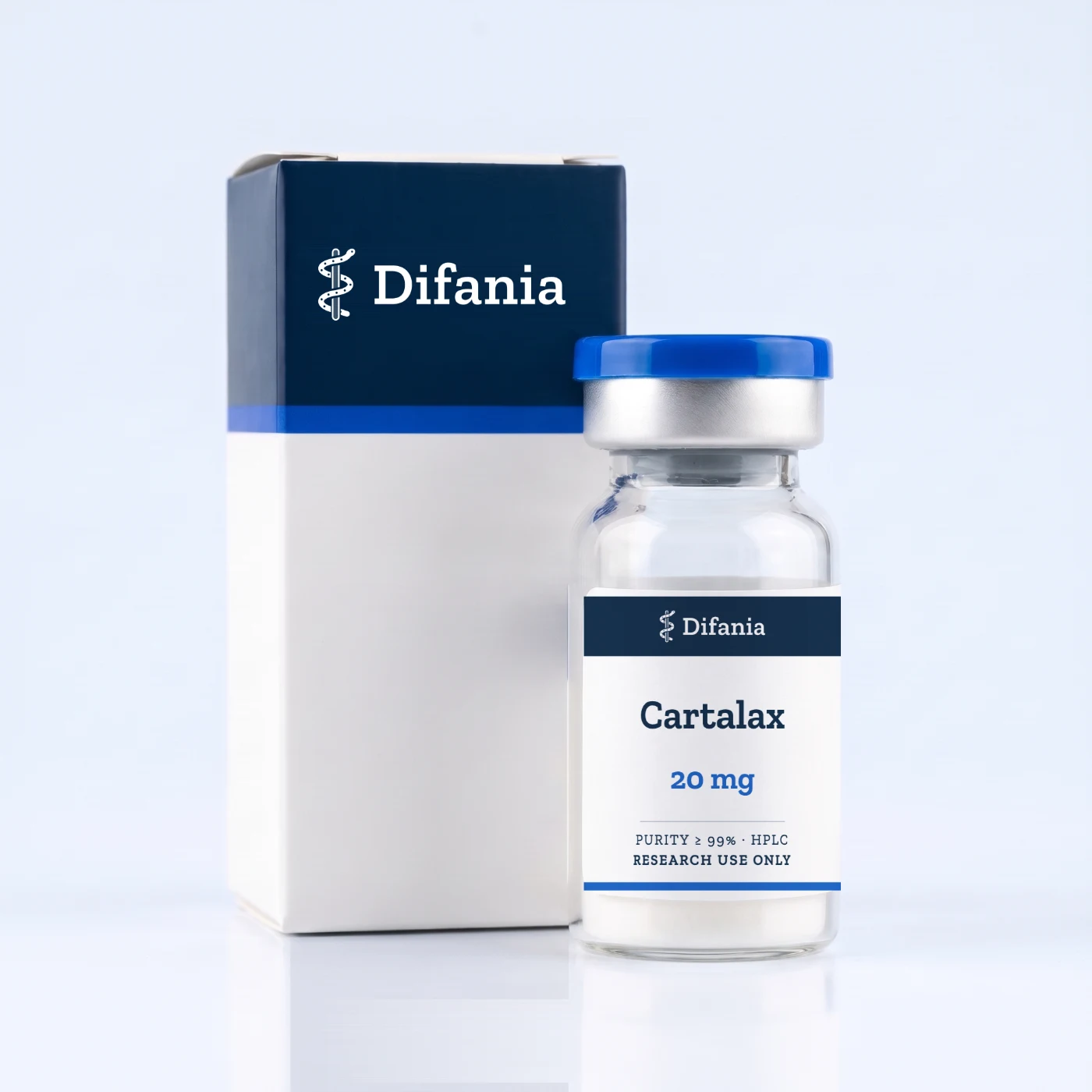
Cartalax in the laboratory
Identification
Cartalax is a peptide, a chain of amino acid residues joined by amide bonds, and Difania files it under the bioregulators group. It is supplied as a lyophilised solid, which means the solution was frozen and the water then removed under vacuum, leaving a dry cake that keeps well while sealed. Each vial holds 20 mg of peptide, and the material is specified at a purity of 99% or higher. The vial contains one peptide on its own, not a blend of components.
Analytical control
Purity is measured by reversed phase high performance liquid chromatography. The dissolved sample is passed through the column, the main peak is integrated against the full chromatogram, and related substances and process residues are counted separately from it. The result is judged against the specification of 99% or higher. Identity is confirmed by mass spectrometry, which compares the measured mass of the peptide with the value expected for its structure. Both results are recorded in the documentation for the lot.
Reconstitution and solubility
Allow the sealed vial to reach room temperature first. Run the solvent slowly down the inner wall of the vial, keeping it away from the cake, and let the peptide dissolve with gentle swirling rather than vigorous shaking. Bacteriostatic water, sterile water or a dilute acetic acid solution are the usual solvents, and the choice follows from how the stock will be handled afterwards. The table gives the concentration that results from three common volumes for the 20 mg vial.
| Vial size | Solvent added | Resulting concentration |
|---|---|---|
| 20 mg | 1 mL | 20 mg/mL |
| 20 mg | 2 mL | 10 mg/mL |
| 20 mg | 4 mL | 5 mg/mL |
Storage and stability
The sealed solid is kept at minus 20 degrees Celsius, out of light, until the material is needed. Solution prepared from the vial belongs at 2 to 8 degrees Celsius. Dividing the solution into portions as soon as it is made means each draw is taken from an aliquot that has not been returned to a temperature change. Let a frozen vial come up to room temperature before you open it, since condensation forming on a cold solid can compromise the material.
Use in the laboratory
Cartalax is supplied for in vitro experiments and for use as a reference material. It sits within the bioregulators group, a field of peptide research, and that is the only context in which this entry is offered. Difania supplies the reagent together with the analytical documentation for its lot. It does not advise on experimental design, on the choice of an assay, or on the interpretation of any data obtained with the peptide.
Safety and handling
Treat Cartalax as a laboratory chemical. Wear gloves and eye protection whenever the seal is broken or a solution is being transferred, and handle the dry solid inside the containment your laboratory applies to fine powders. Waste, rinses and used labware should be disposed of under the rules of your institution and the local regulations that bind it. Cartalax is not a medicinal product, a food, a supplement or a cosmetic. It is not for consumption and it is not for administration to humans or animals.
Lot documentation
Each vial carries a lot number on its label. That number is the key to the records Difania holds for the lot, and quoting it allows the analytical documentation to be retrieved and sent to you. Alongside the lot number, note the date the vial was opened and the solvent used, so that any later observation can be traced back to a specific fill.


