
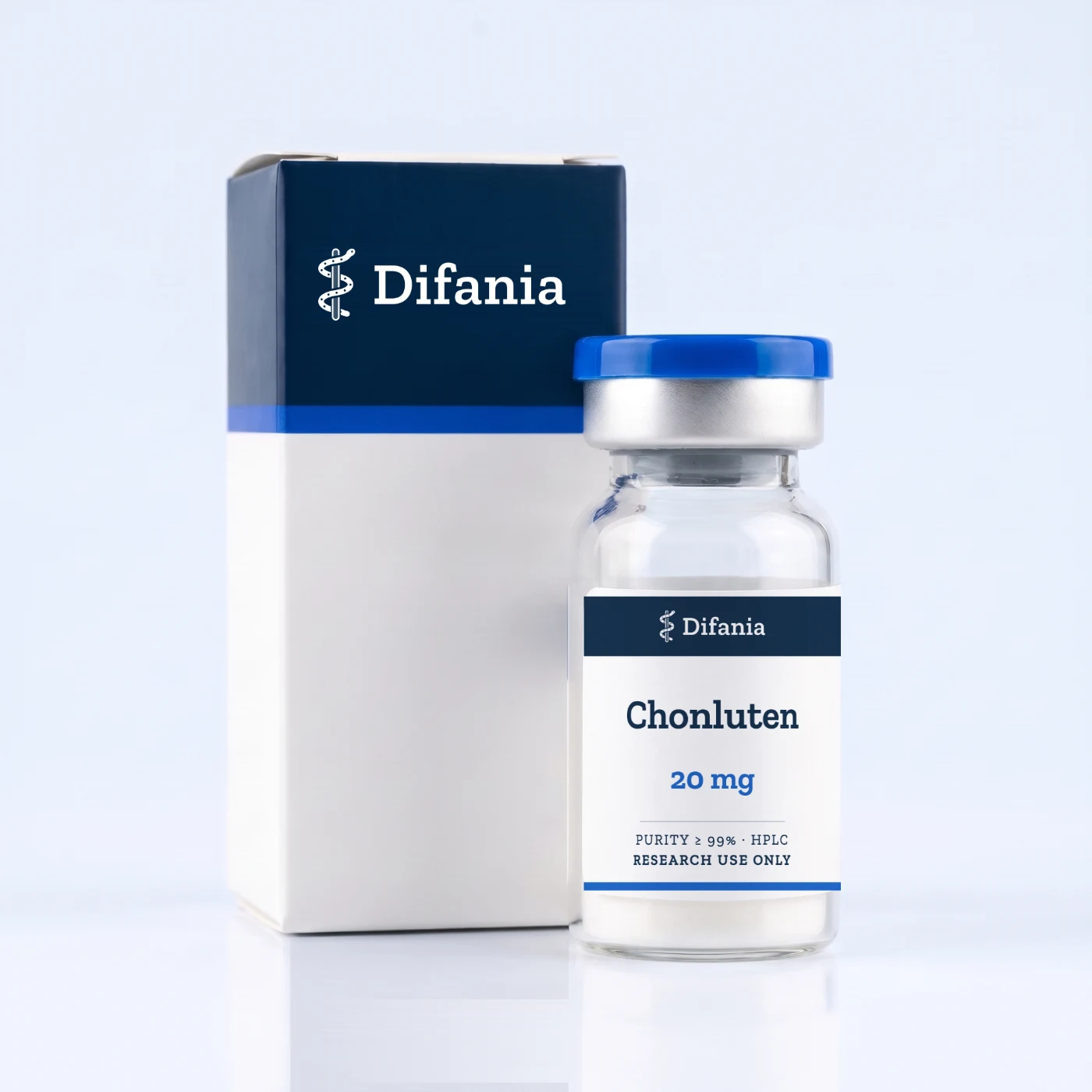
Chonluten in the laboratory
Identification
Chonluten is a peptide, meaning a short chain of amino acid residues, and it is listed by Difania under bioregulators. The material is supplied as a lyophilised solid, prepared by freezing a solution and removing the water under vacuum. One vial holds 20 mg, and the specified purity is 99% or higher. The vial is a single compound rather than a blend, so no ratio of components needs to be set when you weigh it out.
Analytical control
Two complementary techniques are used. Reversed phase high performance liquid chromatography measures purity, separating the peptide from related species so that the main peak can be quantified against the specification of 99% or higher. Mass spectrometry confirms identity by measuring the molecular mass of the peptide. The results of both tests are filed against the lot, and the record is the reference for the vial you hold.
Reconstitution and solubility
Start with the sealed vial at room temperature. Add the solvent slowly along the wall of the vial, avoiding the cake, then roll the vial gently or leave it to stand until the solid has fully dissolved. Bacteriostatic water, sterile water and a dilute acetic acid solution are the usual solvents. The table lists the concentrations produced by three solvent volumes, starting with the largest.
| Vial size | Solvent added | Resulting concentration |
|---|---|---|
| 20 mg | 4 mL | 5 mg/mL |
| 20 mg | 2 mL | 10 mg/mL |
| 20 mg | 1 mL | 20 mg/mL |
Storage and stability
Once reconstituted, the solution is moved to 2 to 8 degrees Celsius straight away and divided into portions as it is prepared, so that each draw leaves the rest undisturbed. Until it is dissolved, the solid remains sealed at minus 20 degrees Celsius and protected from light. Warm the vial to room temperature before breaking the seal, because moisture drawn onto a cold cake will affect the material you then weigh.
Use in the laboratory
Chonluten is intended for in vitro work and as a reference material. The field it belongs to is the bioregulators group of peptide research, and this entry is listed for that field alone. Difania supplies the reagent and the analytical documentation recorded against its lot. Experimental design, assay selection and the reading of results are outside what Difania advises on, and remain the responsibility of the laboratory.
Safety and handling
Chonluten is not a medicinal product, a food, a supplement or a cosmetic, and it must not be consumed or administered to humans or animals. Within the laboratory it is a chemical to be handled with care: gloves and eye protection while the vial is open, and fine powder kept inside appropriate containment. Discard waste, rinse liquids and contaminated consumables in line with institutional policy and local regulations.
Lot documentation
The lot number on each vial is what ties the material to its records. Give Difania that number and the analytical documentation for the lot can be retrieved. In your own notes, pair the lot number with the day the vial was opened and the solvent you chose, which lets any later result be traced to a particular fill.


