
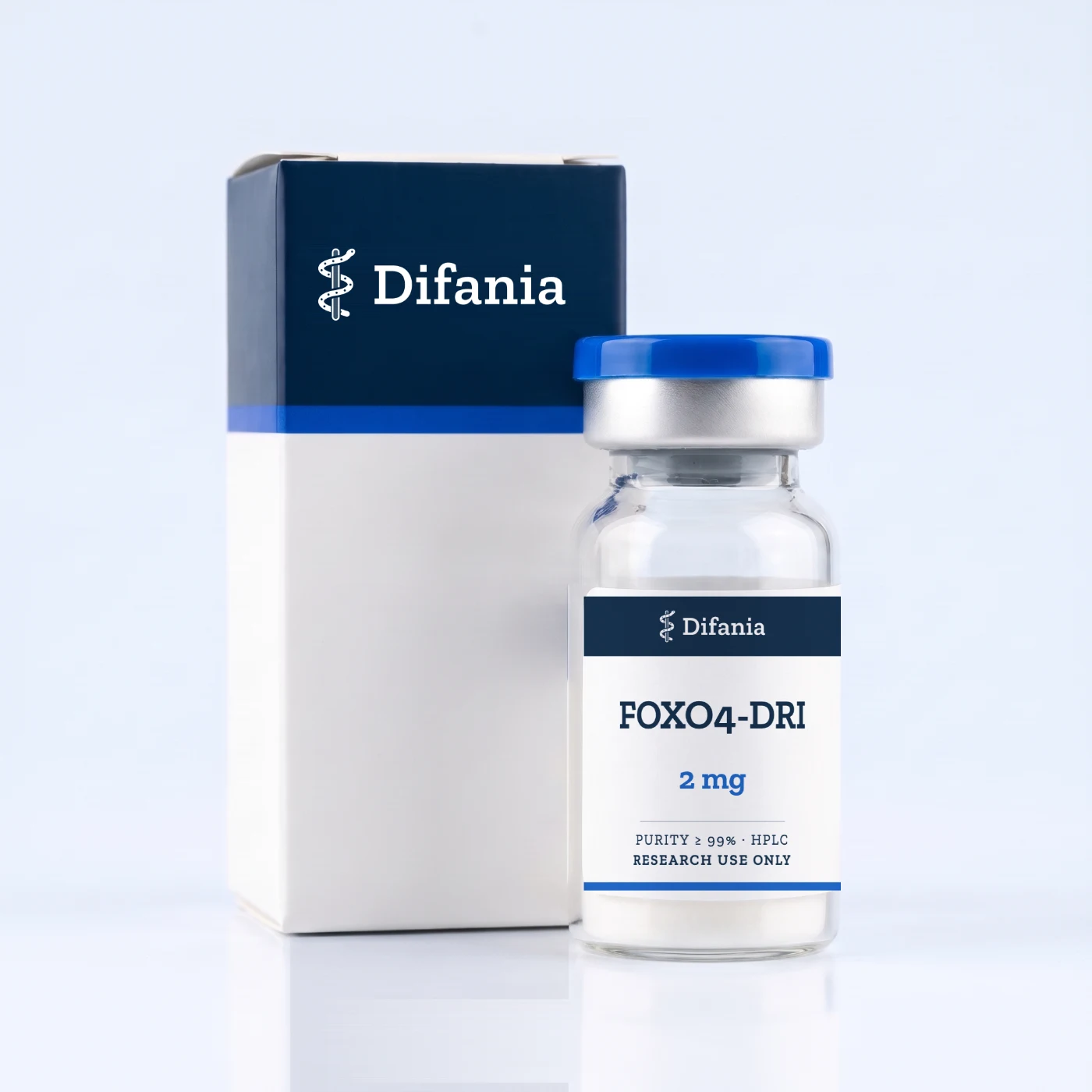
FOXO4-DRI in the laboratory
Identification
FOXO4-DRI sits in the cellular ageing section of the catalogue and reaches the laboratory as a lyophilised synthetic peptide. The record kept against it is a short one, and the honest thing to do on a product page is to say so at the start: the catalogue holds the physical form, a purity specification of 99 percent or higher, and two fill sizes, 2 mg and 10 mg of peptide to the vial. There is no CAS number, no molecular formula, no molar mass and no sequence entered for this item, so none of those values is quoted here or anywhere else on the page. An identifier needed for a goods inward entry should be copied from the analytical documentation that belongs to the lot in hand.
The gap between the two fills is wider than it looks on a listing. A 2 mg cake occupies very little space at the base of the glass and can be taken for an empty vial under poor bench light, which is worth knowing before anyone concludes that a delivery is short. The 10 mg fill leaves a clearly visible deposit and carries a long series of experiments on one batch. Peptides of this type are assembled by solid phase synthesis, purified and then freeze dried, which is why the solid arrives as a light porous cake rather than a dense powder. How readily that cake clears, and how the solution behaves on standing, is a property of the individual lot, and the lot paperwork is the only document that describes it.
Analytical control
Two measurements stand behind the material. Purity is determined by reversed phase high performance liquid chromatography, in which the main peak is integrated against the whole chromatogram and resolved from the truncated sequences and side products that synthesis leaves behind; the specification applied to this item is 99 percent or higher. Identity is confirmed by mass spectrometry on the intact peptide. Because the catalogue carries no calculated mass for this entry, the measured value reported in the lot documentation is the reference figure, and that document is worth reading before the first vial is opened.
Reconstitution and solubility
Take the vial out of the freezer and let it stand until it has reached room temperature, then add solvent slowly down the inside wall of the glass so that the stream does not drive straight into the cake. Bacteriostatic water, sterile water and a dilute acetic acid solution are the three solvents in ordinary use. Rock the vial gently from side to side rather than shaking it, since foam strands material on the stopper and in the neck.
| Vial | Solvent added | Resulting concentration |
|---|---|---|
| 2 mg | 1 mL | 2 mg/mL |
| 2 mg | 2 mL | 1 mg/mL |
| 10 mg | 2 mL | 5 mg/mL |
| 10 mg | 5 mL | 2 mg/mL |
Storage and stability
Sealed solid keeps best at minus 20 degrees Celsius, in the dark, and there is no reason to disturb it before the day the work is scheduled. Let a cold vial equilibrate on the bench before the stopper is pierced, so that moisture from the air does not settle on chilled powder. Once the peptide is in solution the condition changes to 2 to 8 degrees Celsius, and the sensible move is to divide the stock into single session portions at the moment of reconstitution rather than returning to one tube day after day. Write the date of reconstitution on every portion, because a solution carries no other record of its own age.
Use in the laboratory
The material is supplied for in vitro experiments and for use as a reference substance in analytical work, including method development and system suitability runs. The catalogue files it under cellular ageing, which is the research field in which peptides of this type appear. Difania supplies the reagent and the analytical documentation held for its lot, and nothing beyond that: the design of an experiment, the choice of controls and conditions, and the reading of any result rest with the laboratory carrying out the work.
Safety and handling
Treat the contents as a laboratory chemical whose hazards are not fully characterised. Gloves and eye protection belong on whenever the vial is open or solution is being moved from one container to another, and dry powder is best handled away from draughts. Residues, rinsings and used consumables go to waste under the rules of your institution and the local regulations that apply to it. This is not a medicinal product, not a food, not a supplement and not a cosmetic. It is not for consumption, and it is not for administration to humans or to animals.
Lot documentation
Every vial leaves with a lot number printed on the label. That number is the link between the glass on your bench and the analytical documentation Difania keeps, and quoting it in a message is all that is needed for the paperwork to be sent across. Copy it into the laboratory record together with the date the vial was opened, so that a result produced months later can still be traced back to the batch it came from.


