
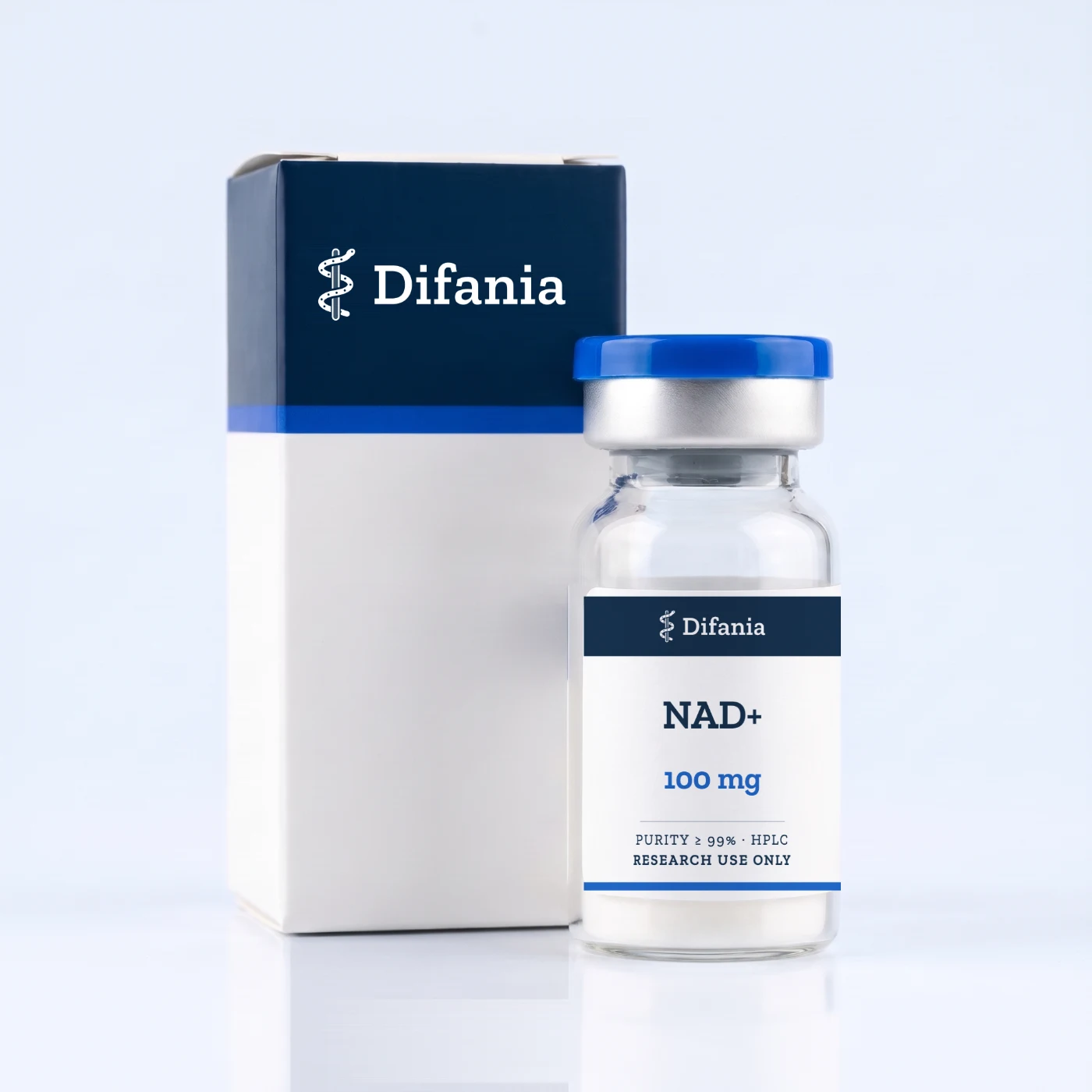
NAD+ in the laboratory
Identification
NAD+ is nicotinamide adenine dinucleotide, a coenzyme assembled from two nucleotides joined through a diphosphate bridge, one carrying an adenine base and the other a nicotinamide. The catalogue records its CAS number as 53-84-9, its molecular formula as C21H27N7O14P2 and its molar mass as 663.4 g/mol. The two phosphorus atoms in that formula mark the phosphate bridge, and they explain why the molecule is strongly polar and why it is supplied as a dry solid to be taken up in an aqueous solvent. Difania files the material under cellular ageing research, as a lyophilised solid at a purity specification of 99% or higher, in three fill sizes: 100 mg, 500 mg and 1000 mg per vial.
Analytical control
Purity is established by reversed phase high performance liquid chromatography. The sample is resolved on the column, the main peak is integrated against the full chromatogram, and related substances and degradation products are separated from it so that they can be counted against the specification of 99% or higher. Identity is confirmed by mass spectrometry, where the measured mass is compared with the 663.4 g/mol calculated from the formula C21H27N7O14P2. Both results are filed against the lot number printed on the label.
Reconstitution and solubility
Bring the sealed vial up to room temperature before opening it, because a cold cake draws condensation onto the powder. Add the chosen solvent slowly down the inner wall of the vial, not onto the solid, and swirl gently until the powder has dissolved. Bacteriostatic water suits a stock that will be drawn from repeatedly, sterile water suits a solution made for one session, and a dilute acetic acid solution is an option where the protocol asks for an acidic working solution. Avoid vigorous shaking, which introduces air into the solution.
The table gives one practical volume for each fill size and the concentration it produces.
| Vial size | Solvent added | Resulting concentration |
|---|---|---|
| 100 mg | 5 mL | 20 mg/mL |
| 500 mg | 25 mL | 20 mg/mL |
| 1000 mg | 50 mL | 20 mg/mL |
Other volumes can be used when a different working concentration is needed. The concentration is the stated mass divided by the volume added.
Storage and stability
Keep the sealed solid at minus 20 degrees Celsius, out of direct light, until the material is wanted. Once the powder has been taken up, the solution belongs at 2 to 8 degrees Celsius. It is best divided into working portions as it is prepared, so that each withdrawal leaves the remainder undisturbed. Repeated freezing and thawing of a solution is best avoided, so a thawed portion should be used rather than returned to the freezer.
Use in the laboratory
The material is supplied for in vitro research and for use as a reference standard, for example when a chromatographic or mass spectrometric method is being set up or checked. NAD+ is a central reagent in cellular energy metabolism, and the catalogue places it in that field of research. Difania supplies the reagent together with the analytical documentation held for its lot. It does not advise on experimental design or on the interpretation of results obtained with the material.
Safety and handling
Wear gloves and eye protection whenever a vial is open or solutions are being transferred, and handle the dry powder within the containment your laboratory uses for fine solids. Dispose of residues, rinses and used labware under the rules of your institution and the local regulations that apply to it. This is a laboratory chemical. It is not a medicinal product, food, supplement or cosmetic, it is not for consumption, and it is not for administration to humans or animals.
Lot documentation
Each vial bears a lot number on its label. Quote that number when you contact Difania, and the analytical documentation held for that lot can be retrieved for you. Record the lot number together with the date the vial was opened, so that every later result can be traced back to the fill it came from.


