
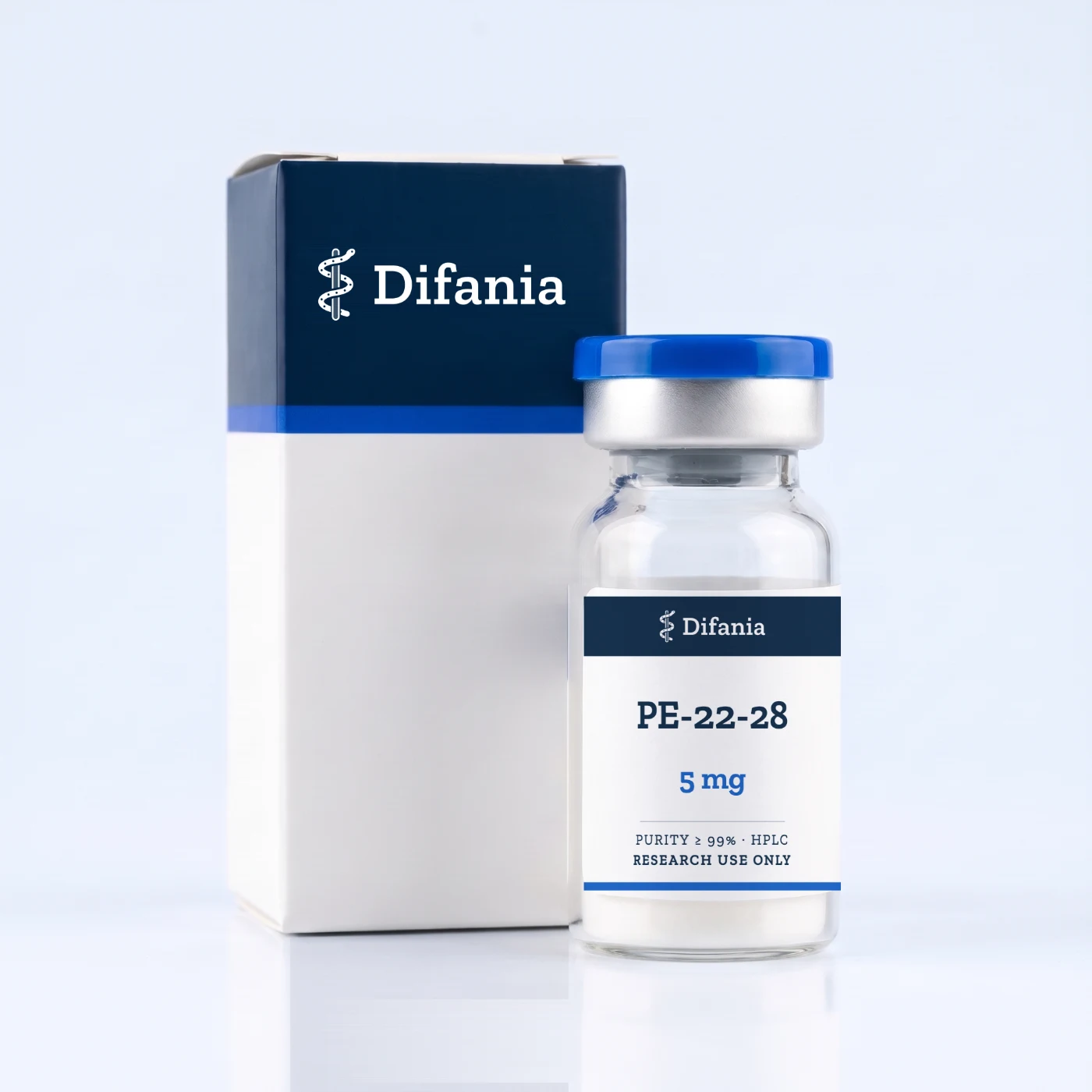
PE-22-28 in the laboratory
Identification
PE-22-28 sits in the neuropeptides group of the catalogue and is supplied as a synthetic peptide in lyophilised form. The entry is a short one, and it is honest about its limits: it records the form, a purity specification of 99 percent or higher and two fill sizes, 5 mg and 10 mg of peptide per vial. No CAS number, molecular formula, molar mass or sequence is held against this product, and none is quoted here, because a figure invented for a catalogue page would be worse than no figure at all. What can be said with confidence is structural in the general sense: the material is a short chain of amino acid residues assembled by solid phase synthesis, purified chromatographically and isolated by freeze drying, which is why it arrives as a light cake rather than as a crystalline powder. A cake of that kind is hygroscopic and takes up atmospheric moisture readily, so the handling notes below are not a formality. Where an identifier is needed for a chemical register or a goods inward record, the documentation issued with the lot is the correct source.
Analytical control
Identity and purity are settled by two methods that do not depend on each other. Reversed phase HPLC separates the main peak from deletion sequences, truncated chains and other process related impurities, and it is the measurement against which the specification of 99 percent or higher is applied. Mass spectrometry confirms the identity of the intact peptide, with the result recorded in the paperwork for the lot. Since the catalogue holds no calculated mass for this entry, that paperwork is where the expected and measured values are set side by side.
Reconstitution and solubility
Bring the vial to room temperature, then introduce solvent slowly down the inner wall so the cake dissolves from its edge rather than being driven into the liquid. Swirl gently until the solution is clear and colourless, and stop there. Shaking and vortexing foam a peptide solution, and foam deposits material on the stopper where it cannot be recovered.
| Vial | Solvent added | Resulting concentration |
|---|---|---|
| 5 mg | 1 mL | 5 mg/mL |
| 5 mg | 2.5 mL | 2 mg/mL |
| 5 mg | 5 mL | 1 mg/mL |
| 10 mg | 2 mL | 5 mg/mL |
| 10 mg | 5 mL | 2 mg/mL |
Storage and stability
Keep the sealed solid at minus 20 degrees Celsius, in the dark, until the day the work is done. The freeze dried form is the stable one and benefits from being left alone. After reconstitution the solution is held at 2 to 8 degrees Celsius, portioned at once into volumes that each cover a single session, so that no tube is repeatedly warmed and chilled. Whether it holds solid or solution, let a vial reach room temperature before the stopper is pierced.
Use in the laboratory
The material is supplied for in vitro experiments and for use as a reference substance, for example as a characterised standard while a chromatographic method is being developed or a detection workflow qualified. Peptides catalogued in this group appear in neuropeptide signalling research. Difania supplies the reagent and the analytical documentation that belongs to its lot, and does not advise on experimental design, on conditions or on how a result should be read.
Safety and handling
Handle the vial as a laboratory chemical whose hazard profile is not fully characterised. Gloves and eye protection are expected whenever the vial is open or solution is being moved, and a wipeable bench surface makes a spill a short job. Unused solution, rinsings and empty vials are disposed of under the rules of your institution and the local waste regulations in force. This reagent is not a medicinal product, a food, a supplement or a cosmetic, and it is intended neither for consumption nor for administration to humans or animals.
Lot documentation
A lot number is printed on every vial that leaves the catalogue, and it is the single piece of information Difania needs in order to retrieve the analytical documentation held for that filling. Quote it in any enquiry about a particular vial. Writing it into your own records beside the date of opening and the reconstitution solvent keeps a stored result tied to the material that produced it.


