
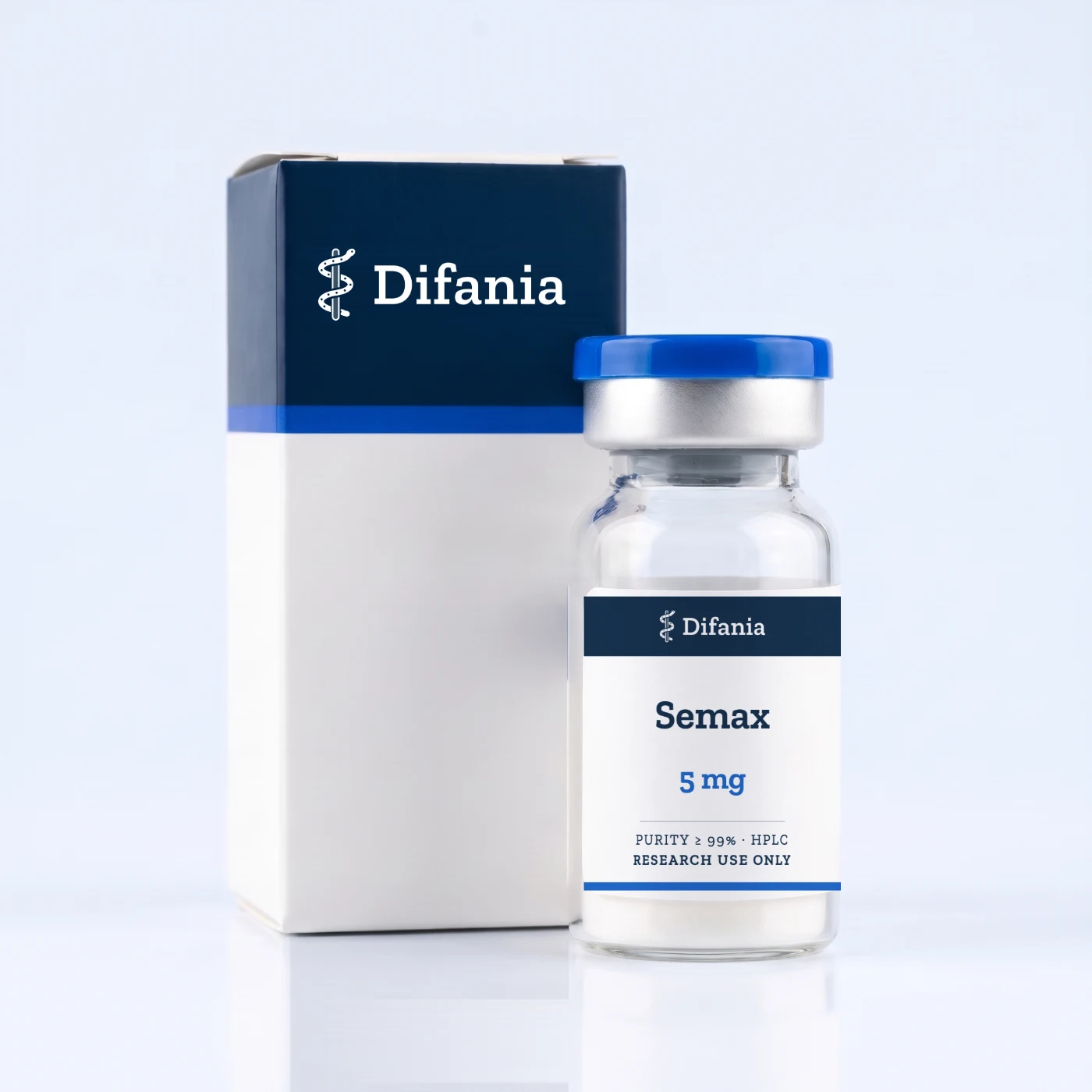
Semax in the laboratory
Identification
Semax is a heptapeptide. The catalogue records seven residues in the order Met-Glu-His-Phe-Pro-Gly-Pro, beginning with methionine and closing on proline, and it is that short chain which gives the item its identity rather than any larger structural feature. It is held under CAS 80714-61-0, with the molecular formula C37H51N9O10S and a molar mass of 813.9. The single S atom in the formula belongs to the methionine at the start of the chain, which is the only residue in the sequence carrying one.
The back half of the chain is unusual in its composition: two prolines separated by a glycine. Proline is the one residue that constrains the backbone rather than leaving it free to rotate, so a sequence holding two of them in seven positions is conformationally stiffer than its length alone would suggest. Histidine and phenylalanine sit in the middle, the first ionisable across the range most buffers cover, the second aromatic and therefore visible to an ultraviolet detector.
Difania supplies the material as a synthetic lyophilised solid in three vial sizes, 5 mg, 10 mg and 30 mg. It is catalogued under neuropeptides, and it also appears as one of the two components of the Semax and Selank blend, where it is freeze dried together with the second peptide in one vial. The entry on this page is the single component form. No salt form is recorded for this item.
Analytical control
Purity is determined by reversed phase high performance liquid chromatography. The main peak is integrated against the whole chromatogram, which separates the intended heptapeptide from the truncated and deletion sequences that stepwise synthesis can leave behind, and the specification applied here is 99 percent or higher. Identity is confirmed by mass spectrometry, where the measured mass is compared with the value calculated from the catalogued formula, 848.8 being the figure for a different item and 813.9 the one that applies to this one. Both results belong to one lot, so the lot paperwork, not a general product description, is what describes a particular vial.
Reconstitution and solubility
Bring the vial to room temperature before breaking the seal. Run the solvent slowly down the inner wall of the glass rather than directing it onto the cake, then swirl until the liquid is clear. Shaking achieves nothing except foam, and foam strands material against the stopper. Bacteriostatic water, sterile water and a dilute acetic acid solution are the solvents in normal use.
| Vial | Solvent added | Resulting concentration |
|---|---|---|
| 5 mg | 1 mL | 5 mg/mL |
| 5 mg | 2.5 mL | 2 mg/mL |
| 10 mg | 2 mL | 5 mg/mL |
| 10 mg | 5 mL | 2 mg/mL |
| 30 mg | 6 mL | 5 mg/mL |
| 30 mg | 15 mL | 2 mg/mL |
Storage and stability
The unopened vial belongs at minus 20 degrees Celsius, shielded from light, and that is where it should remain until the work is actually booked in. Warming to room temperature on the bench before the stopper is pierced is the step most often skipped and the one worth keeping, because cold glass pulls moisture out of the air and into a hygroscopic cake. After reconstitution the solution is held at 2 to 8 degrees Celsius. Split it into working portions at the moment it dissolves instead of returning to the same tube day after day, and date the label, since the solution carries no other record of its own age.
Use in the laboratory
The material is supplied for in vitro work and for use as a reference standard in analytical method development, including calibration series and system suitability checks. Short peptides of this kind appear in neuropeptide research, which is the section of the catalogue this entry sits in. Difania provides the reagent and the analytical documentation belonging to its lot, and does not advise on experimental design, choice of controls or conditions. Those decisions rest with the laboratory running the work.
Safety and handling
Treat the contents as a laboratory chemical whose hazards are not fully characterised. Gloves and eye protection are worn while the vial is open and while solutions are being prepared, and the dry solid is best handled where airborne dust can be contained. Residues, spent solutions and contaminated consumables go out under the rules of your institution and the waste regulations in force locally. This is not a medicinal product, a food, a supplement or a cosmetic. It is not for consumption and not for administration to humans or animals.
Lot documentation
Every vial leaves with a lot number printed on its label. Quote that number and Difania can retrieve the analytical documentation held for the batch it belongs to. Record it in the notebook next to the date the vial was opened, so that a result read back months later can still be tied to the exact material that produced it.


