
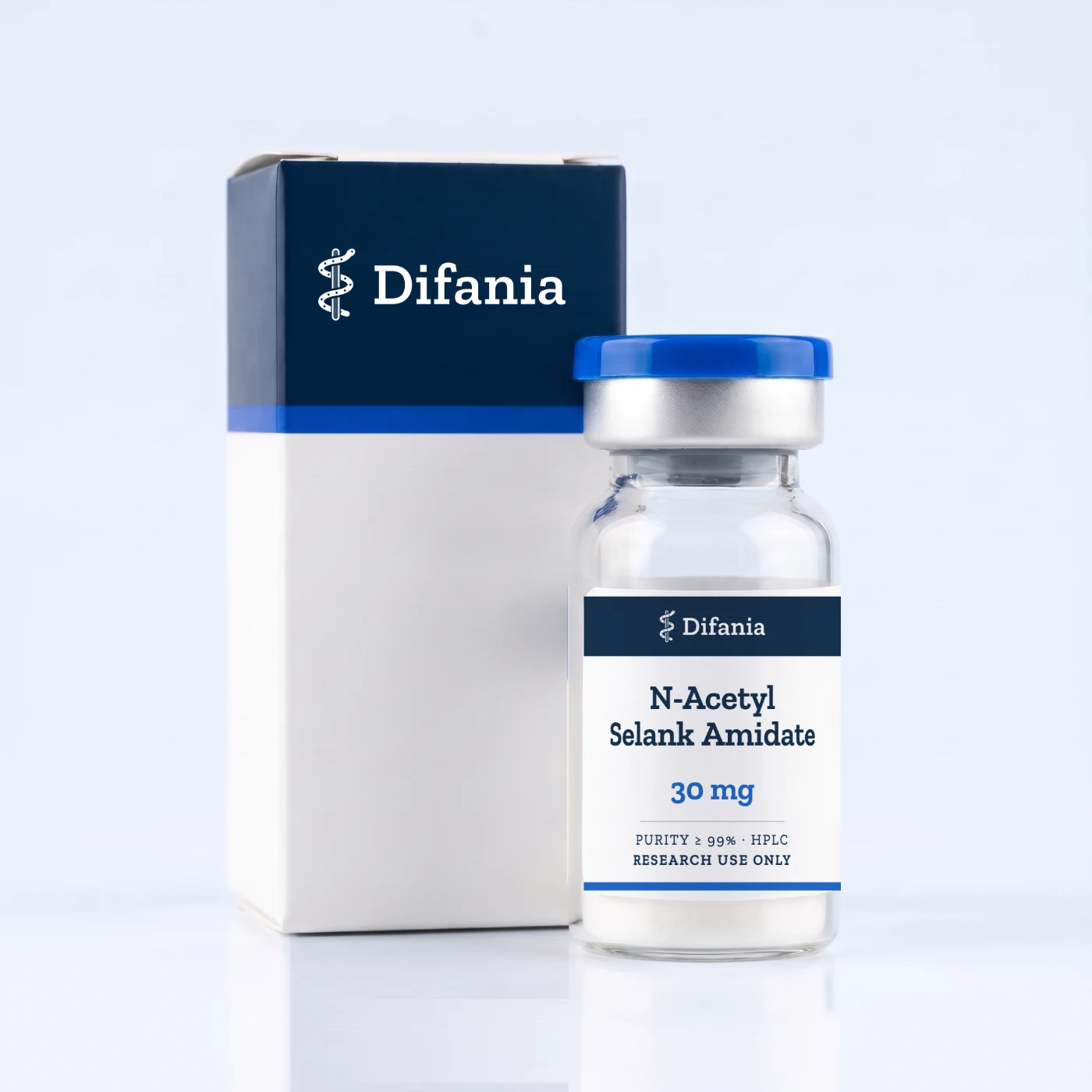
N-Acetyl Selank Amidate in the laboratory
Identification
N-Acetyl Selank Amidate is listed in the neuropeptide group of the Difania catalogue and is offered as a lyophilised solid in one fill size, a 30 mg vial. The name describes how the molecule is built: a Selank-based peptide carrying an acetyl cap on its amino terminus and an amide in place of a free carboxylic acid at its carboxyl terminus. Each end group changes the electrical character of the chain at that point, so the behaviour of the reagent in a given solvent cannot be assumed to match that of the unmodified parent. The catalogue specifies purity at 99% or higher, and that figure is the reference for every lot. Because only one vial size is offered, the choice a buyer makes concerns the solvent and the working concentration, not the pack.
Analytical control
Chromatographic purity is assessed by HPLC in reversed phase mode. The trace is inspected for the principal peak, for minor related substances and for residues carried over from synthesis, and the area of the principal peak is compared with a 99% or higher specification. Identity is checked by mass spectrometry, which reports the observed mass so that it can be matched to the structure the name describes. Each lot therefore carries two results, both stored against the lot number printed on the vial.
Reconstitution and solubility
Take the sealed vial from the freezer and let it stand until it reaches room temperature. Run the chosen solvent slowly down the glass wall, keeping it off the powder, then rock the vial gently or leave it to rest until the solid has fully dissolved. Bacteriostatic water, sterile water and dilute acetic acid are the solvents normally used. Bacteriostatic water suits repeated sampling, sterile water suits a single use, and acetic acid is kept for a powder that stays hazy in plain water.
| Vial | Added solvent | Concentration |
|---|---|---|
| 30 mg | 2 mL | 15 mg/mL |
| 30 mg | 5 mL | 6 mg/mL |
The first row gives a concentrated stock, while the second gives a dilute one that is easier to pipette in larger aliquots. Settle the volume against your planned working dilutions before the vial is opened, and write the chosen concentration on the label.
Storage and stability
The sealed solid is held at minus 20 degrees Celsius with protection from light. Once dissolved, the liquid is kept at 2 to 8 degrees Celsius. Splitting the stock into portions soon after preparation means the bulk is opened less often, and a portion taken out of the cold should be used up rather than returned to the freezer. A frozen vial needs to reach room temperature before it is opened.
Use in the laboratory
The reagent is intended for in vitro work and as a reference material. Neuropeptide research is the field the catalogue assigns to it, and the entry is listed for laboratories active in that area. Difania provides the material together with its analytical records for the relevant lot. Experimental design and the interpretation of any data generated rest with the purchasing laboratory, since Difania does not advise on either.
Safety and handling
Treat the vial as a laboratory chemical. Wear gloves and eye protection when the vial is open or liquid is being moved, and contain the dry powder using the measures your site applies to fine solids. Waste, rinsings and used labware are disposed of according to institutional procedures and local law. It has no standing as a medicine, foodstuff, dietary supplement or cosmetic. Do not consume it or give it to people or animals.
Lot documentation
Every vial bears a lot number printed on its label. Quoting that number in a request is how the analytical file for the lot is retrieved. Keep a note of the lot number beside the day the seal was broken and the solvent that went in, so each later observation can be tied to one fill.


