
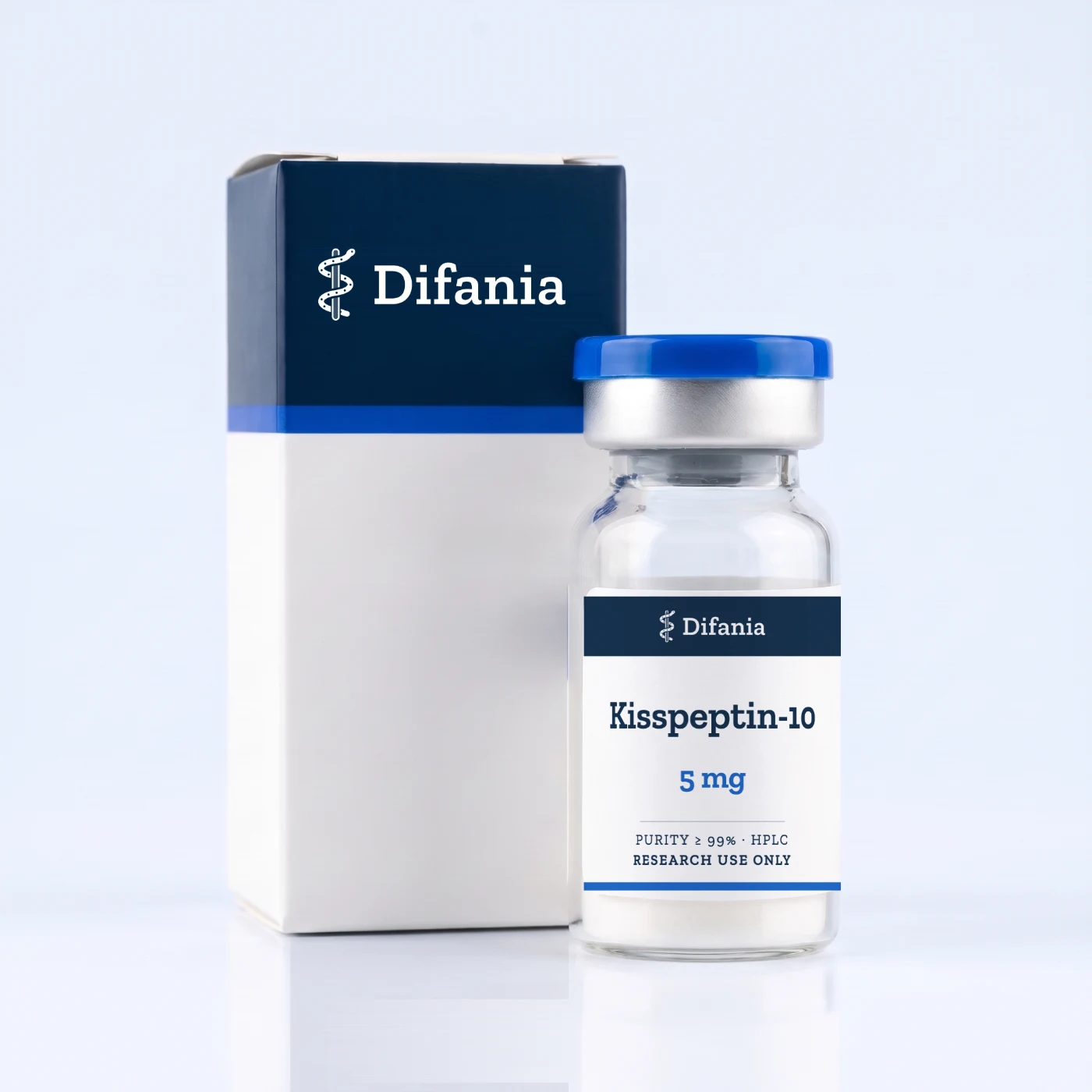
Kisspeptin-10 in the laboratory
Identification
Kisspeptin-10 is the ten residue form of the kisspeptin chain, which is what the figure in the catalogue name records. The catalogue holds it under CAS 374675-21-5, with the molecular formula C63H83N17O14 and a molar mass of 1302.4. Seventeen nitrogen atoms spread across sixty three carbons is the composition the formula reports, and the molar mass is the number to reach for whenever a mass concentration has to be converted into a molar one at the bench.
Difania supplies the material as a synthetic, freeze dried solid in two vial sizes, 5 mg and 10 mg. No sequence is recorded in the catalogue for this entry, and the item appears in no blend, so it is ordered on its own and the amount used in an experiment is set independently of anything else.
The catalogue files Kisspeptin-10 in the neuropeptide section. On the shelf it behaves like other short chain peptides: the cake in a 5 mg vial occupies very little space in the glass, which can read as an underfilled vial when it is nothing of the sort, and lyophilised peptides take up moisture from room air, which is the reason a cold vial is warmed before it is opened.
Analytical control
Purity is determined by reversed phase high performance liquid chromatography. The main peak is integrated against the whole chromatogram, which is what separates the intended decapeptide from the truncated sequences and incomplete couplings that solid phase synthesis can leave behind, and the specification applied to this item is 99 percent or higher. Identity is established by mass spectrometry, the measured mass being compared against the value calculated from the catalogued formula, 1302.4. Both determinations belong to one lot, so the lot paperwork, not the catalogue page, is the document that describes the vial in your hand.
Reconstitution and solubility
Bring the vial to room temperature before the seal is broken. Add the solvent slowly down the inner wall of the glass rather than directly onto the cake, then swirl until the liquid runs clear. Shaking raises foam and strands material on the stopper, so it gains nothing. Bacteriostatic water, sterile water and a dilute acetic acid solution are the solvents in ordinary use.
| Vial | Solvent added | Resulting concentration |
|---|---|---|
| 5 mg | 1 mL | 5 mg/mL |
| 5 mg | 2.5 mL | 2 mg/mL |
| 10 mg | 2 mL | 5 mg/mL |
| 10 mg | 5 mL | 2 mg/mL |
Storage and stability
Keep the unopened vial at minus 20 degrees Celsius and out of the light until the day the work is scheduled; that is where the sealed solid is most stable. Give it time on the bench to reach room temperature before the stopper is pierced, so that moisture does not condense onto cold powder. After reconstitution the material is held at 2 to 8 degrees Celsius, and the stock is best split into portions immediately rather than returned to the refrigerator and reopened repeatedly. Write the date of reconstitution on the label, since a solution keeps no other record of its own age.
Use in the laboratory
This item is supplied for in vitro work and for use as a reference material in analytical method development, including calibration and system suitability runs. Peptides of the kisspeptin family appear in neuroendocrinology research, which is the field the catalogue reflects in filing the entry under neuropeptides. Difania provides the reagent and the analytical documentation belonging to its lot, and does not advise on experimental design. Decisions about conditions, controls and endpoints rest with the laboratory doing the work.
Safety and handling
The toxicological profile of this peptide is not fully characterised, so treat it as a laboratory chemical at every stage. Gloves and eye protection are expected while the vial is open and while solutions are being prepared, and dry powder is best handled where airborne dust can be contained. Residues, empty vials and contaminated consumables go to waste under the rules of your institution and the regulations in force locally. This material is not a medicinal product, a food, a supplement or a cosmetic. It must not be consumed and must not be administered to humans or to animals.
Lot documentation
A lot number is printed on the label of every vial. Quoting it allows Difania to retrieve the analytical documentation held for that batch. Record it in the notebook alongside the date the vial was first opened, so that a result reviewed months later can still be traced back to the exact material that produced it.


