
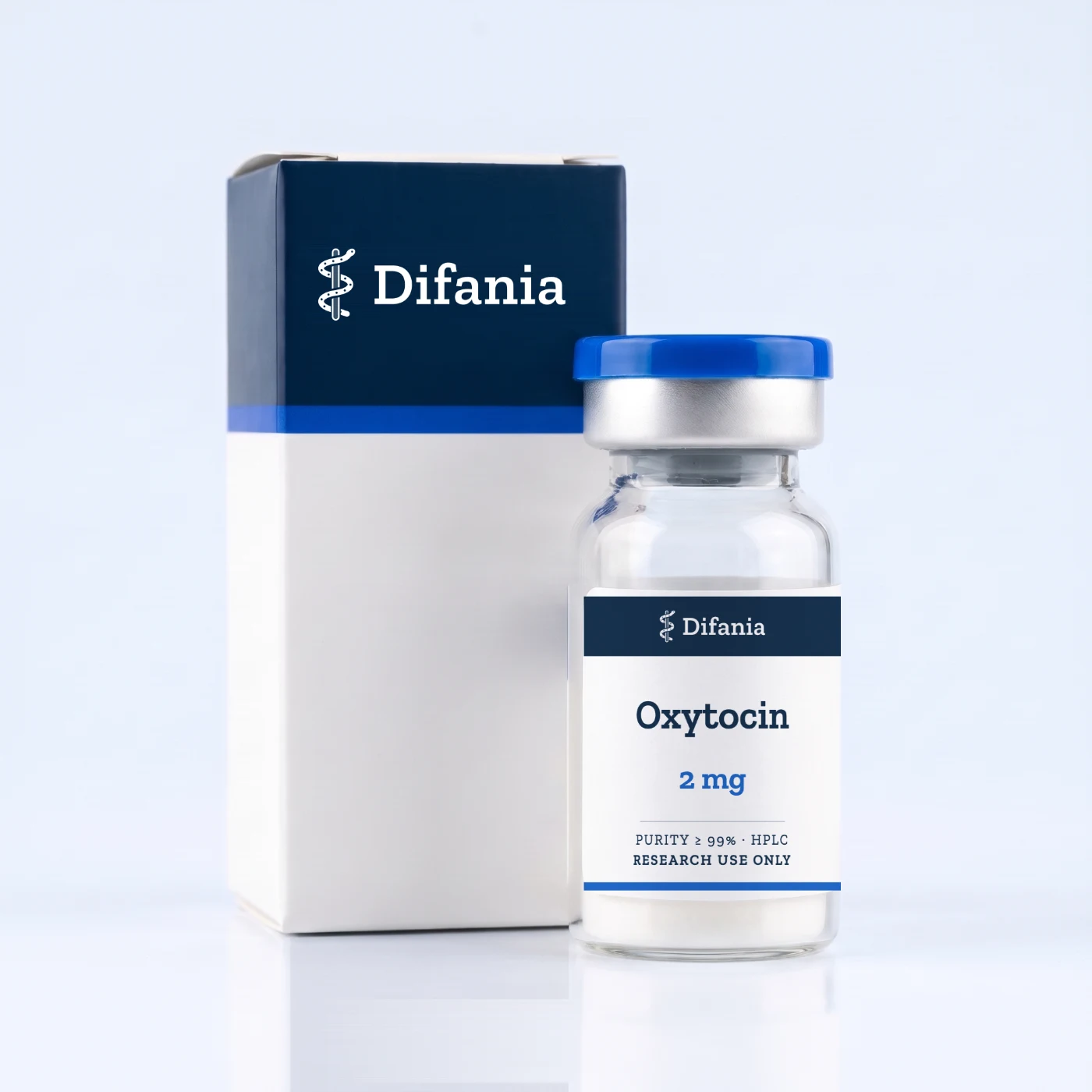
Oxytocin in the laboratory
Identification
Oxytocin is a short cyclic peptide: the two sulphur atoms recorded in its molecular formula, C43H66N12O12S2, are the pair that forms the disulphide bridge closing the ring, and the remaining residues extend from it as a short tail. The catalogue holds the item under CAS 50-56-6, one of the older registry numbers in this section, with a molar mass of 1007.2. That mass is the figure used when a stock prepared by weight has to be expressed in molar terms.
Difania supplies it as a synthetic, lyophilised solid in three vial sizes, 2 mg, 5 mg and 10 mg, which is the widest choice offered anywhere in the neuropeptide part of the catalogue. No sequence is recorded for this entry, and the item is not a component of any blend, so it arrives as a single compound in a single vial.
The disulphide bridge is the structural feature that matters most in practice. A bridged peptide is more sensitive to oxidation than a plain linear chain, which is why the handling notes below lean on cold, dark and sealed storage rather than on anything unusual in the way the vial is opened.
Analytical control
Identity and purity are each established on their own instrument. Purity comes from reversed phase high performance liquid chromatography, where the main peak is integrated against the complete chromatogram and judged against the specification applied to this item, 99 percent or higher; the same chromatogram is what reveals related substances and incompletely coupled sequences. Identity comes from mass spectrometry, the measured mass being compared with the value calculated from the catalogued formula, 1007.2. Both results are recorded against a single lot number.
Reconstitution and solubility
Let the vial warm to room temperature first, then run the solvent slowly down the inside wall of the glass so that it meets the cake gently. Swirl rather than shake: foam strands material against the stopper and serves no purpose. Bacteriostatic water, sterile water and a dilute acetic acid solution are the usual solvents, and the choice between them is normally decided by whether the stock will be entered once or many times.
| Vial | Solvent added | Resulting concentration |
|---|---|---|
| 2 mg | 1 mL | 2 mg/mL |
| 2 mg | 2 mL | 1 mg/mL |
| 5 mg | 1 mL | 5 mg/mL |
| 5 mg | 2.5 mL | 2 mg/mL |
| 10 mg | 2 mL | 5 mg/mL |
| 10 mg | 5 mL | 2 mg/mL |
Storage and stability
The sealed solid belongs in a freezer at minus 20 degrees Celsius, shielded from light, and should stay there until the work is actually due. Before the stopper is pierced, let the glass come up to room temperature on the bench, otherwise moisture condenses onto cold powder as soon as the seal is broken. A reconstituted solution is kept at 2 to 8 degrees Celsius and is best divided into single use portions straight away, which spares the bulk of the stock from repeated warming. Date the label at the moment of reconstitution.
Use in the laboratory
The material is offered for in vitro work and as a reference standard in analytical method development, where a well characterised peptide with a known molar mass is useful for calibration and system suitability. Oxytocin is a long established subject of neuroendocrinology research, and the catalogue places it accordingly among the neuropeptides. Difania supplies the reagent together with the analytical documentation for its lot. It does not advise on experimental design, and the choice of conditions, controls and endpoints belongs to the laboratory running the study.
Safety and handling
Not a medicinal product, not a food, not a supplement and not a cosmetic: this is a laboratory reagent, and nothing in the catalogue makes it anything else. It must not be consumed and must not be administered to humans or to animals. Wear gloves and eye protection whenever the vial is open or a solution is being prepared, and keep dry powder away from draughts so that dust is not raised. Dispose of residues, spent solutions and contaminated consumables according to your institution’s rules and the local waste regulations.
Lot documentation
Every vial leaves with a lot number on its label. That number is the key to the analytical documentation Difania holds for the batch, and quoting it is all that is needed to have the paperwork retrieved. Copy it into the laboratory notebook along with the date the vial was opened, so that the material behind a result can still be identified long after the vial itself has been discarded.


