
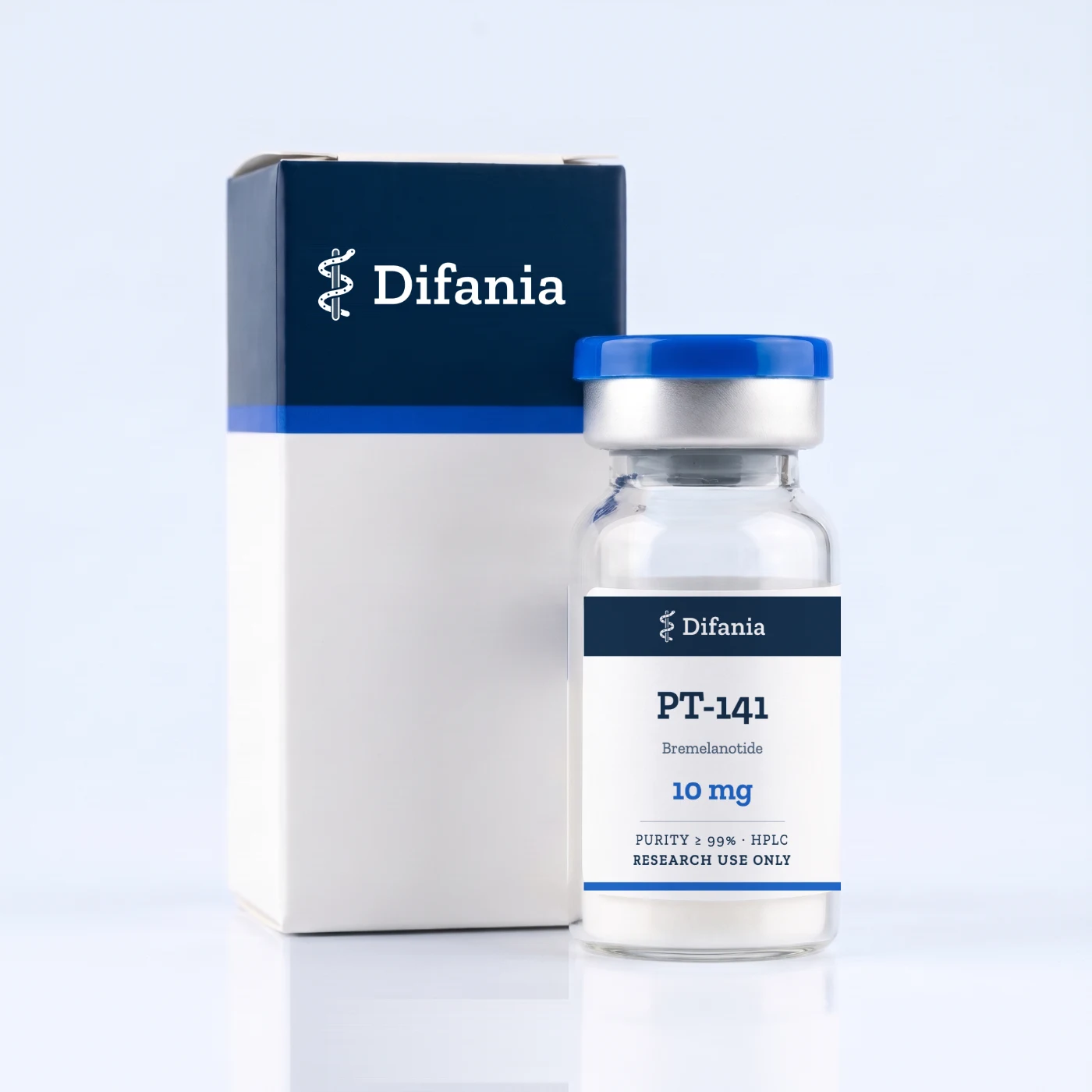
PT-141 (Bremelanotide) in the laboratory
Identification
PT-141 is catalogued under skin peptides, where the record also gives its name as bremelanotide. The item is a melanocortin peptide analogue, a lyophilised powder sold in one fill size of 10 mg per vial, with purity specified at 99% or higher. The catalogue holds the CAS number 189691-06-3, the molecular formula C50H68N14O10 and a molar mass of 1025.2 g/mol. The formula holds fourteen nitrogen atoms and ten oxygen atoms and no sulphur, so there are no sulphur-based groups to guard against oxidation during weighing and reconstitution. For any molar calculation, work from the 1025.2 g/mol figure, which is also the reference against which each lot’s identity is judged.
Analytical control
Each lot is run by reversed phase HPLC to establish purity. The principal component is separated from related substances and manufacturing residues, and its share is judged against the 99% or higher specification. Mass spectrometry confirms identity by comparing the observed mass with 1025.2 g/mol, the value derived from C50H68N14O10. Both results are kept under the lot number, which makes the paired records easy to retrieve.
Reconstitution and solubility
Bring the sealed vial to room temperature before it is opened. Introduce the solvent slowly along the inner wall of the vial, never directly onto the solid, then gently swirl it or let it sit until no solid remains. Bacteriostatic water, sterile water and dilute acetic acid are the solvents commonly chosen. Bacteriostatic water is best for a stock sampled over days, sterile water for a solution used at once, and acetic acid where water alone is slow to clear the solid.
| Vial | Added solvent | Concentration |
|---|---|---|
| 10 mg | 2.5 mL | 4 mg/mL |
| 10 mg | 5 mL | 2 mg/mL |
Select the row that matches your onward dilutions, and keep that choice the same across a series of preparations so that results remain comparable.
Storage and stability
Hold the unopened powder at minus 20 degrees Celsius, away from light, until it is required. After reconstitution, split the liquid into portions kept at 2 to 8 degrees Celsius, which leaves the main volume closed. Bring a frozen vial up to room temperature before the seal comes off, because cold glass draws condensation onto the contents.
Use in the laboratory
The reagent is intended for in vitro experiments and as a reference material. It is catalogued under skin peptides, and the field in which melanocortin peptides of this class are studied is laboratory work on melanocortin receptor biology. Difania supplies the material along with its lot-specific analytical file. Difania offers no advice on experimental design or on how results should be read.
Safety and handling
Gloves and eye protection are needed while the vial stands open or liquid is moved, and the dry solid should be contained in the way any fine powder would be. Dispose of residues, rinses and used labware under institutional rules and local regulations. The item counts as a laboratory chemical and is not a medicine, foodstuff, supplement or cosmetic. Do not consume it or give it to people or animals.
Lot documentation
Each vial is labelled with a lot number, and citing that number lets Difania retrieve the paperwork for the lot. Log the lot number with the opening date and the solvent you chose, so any result can be matched to the exact fill.


