
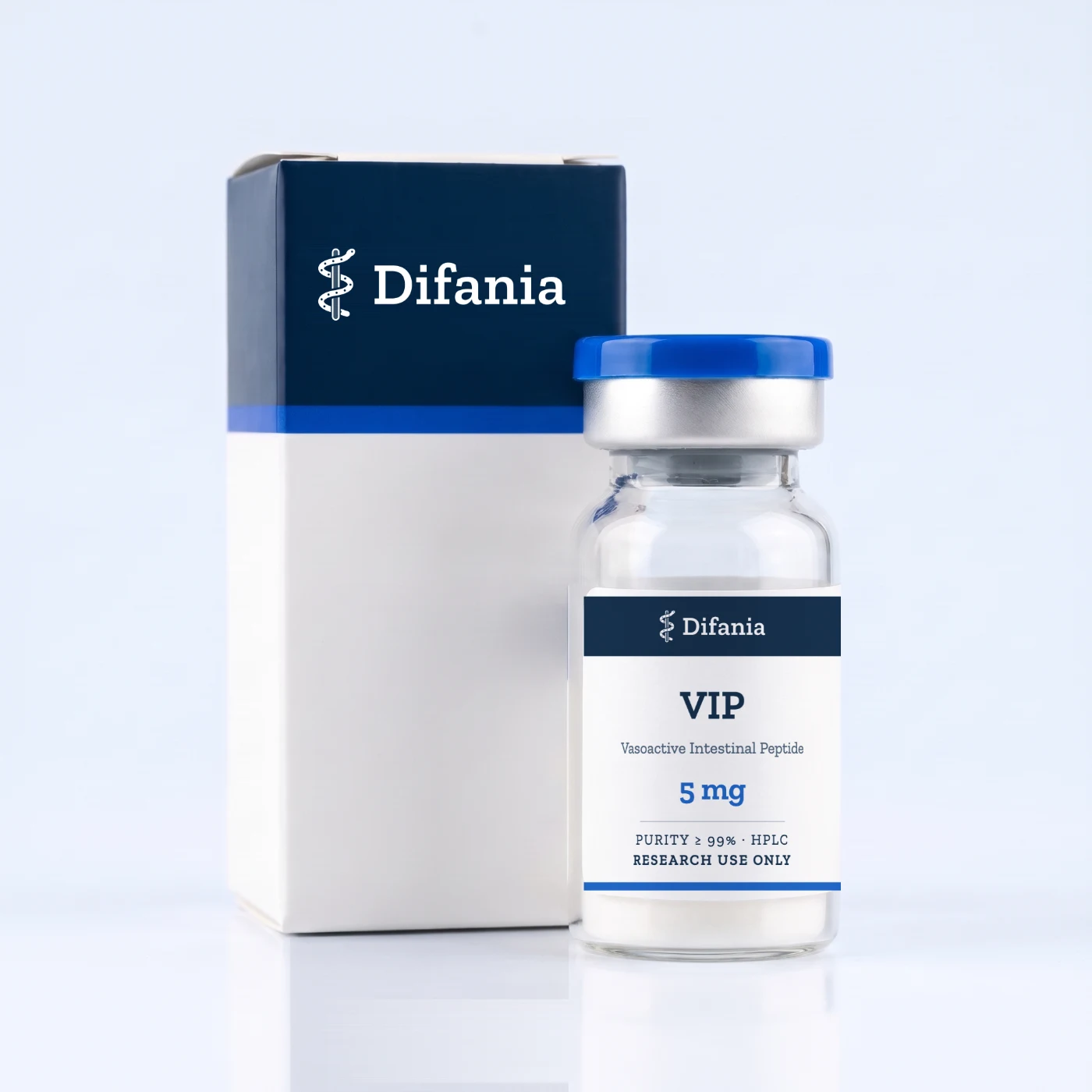
VIP (Vasoactive Intestinal Peptide) in the laboratory
Identification
Vasoactive intestinal peptide, shortened to VIP in the catalogue, is a neuropeptide belonging to the secretin and glucagon family of peptide hormones, a group whose members share a common structural plan rather than a common target. Difania supplies synthetic material as a lyophilised solid and lists it under tissue research. The record for this item holds CAS 40077-57-4, the molecular formula C147H238N44O42S and a molar mass of 3325.8. That formula contains exactly one sulphur atom, which is worth registering before a solvent is chosen and before an open solution is left standing. The catalogue offers two fills, 5 mg and 10 mg of peptide, both released against the same specification. No sequence listing or salt form is recorded for this entry.
Analytical control
Purity rests on reversed phase HPLC, the separation that pulls the main peak clear of the related substances left by synthesis and cleavage, and the specification applied to this item is 99 percent or higher. Identity rests on mass spectrometry, where the measured mass of the intact peptide is set against the value calculated from the catalogued formula. Both numbers are properties of a particular lot, not of a product line, and the lot paperwork is therefore what describes the vial in your hand.
Reconstitution and solubility
Allow the vial to reach room temperature before the seal is broken. Direct the solvent against the glass wall so that the cake dissolves from its edge inwards, then turn the vial slowly until the liquid runs clear and colourless. Vigorous agitation produces foam and nothing else of value.
| Vial | Solvent added | Resulting concentration |
|---|---|---|
| 5 mg | 1 mL | 5 mg/mL |
| 5 mg | 5 mL | 1 mg/mL |
| 10 mg | 2 mL | 5 mg/mL |
| 10 mg | 5 mL | 2 mg/mL |
Storage and stability
Sealed vials sit at minus 20 degrees Celsius, away from light, and that is where they should stay until the experiment is ready for them. A reconstituted solution is held at 2 to 8 degrees Celsius and is best split into single use portions straight after dissolution, since repeated warming and chilling of one tube is the commonest avoidable loss in peptide work. Any chilled vial, solid or solution, is brought back to room temperature before it is opened.
Use in the laboratory
VIP is supplied for in vitro experiments and as a reference material in analytical work, including calibration and system suitability checks where a characterised peptide is needed. Peptides of this family appear in neuropeptide signalling and receptor research. Difania supplies the material together with the analytical documentation that belongs to its lot; the choice of conditions, controls and endpoints stays entirely with the laboratory running the work.
Safety and handling
This is a laboratory chemical with incompletely characterised hazards, and ordinary bench discipline applies to it. Wear gloves and eye protection whenever the vial is open or solution is being moved, and keep powder away from draughts while it is exposed. Unused solution, rinsings and empty vials are disposed of under the rules of your institution and the waste regulations in force locally. It is not a medicinal product, a food, a supplement or a cosmetic, not for consumption and not for administration to humans or to animals.
Lot documentation
Every vial leaves with a lot number on its label, and that number is the key to the analytical documentation Difania holds for the filling. Send it with any question about a specific vial and the paperwork can be retrieved and forwarded. Recording it in the laboratory notebook, next to the date of opening and the solvent used, keeps the link intact between a stored observation and the exact batch of material that produced it.


