
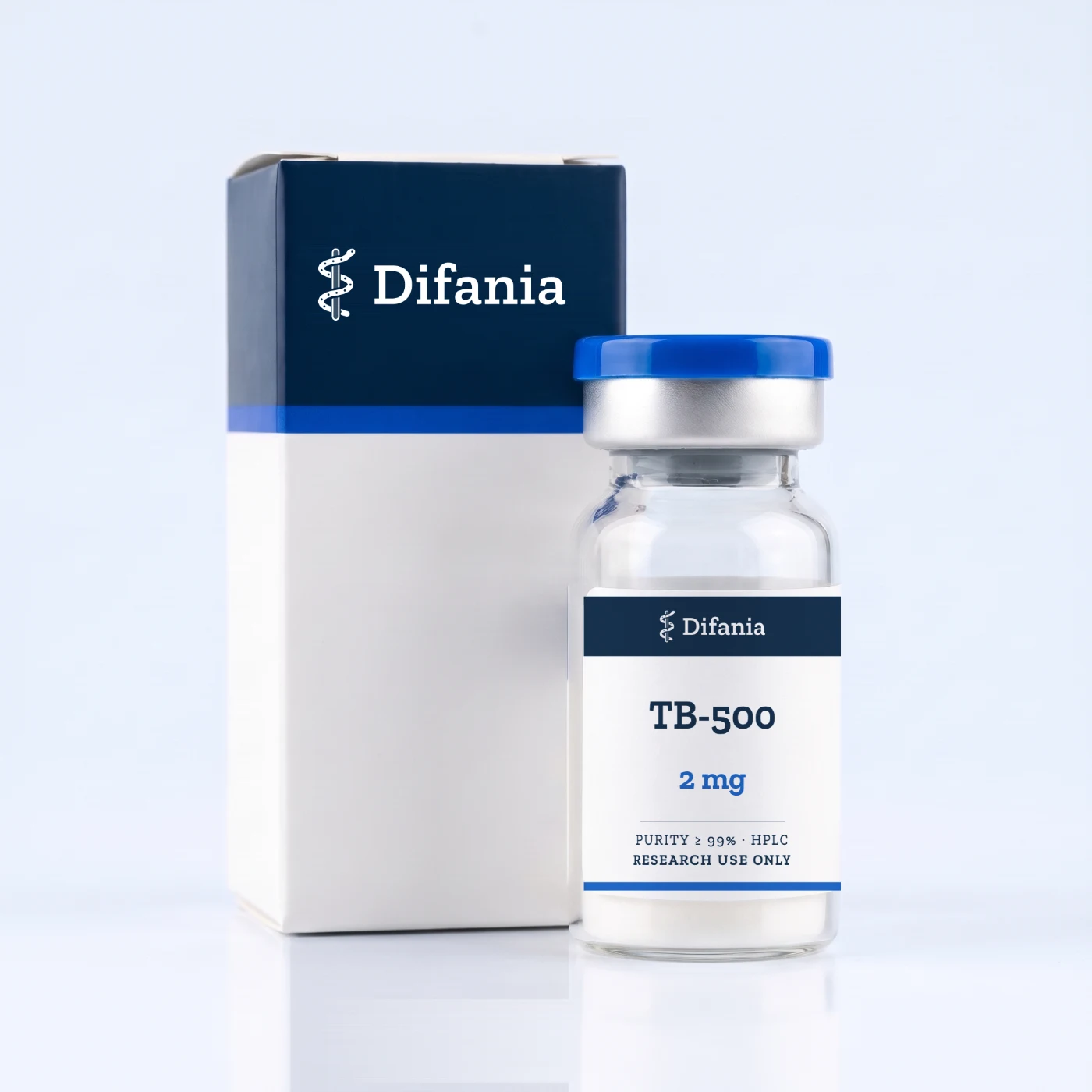
TB-500 in the laboratory
Identification
TB-500 is a synthetic peptide catalogued by Difania under tissue research and supplied as a lyophilised solid. The record holds CAS number 77591-33-4, the molecular formula C212H350N56O78S and a molar mass of 4963.5 g/mol. A single sulphur atom appears in the formula, which places one sulphur bearing residue in the chain and is worth noting when an open solution is to be kept for any length of time. No sequence listing and no salt form is held in the catalogue for this item, so the paperwork issued with the lot remains the reference for anything beyond the figures above. Three fill sizes are listed, 2 mg, 5 mg and 10 mg of peptide, each specified at a purity of 99% or higher. The same peptide is also catalogued as a component of three combined vials: with BPC-157, in GLOW alongside BPC-157 and GHK-Cu, and in KLOW alongside BPC-157, GHK-Cu and KPV.
Analytical control
Release rests on two measurements. Reversed phase HPLC separates the peptide from related substances and from residues of synthesis and purification; the main peak is integrated and compared against the catalogue specification of 99% or higher. Mass spectrometry establishes identity, with the measured mass set against the 4963.5 g/mol calculated from the stated formula and matching the CAS registered structure. On a chain of this size the mass measurement is a sharp test, because any shortfall or excess of a residue displaces the result by far more than the error of the instrument. Both outcomes are recorded in the file kept for the lot.
Reconstitution and solubility
Let the vial stand until it has reached room temperature, then break the seal. Introduce the solvent slowly against the inner wall rather than onto the cake itself, and allow the solid to dissolve by gentle swirling or by simply leaving the vial to stand. Avoid vortexing while undissolved material remains.
| Vial size | Solvent added | Resulting concentration |
|---|---|---|
| 2 mg | 1 mL | 2 mg/mL |
| 5 mg | 1 mL | 5 mg/mL |
| 10 mg | 1 mL | 10 mg/mL |
| 10 mg | 2 mL | 5 mg/mL |
Bacteriostatic water, sterile water and a dilute acetic acid solution are the three solvents ordinarily used, the acid route reserved for a cake that clears slowly in water on its own.
Storage and stability
Before opening, the vial belongs at minus 20 degrees Celsius, sealed and kept dark. Bring it to room temperature while it is still closed, so that moisture does not condense onto cold solid when the stopper is lifted. Reconstituted material is held at 2 to 8 degrees Celsius and is best divided into single use portions as it is prepared, which keeps the bulk of the stock from repeated warming and cooling and, for a peptide carrying a sulphur bearing residue, limits how long any one portion spends open.
Use in the laboratory
The material is intended for in vitro experiments and for use as a reference standard, for example while an analytical method is being developed or checked. Peptides in the tissue research group appear in in vitro work on cell migration and tissue repair, and this entry is catalogued for laboratories working in that field. Difania supplies the reagent together with the analytical documentation held for its lot, and does not advise on experimental design or on the interpretation of findings.
Safety and handling
Handle the contents as a laboratory chemical. Gloves and eye protection should be worn while the vial is open and while solutions are drawn or diluted, and the dry solid is best handled in the containment your laboratory applies to fine powders. Dispose of residues, spent solutions and empty vials under your institution’s rules and the local regulations covering laboratory waste. None of this is a medicinal product, a food, a supplement or a cosmetic; it is sold as a reagent alone, and it is not to be consumed or administered to humans or to animals.
Lot documentation
A lot number is printed on the label of every vial, and it is the key to the analytical documentation Difania holds for that fill. Quoting it is all that is needed for the records to be found and sent to you. Enter it in your laboratory record next to the date the vial was opened, so that results produced later can still be matched to the material that gave them.


