
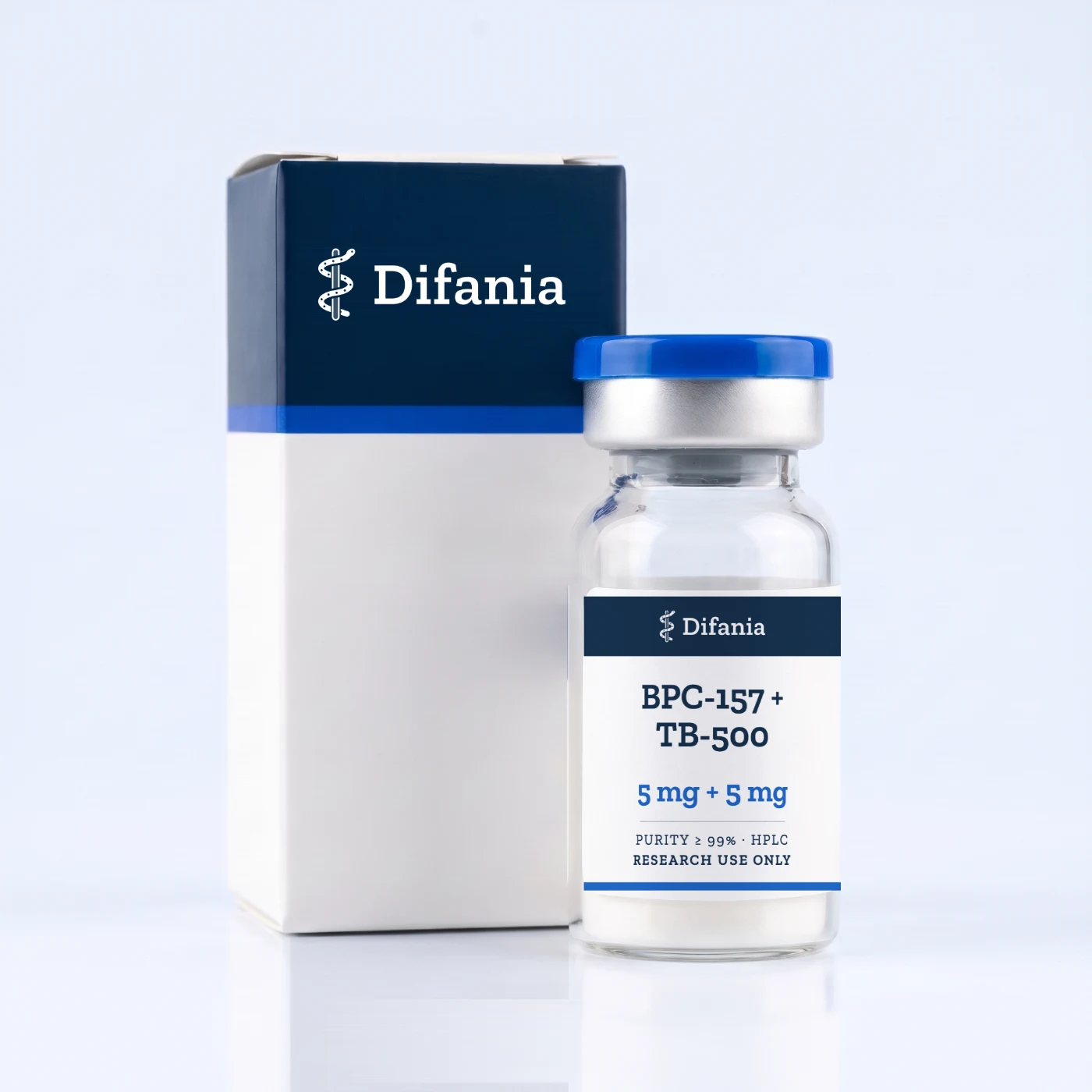
BPC-157 + TB-500 in the laboratory
Composition
The vial holds two peptides freeze dried as a single cake: BPC-157 and TB-500. Difania catalogues the pair under tissue research and fills it at three weights, 5 mg + 5 mg, 10 mg + 10 mg and 15 mg + 15 mg, where the first figure is the BPC-157 content and the second the TB-500 content. Both components are present in equal amounts at every fill weight, so moving up the range changes the quantity of material in hand and nothing about the proportion between the two.
Both are supplied as synthetic lyophilised solids rather than as solutions. Because they share one cake they also share one reconstitution, which is the practical argument for a blend over two separate vials. The matching limitation is fixed at the point of filling: once the cake has dissolved, the two peptides cannot be separated, weighed out independently or recovered at some other ratio. Work that needs a different proportion, or one component on its own, starts from the two single component catalogue entries instead.
The record holds no CAS number, molecular formula or molar mass, since those identifiers describe single substances rather than mixtures. The catalogue carries the fill weights above and the purity specification instead.
Analytical control
Purity is determined by reversed phase high performance liquid chromatography, with the peaks of interest integrated against the whole chromatogram, and the specification applied to this item is 99 percent or higher. Identity is confirmed by mass spectrometry, where the measured mass of each component is compared with the mass expected for that peptide.
The two methods answer separate questions: chromatography reports how much of the material is the intended substance, mass spectrometry whether that substance is the one named on the label. Both results belong to a specific lot, and it is the lot paperwork that describes a particular vial.
Reconstitution and solubility
Let the sealed vial reach room temperature before the seal is broken, so that moisture does not condense onto cold glass or cold powder. Introduce the solvent slowly down the inner wall rather than directly onto the cake, then rotate the vial gently until the liquid runs clear. Shaking and vortexing only produce foam and strand peptide on the stopper.
| Vial | Solvent added | Concentration of each component |
|---|---|---|
| 5 mg + 5 mg | 2 mL | 2.5 mg/mL |
| 10 mg + 10 mg | 2 mL | 5 mg/mL |
| 10 mg + 10 mg | 5 mL | 2 mg/mL |
| 15 mg + 15 mg | 3 mL | 5 mg/mL |
| 15 mg + 15 mg | 5 mL | 3 mg/mL |
Bacteriostatic water is the common choice where one vial will be drawn on more than once, sterile water where the work has to stay free of additives, and a dilute acetic acid solution where a reluctant cake needs help before any further dilution.
Storage and stability
Keep the unopened vial at minus 20 degrees Celsius, protected from light, and bring it to room temperature before the stopper is pierced. Reconstituted material is handled differently: hold it at 2 to 8 degrees Celsius and portion it out as soon as it has dissolved, so the bulk never sees a second temperature cycle. Write the date of reconstitution on the vial, since the solution itself records nothing.
Use in the laboratory
This blend is intended for in vitro work and for use as a reference material in analytical method development. Both components are catalogued under tissue research, which is the field in which they appear, and a co-lyophilised pair at a fixed ratio gives a convenient starting point for comparison against the single components. Difania supplies the material and the documentation held for its lot, and does not advise on experimental design.
Safety and handling
Gloves and eye protection belong on before the vial is opened, and dry powder is best handled where airborne dust can be controlled, since the hazards of this material are not fully characterised. Residues, spent solutions and contaminated consumables go to waste under the rules of your institution and the local regulations that apply to it. Nothing in this vial is a medicinal product, a food, a supplement or a cosmetic. The blend is not for consumption and is not to be administered to humans or animals.
Lot documentation
A lot number is printed on the label of every vial: quote it and Difania can retrieve the analytical documentation held for that batch. Keep the number in your records next to the date the vial was opened, so that a result read months later can still be traced to the material behind it. Orders placed by 14:00 on a business day are dispatched the same day.


