
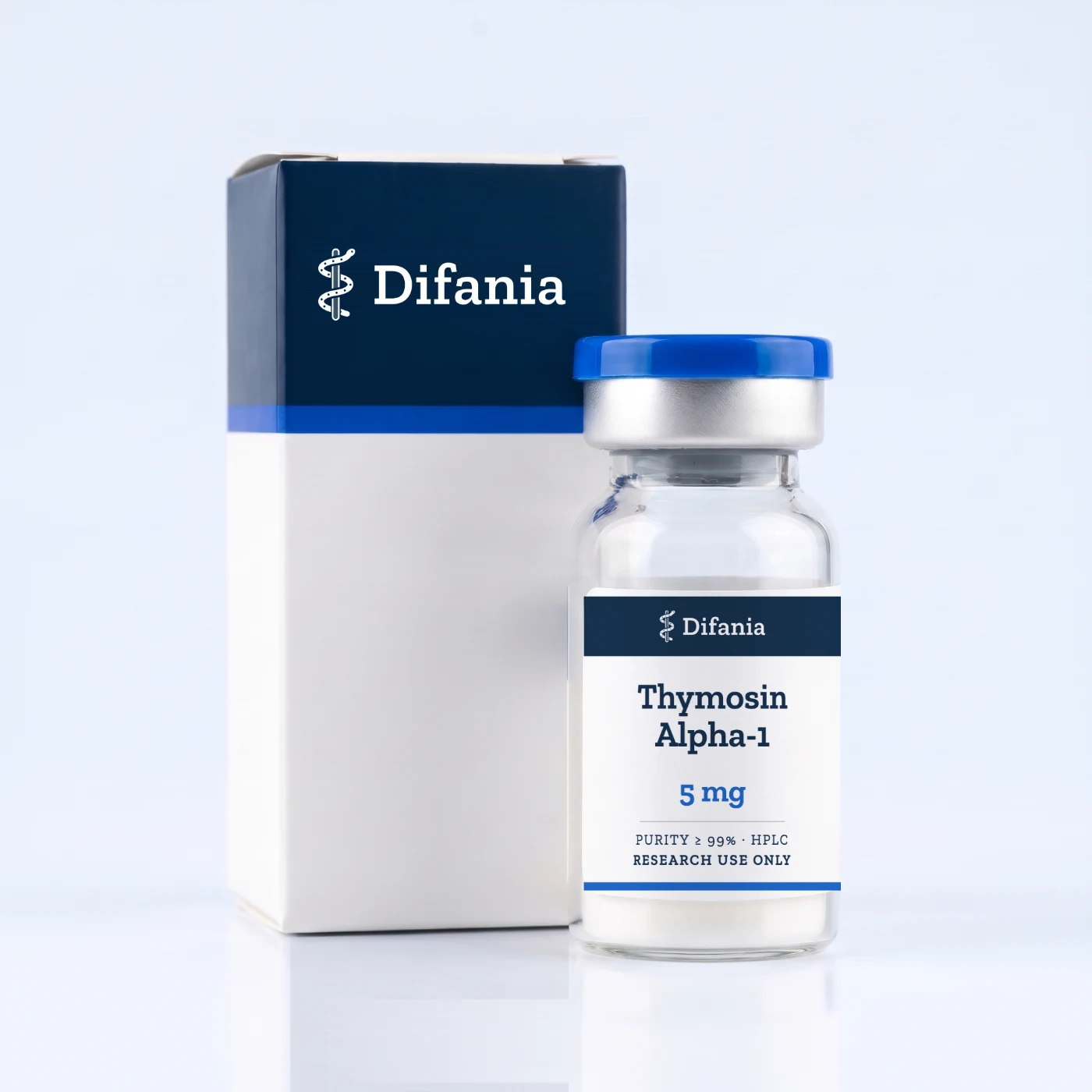
Thymosin Alpha-1 in the laboratory
Identification
Thymosin Alpha-1 belongs to the thymosin family of peptides and is supplied here as a synthetic, lyophilised solid rather than as a solution or an extract. The catalogue record holds CAS 62304-98-7, the molecular formula C129H215N33O55 and a molar mass of 3108.3. That formula contains no sulphur, which sets this peptide apart from several others in the same section of the catalogue and removes one of the usual concerns about an opened stock standing in air.
Difania lists the item under tissue research and offers it in two vial sizes, 5 mg and 10 mg. No sequence listing and no salt form are held in the catalogue record for this product, so the formula, the mass and the CAS number are the identifiers available for it. Neither size is part of a catalogued blend; this peptide is supplied only as a single component.
The molar mass of 3108.3 puts it in the middle of the range handled on a typical peptide bench: substantial enough to behave as a chain in solution rather than a small molecule, and light enough that a 10 mg vial still yields a generous number of working portions.
Analytical control
Purity is determined by reversed phase high performance liquid chromatography, with the main peak integrated against the whole chromatogram so that truncated and deletion sequences from the synthesis are accounted for. The specification applied to this item is 99 percent or higher. Identity is confirmed by mass spectrometry, where the measured mass of the intact peptide is compared with the mass calculated from the catalogued formula. The two methods answer different questions, one about how much of the contents is the intended material and one about whether that material is what the label says, and both results belong to a particular lot.
Reconstitution and solubility
Give the vial time on the bench to reach room temperature, then break the seal and introduce the solvent slowly, directing it against the glass so that the cake dissolves from the edge inwards. Rotate the vial gently until the liquid runs clear. Vigorous shaking achieves nothing useful and leaves peptide stranded in foam on the stopper.
| Vial | Solvent added | Resulting concentration |
|---|---|---|
| 5 mg | 2 mL | 2.5 mg/mL |
| 5 mg | 5 mL | 1 mg/mL |
| 10 mg | 2 mL | 5 mg/mL |
| 10 mg | 5 mL | 2 mg/mL |
Bacteriostatic water is the usual solvent where a vial will be sampled more than once, sterile water where no additive is acceptable, and a dilute acetic acid solution where a cake needs help before any further dilution.
Storage and stability
The sealed solid is stored at minus 20 degrees Celsius and protected from light until the experiment calls for it. Let the vial come to room temperature before it is opened: that single step keeps condensation off cold glass and cold powder. Reconstituted solution belongs at 2 to 8 degrees Celsius, and the moment to divide it into portions is immediately after it dissolves, while the whole volume is in hand. A date written on the label then saves a good deal of guessing later.
Use in the laboratory
Thymosin Alpha-1 is intended for in vitro work and for use as a reference material in analytical method development, including calibration and system suitability checks. Peptides of this family appear in immunological research, and the catalogue places this item in its tissue research section. What Difania supplies is the material itself together with the analytical documentation held for its lot; the design of the work, the controls chosen and the conditions used remain with the laboratory.
Safety and handling
This is a laboratory reagent of incompletely established hazard and is handled on that basis. Keep gloves and eye protection on from the moment the vial is opened until the solutions have been put away, and work with dry powder where airborne dust can be controlled. Residues, spent solutions and contaminated consumables are disposed of under the rules of your institution and the waste regulations in force locally. The peptide is not a medicinal product, a food, a supplement or a cosmetic. Neither consumption nor administration to humans or animals is an intended use.
Lot documentation
A lot number is printed on the label of each vial and is the reference that matters. Quote it and Difania can retrieve the analytical documentation held for that batch. Keep it in your records beside the date the vial was opened, so that a measurement examined months later can still be traced back to the material it was made with.


