
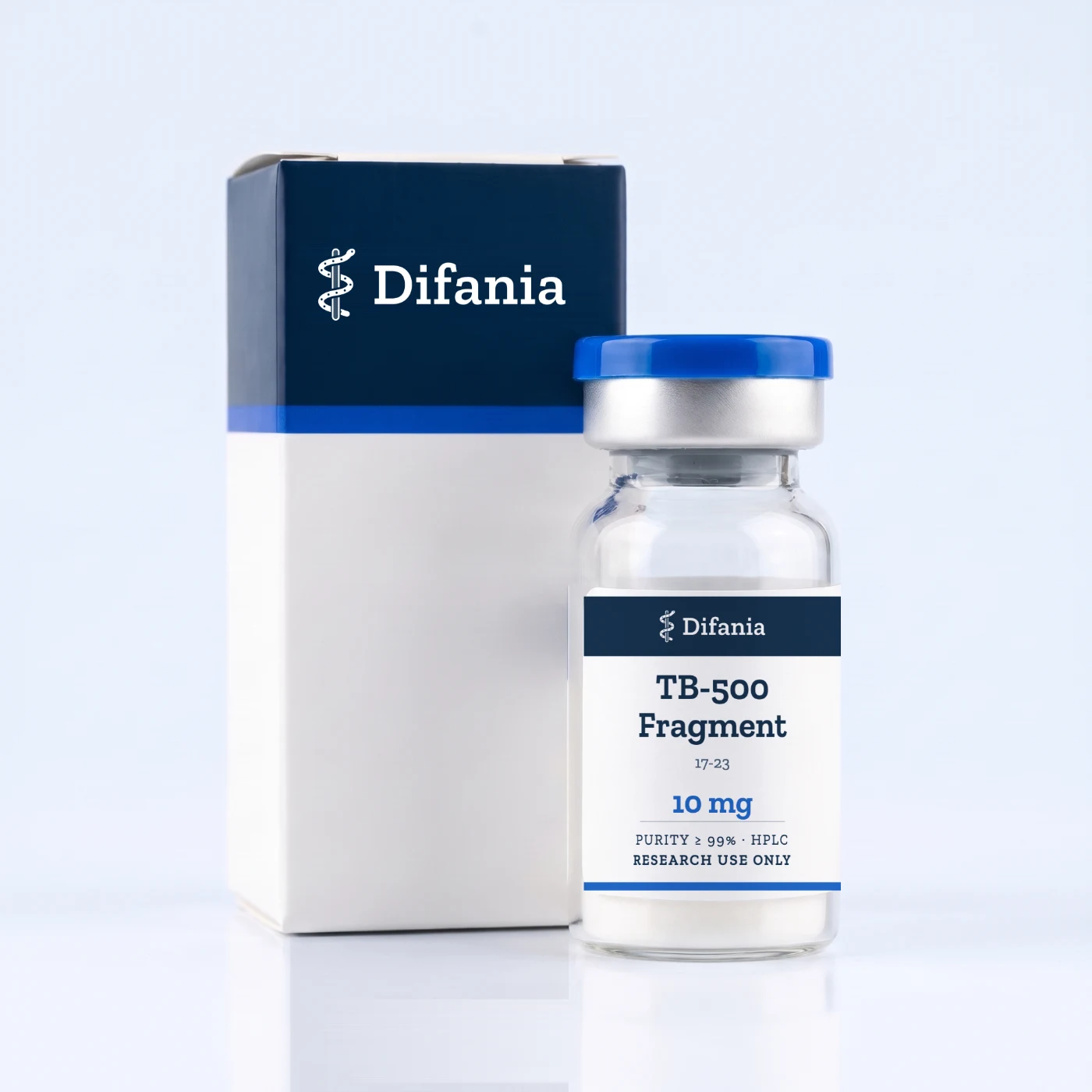
TB-500 Fragment (17-23) in the laboratory
Identification
TB-500 Fragment (17-23) is a short synthetic peptide catalogued by Difania under tissue research and supplied as a lyophilised solid in a sealed vial. The catalogue name is the informative part of this entry: it marks the material as the fragment covering positions 17 to 23 of the parent chain, so what is in the vial is a defined section of a longer peptide rather than the whole of it. The full length peptide is a separate catalogue entry with its own identifiers and fill sizes. The record for this item is deliberately sparse. It holds the form, a purity specification of 99% or higher and one fill size, 10 mg of peptide per vial. No CAS number, molecular formula, molar mass or sequence listing is entered against it, and none is stated here, so nothing is said on this page about elemental composition. The item is supplied on its own and is not listed as a component of any combined vial. Being short and freeze dried, the solid is very light and may sit as a film against the glass instead of a visible pellet.
Analytical control
Identity and purity for this material come from the work done on each lot rather than from a registry entry. Reversed phase HPLC resolves the peptide from related substances and from residues left by synthesis and purification, and the integrated main peak is judged against the catalogue specification of 99% or higher. Mass spectrometry confirms identity by measuring the mass of the material against the value expected for the synthesised fragment. The two results are filed together under the lot number, and that file is what Difania can produce for any vial you name.
Reconstitution and solubility
Take the vial from cold storage and leave it sealed until the glass has warmed to room temperature. Add the solvent slowly, letting it run down the inner wall rather than striking the cake, and then swirl gently or let the vial stand until the solid has cleared. Do not vortex while undissolved material is still present.
| Vial size | Solvent added | Resulting concentration |
|---|---|---|
| 10 mg | 1 mL | 10 mg/mL |
| 10 mg | 2 mL | 5 mg/mL |
| 10 mg | 5 mL | 2 mg/mL |
Bacteriostatic water suits a stock drawn on over several sessions, sterile water a solution used straight away, and a dilute acetic acid solution the case where water alone leaves the cake slow to dissolve.
Storage and stability
Sealed vials keep at minus 20 degrees Celsius, in the dark, and should stay closed until the work is ready for them. A reconstituted solution is held at 2 to 8 degrees Celsius and split into single use portions at the point of preparation, so the whole stock is not warmed and returned to the cold again and again. Letting a vial equilibrate to room temperature before opening keeps moisture off the cold contents.
Use in the laboratory
The fragment is supplied for in vitro experiments and for use as a reference material, for instance when a chromatographic method is being set up or a peak assignment checked against a known input. Short defined fragments are also taken as comparators alongside the full length peptide, which is catalogued separately. Peptides in the tissue research group appear in in vitro work on cell behaviour and tissue repair, and this entry is listed for laboratories working in that area. Difania provides the material and the analytical documentation recorded against its lot, and does not advise on experimental design or on how results should be read.
Safety and handling
Gloves and eye protection belong on while the vial is open and while solutions are transferred, and the dry solid is best handled inside the containment your laboratory uses for fine powders. Residues, rinses and used labware are disposed of under the rules of your institution and the local regulations that apply to laboratory waste. This is a laboratory chemical: not a medicinal product, not a food, not a supplement and not a cosmetic, not for consumption, and not for administration to humans or to animals.
Lot documentation
The number printed on the vial label identifies the lot. It links the vial on your bench to the analytical documentation Difania holds, and quoting it in a message is enough for that documentation to be retrieved and sent. Record it in your own notes together with the date the vial was first opened, so that a result obtained later can be traced back to the exact fill it came from.


