
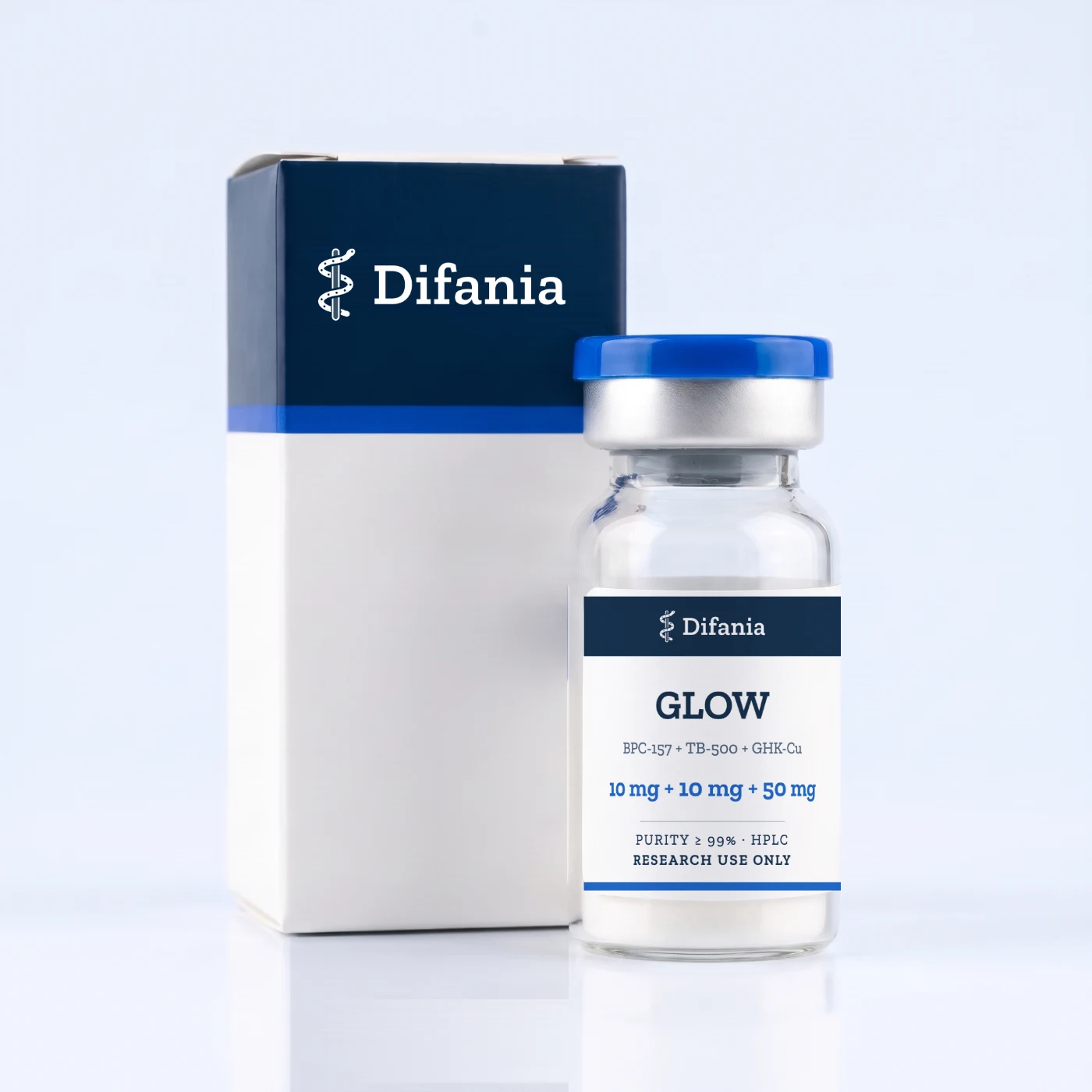
GLOW (BPC-157 + TB-500 + GHK-Cu) in the laboratory
Composition
GLOW is catalogued as a three component blend and supplied as one lyophilised cake containing BPC-157, TB-500 and GHK-Cu. The single fill weight is 10 mg + 10 mg + 50 mg, read in the order the components are named: 10 mg of BPC-157, 10 mg of TB-500 and 50 mg of GHK-Cu. Two of the three are therefore present in equal amounts, while the copper bearing component is filled at five times that weight, and this asymmetry is the defining feature of the item.
BPC-157 and TB-500 are peptides. GHK-Cu is a copper complexed peptide, which is why colour is visible in a cake that would otherwise look white. All three are supplied as synthetic lyophilised solids and share a single reconstitution step, so one solvent addition brings the whole mixture into solution together.
That convenience carries a fixed consequence. The ratio between the three components is set when the vial is filled and cannot be changed afterwards, nor can one component be drawn out of a dissolved cake on its own. Work that needs a different proportion starts from the three single component entries, which are catalogued separately for exactly that reason. No CAS number, molecular formula or molar mass is held for the blend, since those identifiers describe single substances rather than mixtures. The fill weight above and the purity specification are what the catalogue holds in their place.
Analytical control
Purity is established by reversed phase high performance liquid chromatography, which resolves the components from the truncated and deletion sequences that synthesis leaves behind, and the specification applied here is 99 percent or higher. Identity is confirmed by mass spectrometry, comparing the measured mass of each component against the value expected for that molecule. Both readings belong to one lot. The documentation held for that lot, rather than any general description of the product, is what states the condition of a particular vial.
Reconstitution and solubility
Allow the vial to warm on the bench before the seal is broken. Add the solvent slowly against the inner wall of the glass so that the cake dissolves from the edge inwards, and swirl rather than shake, since foam traps material on the stopper and against the neck.
| Vial | Solvent added | BPC-157 | TB-500 | GHK-Cu |
|---|---|---|---|---|
| 10 mg + 10 mg + 50 mg | 2 mL | 5 mg/mL | 5 mg/mL | 25 mg/mL |
| 10 mg + 10 mg + 50 mg | 5 mL | 2 mg/mL | 2 mg/mL | 10 mg/mL |
| 10 mg + 10 mg + 50 mg | 10 mL | 1 mg/mL | 1 mg/mL | 5 mg/mL |
Bacteriostatic water, sterile water and a dilute acetic acid solution are the solvents normally used. Because the GHK-Cu content is the largest of the three, it is that component which sets the practical lower limit on how little solvent can be added before the solution becomes awkward to handle.
Storage and stability
Before the vial is opened, let it stand until it reaches room temperature, so condensation does not settle on the cold cake. The sealed solid is stored at minus 20 degrees Celsius and kept away from light, which matters more here than for an uncoloured peptide. Once dissolved, hold the solution at 2 to 8 degrees Celsius and split it into portions immediately, so that each withdrawal takes a fresh tube rather than returning to the bulk. Add the date of reconstitution to the label at the same time.
Use in the laboratory
The blend is supplied for in vitro work and as a reference material in analytical method development. Its components are catalogued under tissue research, and that is the field in which they appear. A fixed ratio co-lyophilisate gives a single reproducible starting point for comparative work run against the individual components. Difania provides the reagent and the analytical documentation belonging to its lot; the choice of experimental design, controls and conditions stays with the laboratory doing the work.
Safety and handling
The contents are handled as any incompletely characterised laboratory chemical would be. Gloves and eye protection are appropriate throughout, and dry powder should be handled where airborne dust can be controlled. Spent solutions, residues and contaminated items go to waste under the rules of your institution and local regulations. This material is not a medicinal product, a food, a supplement or a cosmetic, and it is neither for consumption nor for administration to humans or animals.
Lot documentation
A lot number appears on the label of each vial. Quoting it is all Difania needs in order to retrieve the analytical documentation held for the batch concerned. Record it alongside the date the vial was opened, so that an observation made well after the work can still be tied back to the material that produced it.


