
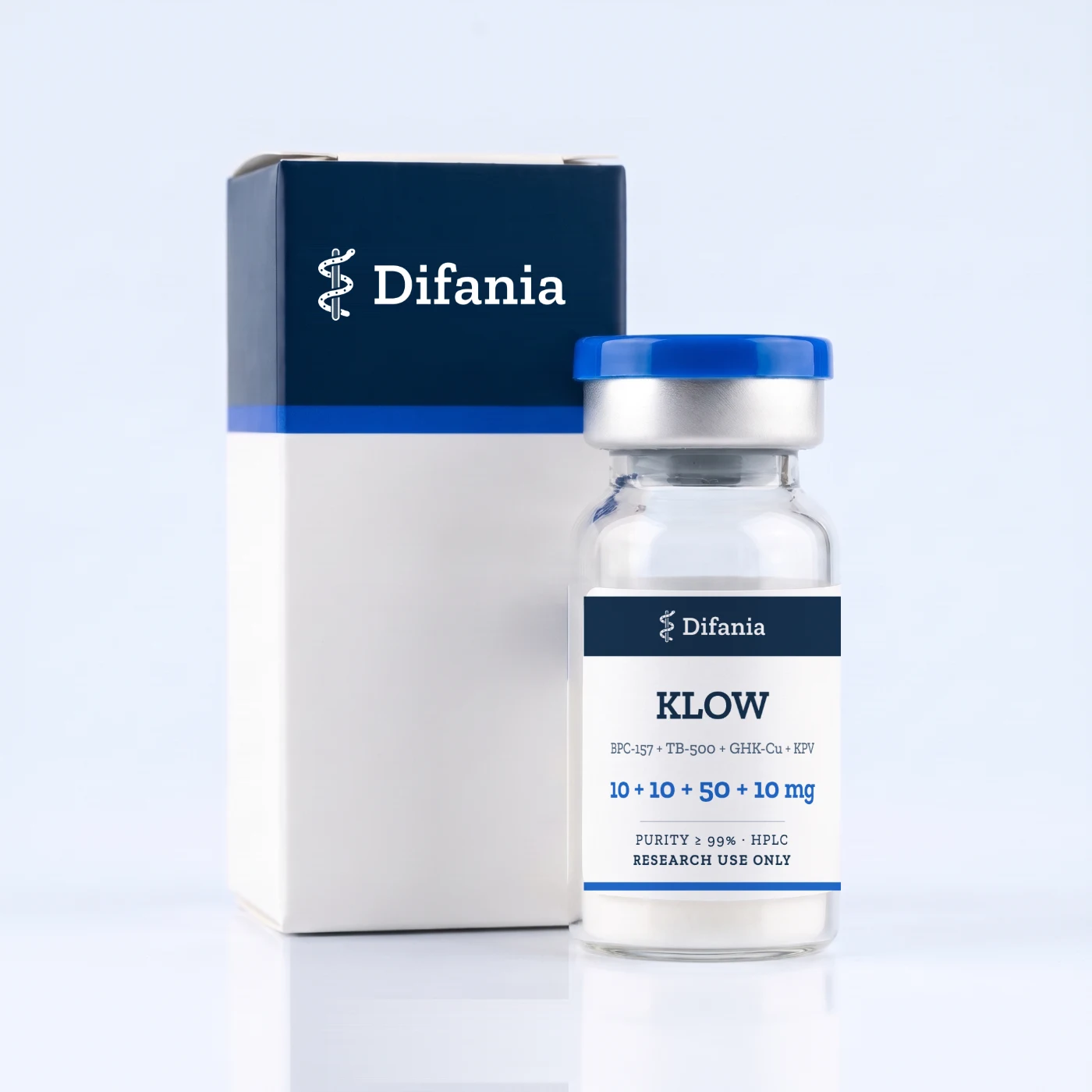
KLOW (BPC-157 + TB-500 + GHK-Cu + KPV) in the laboratory
Composition
KLOW is the four component entry in the catalogue: BPC-157, TB-500, GHK-Cu and KPV, freeze dried together into one cake. The single fill weight is written 10 + 10 + 50 + 10 mg and is read in the order the components are named, so the vial holds 10 mg of BPC-157, 10 mg of TB-500, 50 mg of GHK-Cu and 10 mg of KPV. Three of the four are filled at the same weight, while the copper bearing component is present at five times that amount and dominates the mass of the cake.
Three of the components are peptides. GHK-Cu is a copper complexed peptide, and it is that complex which gives the solid its colour. KPV is the smallest molecule of the set, a short peptide also listed in the catalogue in its own right. All four are supplied as synthetic lyophilised material and are brought into solution in a single step.
What the format gives in convenience it takes away in flexibility, and that trade is fixed at filling. The components dissolve as one solution and cannot be separated, weighed independently or recovered at a different ratio. A laboratory that needs another proportion, or a single component, works from the separate catalogue entries. No CAS number, molecular formula or molar mass is held for the blend itself, since those identifiers belong to single substances; the record carries the fill weight and the purity specification instead.
Analytical control
The material is released against a purity specification of 99 percent or higher. Purity is measured by reversed phase high performance liquid chromatography, which separates each component from the truncated and deletion sequences that remain after synthesis. Identity is confirmed by mass spectrometry, comparing the measured mass of each component with the mass expected for that molecule. Both techniques are applied to a particular lot, and it is the documentation for that lot which describes a given vial, not the catalogue text.
Reconstitution and solubility
Bring the vial to room temperature before the seal is broken. Run the solvent slowly down the inside wall of the glass instead of dropping it onto the solid, then rotate the vial by hand until the liquid is clear. Vortexing and shaking are avoided: they generate foam, and foam leaves material stranded on the stopper.
| Vial | Solvent added | BPC-157 | TB-500 | GHK-Cu | KPV |
|---|---|---|---|---|---|
| 10 + 10 + 50 + 10 mg | 2 mL | 5 mg/mL | 5 mg/mL | 25 mg/mL | 5 mg/mL |
| 10 + 10 + 50 + 10 mg | 5 mL | 2 mg/mL | 2 mg/mL | 10 mg/mL | 2 mg/mL |
| 10 + 10 + 50 + 10 mg | 10 mL | 1 mg/mL | 1 mg/mL | 5 mg/mL | 1 mg/mL |
Bacteriostatic water, sterile water and a dilute acetic acid solution are the usual solvents. Since the GHK-Cu content is by far the largest, it is that component which decides how small a volume can sensibly be used.
Storage and stability
Sealed and solid, the blend belongs at minus 20 degrees Celsius, in the dark. Let the vial stand on the bench until it has reached room temperature before the stopper is pierced, so that condensation does not reach a cold cake. Reconstituted solution is held at 2 to 8 degrees Celsius and is best portioned out at once, so that the bulk is handled a single time rather than on every working day. Note the date of reconstitution on the label while the vial is still in your hand.
Use in the laboratory
KLOW is intended for in vitro work and as a reference material when analytical methods are developed or checked for system suitability. Its components are catalogued under tissue research, the field in which they appear, and a single cake of fixed composition gives a repeatable starting point for comparisons against the individual components. Difania supplies the reagent with the analytical documentation held for its lot, and does not advise on how experiments should be designed or run.
Safety and handling
Everything in the vial is a laboratory chemical and gets handled accordingly. Wear gloves and eye protection while the vial is open and while solutions are being made up, and keep dry powder where airborne dust is controlled. Dispose of residues, used solutions and contaminated consumables under the rules of your institution and the local waste regulations. The material is not a medicinal product, food, supplement or cosmetic, is not for consumption, and is not to be administered to humans or animals.
Lot documentation
Each vial carries a printed lot number. That number is what links the vial to the analytical documentation Difania holds for its batch, and quoting it is enough for the paperwork to be retrieved. Keep it in your records beside the date the vial was first opened, so that any later result can be traced to the exact material behind it.


