
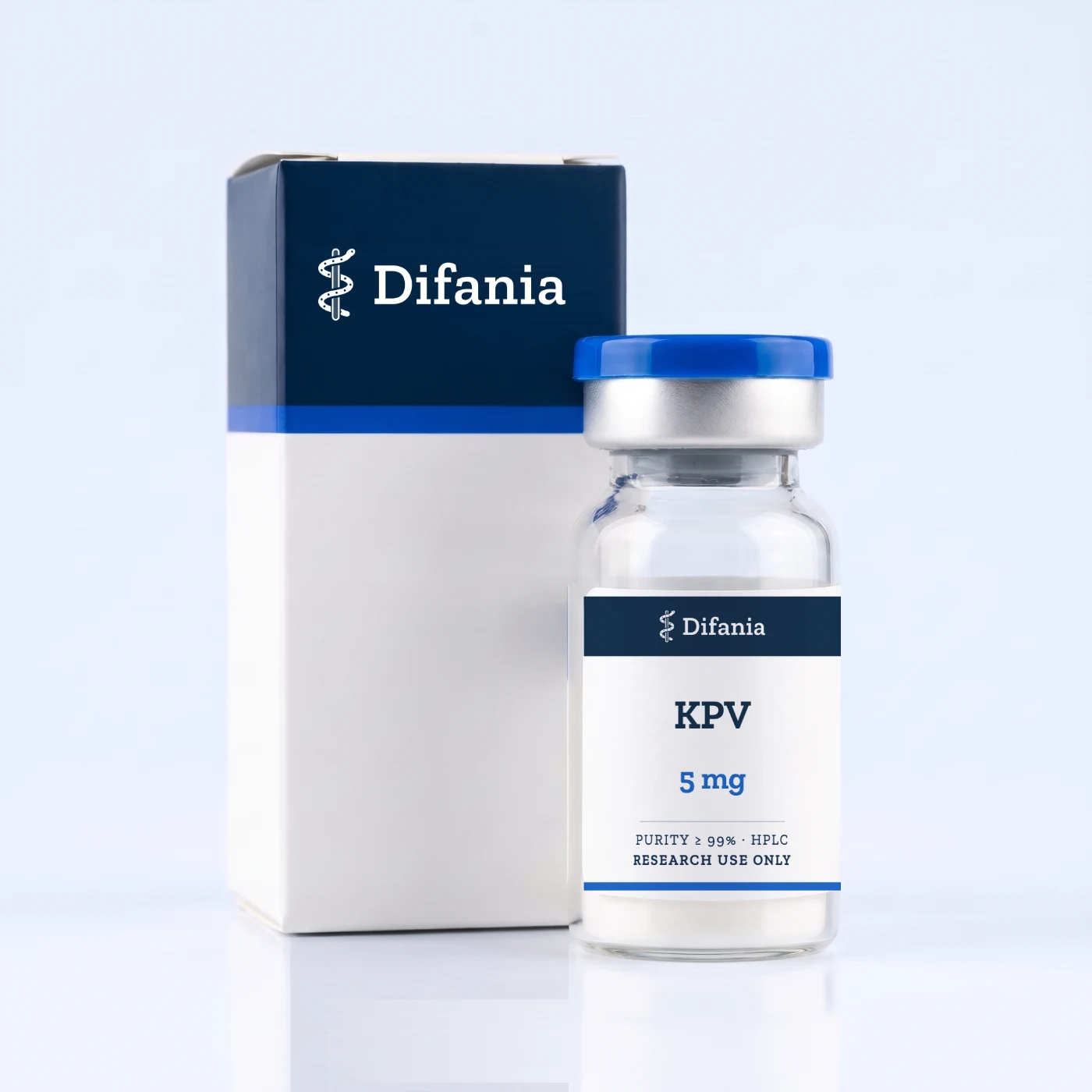
KPV in the laboratory
Identification
KPV is a tripeptide built from three residues, lysine, proline and valine, in that order: the catalogue records the sequence as Lys-Pro-Val. It is held under CAS 67727-97-3, with the molecular formula C16H30N4O4 and a molar mass of 342.4. Those figures make it by some distance the smallest molecule in the tissue research section of the catalogue, and its size is the fact that shapes most of the practical handling advice below.
Difania supplies it as a synthetic, lyophilised solid in two vial sizes, 5 mg and 10 mg. The catalogue also lists it as one of the four components of the KLOW blend, where it is co-lyophilised with BPC-157, TB-500 and GHK-Cu. The entry on this page is the single component form, the one to order when the amount of KPV in an experiment has to be set independently of anything else. No salt form is recorded for this item.
A molecule of this length behaves differently from a long chain peptide in the laboratory. There is no secondary structure to lose, the molar mass is low enough that a small weighing error carries a large relative effect on a calculated concentration, and the quantity of solid in a 5 mg vial is physically small. That last point is worth remembering on first opening, because a thin cake can look like an underfilled vial when it is nothing of the sort.
Analytical control
Purity is established on a reversed phase high performance liquid chromatography system. The main peak is integrated against the full chromatogram, which separates the intended tripeptide from the shorter fragments and incomplete sequences that synthesis can leave behind, and the specification applied to this item is 99 percent or higher. Identity is established by mass spectrometry: the measured mass of the peptide is compared with the mass calculated from the catalogued formula, 342.4. Both results are tied to a single lot, so the lot paperwork is the document that describes a given vial.
Reconstitution and solubility
Let the vial reach room temperature before the seal is broken, then add the solvent slowly along the inner wall of the glass rather than straight onto the solid. Swirl gently until the liquid is clear; shaking only raises foam, which strands material on the stopper. Bacteriostatic water, sterile water or a dilute acetic acid solution are the solvents in normal use.
| Vial | Solvent added | Resulting concentration |
|---|---|---|
| 5 mg | 1 mL | 5 mg/mL |
| 5 mg | 2 mL | 2.5 mg/mL |
| 10 mg | 2 mL | 5 mg/mL |
| 10 mg | 5 mL | 2 mg/mL |
Storage and stability
Unopened, the vial is kept at minus 20 degrees Celsius and shielded from light, which is where it should stay until the day the work is actually scheduled. Give it time on the bench to reach room temperature before the stopper is pierced, so that moisture does not condense onto cold powder. Once dissolved, the material moves to 2 to 8 degrees Celsius, and the stock is best split into working portions straight away rather than returned to the refrigerator and reopened each day. Note the date of reconstitution on the label, because the solution carries no other record of its own age.
Use in the laboratory
KPV is supplied for in vitro work and as a reference material in analytical method development, including calibration and system suitability runs. Short peptides of this kind appear in inflammation research, and the catalogue groups this item under tissue research. Difania provides the reagent and the analytical documentation belonging to its lot. Decisions about experimental design, controls and conditions rest with the laboratory carrying out the work.
Safety and handling
The hazards of this tripeptide are not fully characterised, so it is handled as a laboratory chemical throughout. Gloves and eye protection are expected while the vial is open and while solutions are prepared, and dry powder is best kept where airborne dust can be controlled. Residues and contaminated consumables are disposed of according to the rules of your institution and the waste regulations in force locally. None of this material is a medicinal product, a food, a supplement or a cosmetic. It must not be consumed and must not be administered to humans or animals.
Lot documentation
The label of every vial carries a lot number. Quoting that number lets Difania retrieve the analytical documentation held for the batch it came from. Record it in your notebook together with the date the vial was opened, so that a result reviewed long afterwards can still be connected to the exact material that produced it.


