
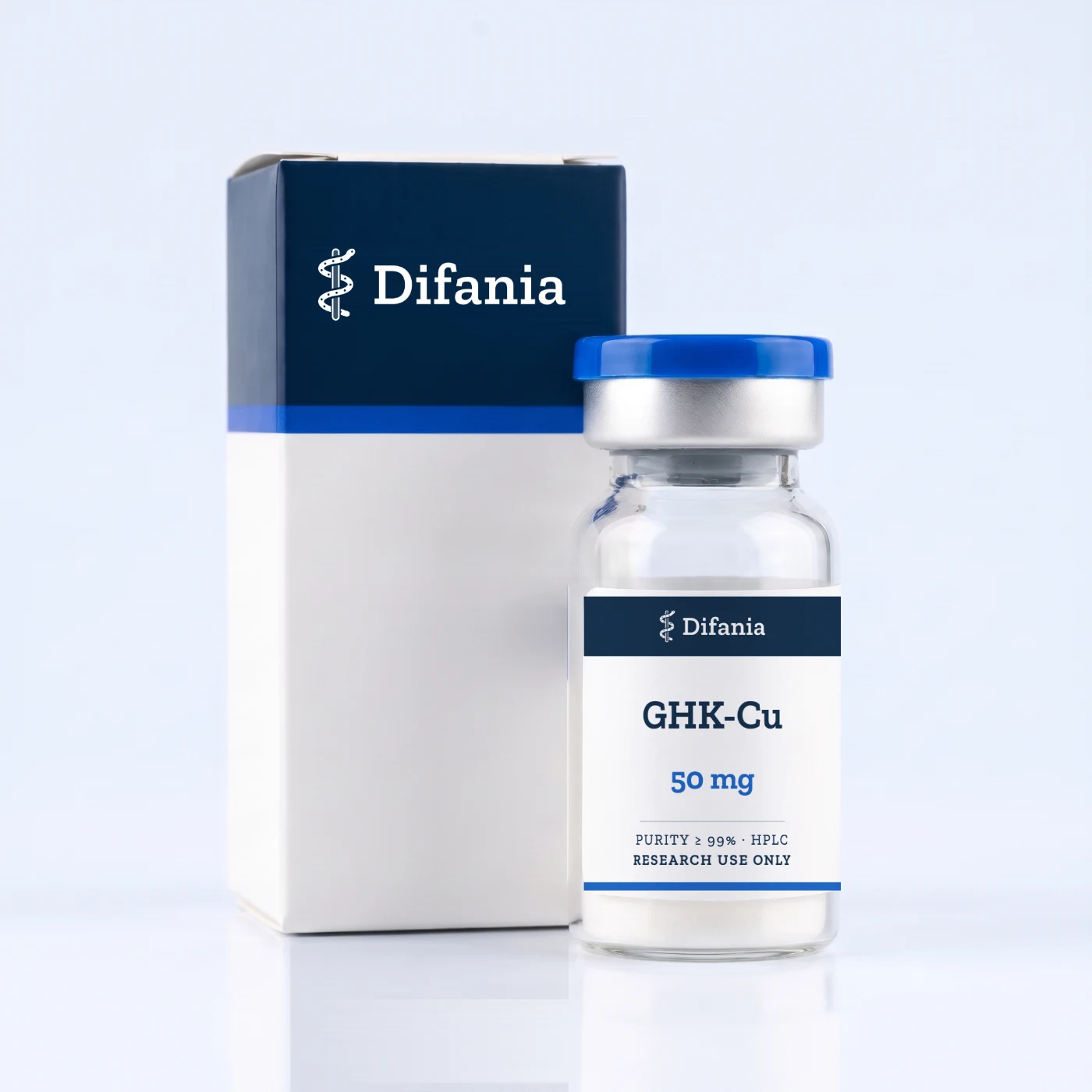
GHK-Cu in the laboratory
Identification
GHK-Cu is a copper complex of the Gly-His-Lys peptide, catalogued by Difania under skin peptides and supplied as a lyophilised solid. The sequence held for the material is Gly-His-Lys, and the copper(II) ion is bound to it, which the catalogue records as Cu²⁺. The record holds CAS number 49557-75-7, the molecular formula C14H22CuN6O4 and a molar mass of 401.9 g/mol. The copper is part of the material’s identity, so the molar mass already includes the metal, and any molar concentration should be calculated from 401.9 g/mol and not from the mass of the peptide alone. Two vial sizes are catalogued, 50 mg and 100 mg, both specified at a purity of 99% or higher. GHK-Cu is also a component of two combined vials in the range: GLOW, which pairs it with BPC-157 and TB-500, and KLOW, which adds KPV to that set.
Analytical control
Purity is established by reversed phase high performance liquid chromatography. The sample is resolved on the column, the main peak is integrated against the full chromatogram, and related substances and process residues are separated from it before the result is compared with the catalogue specification of 99% or higher. Identity is confirmed by mass spectrometry, where the measured mass is read against the 401.9 g/mol calculated from the stated formula, so the result refers to the complex and not to the free peptide. Both results are written into the documentation kept for the lot.
Reconstitution and solubility
Allow the sealed vial to reach room temperature before opening it. Add the solvent slowly down the inner wall, never directly onto the cake, then swirl gently or let the vial stand until the solid has gone into solution. Use glass or plastic transfer equipment rather than metal spatulas, so that the solution stays free of metal contamination.
| Vial size | Solvent added | Resulting concentration |
|---|---|---|
| 50 mg | 5 mL | 10 mg/mL |
| 50 mg | 10 mL | 5 mg/mL |
| 100 mg | 10 mL | 10 mg/mL |
Bacteriostatic water is the usual solvent for a stock drawn on repeatedly, sterile water for one used immediately, and a dilute acetic acid solution where the cake is slow to clear in water alone.
Storage and stability
Keep the sealed solid at minus 20 degrees Celsius, shielded from light, until the day it is wanted. After solvent has been added, the solution belongs at 2 to 8 degrees Celsius, split into working portions while it is being made, so that one aliquot can be taken without disturbing the rest. Avoid repeated freezing and thawing of a solution once it has been made. A vial brought straight from the freezer and opened cold will draw moisture onto its contents, so let it equilibrate first.
Use in the laboratory
The material is supplied for in vitro experiments and for use as a reference material. GHK-Cu belongs to the skin peptide group of the catalogue and is encountered in laboratory research into skin biology, which is the field this entry serves. Difania supplies the reagent together with the analytical documentation recorded against its lot. It does not advise on experimental design or on the reading of results.
Safety and handling
Gloves and eye protection belong on whenever the vial is open or a solution is being transferred, and the dry solid should be handled inside the containment your laboratory applies to fine powders. As a copper-containing laboratory chemical, residues, rinses and used labware go to waste under the rules of your institution and the local regulations that bind it, and they should not be poured down the drain. This is a laboratory chemical. It is not a medicinal product, a food, a supplement or a cosmetic, it is not for consumption, and it is not for administration to humans or animals.
Lot documentation
Every vial carries a lot number on its label, and that number is what connects the material on your bench to the records Difania holds for it. Quote it in an enquiry and the analytical documentation for that lot can be retrieved and sent over. Copy the number into your own notes alongside the date the vial was opened and the solvent used, so that any later result can be traced back to a specific fill.


