
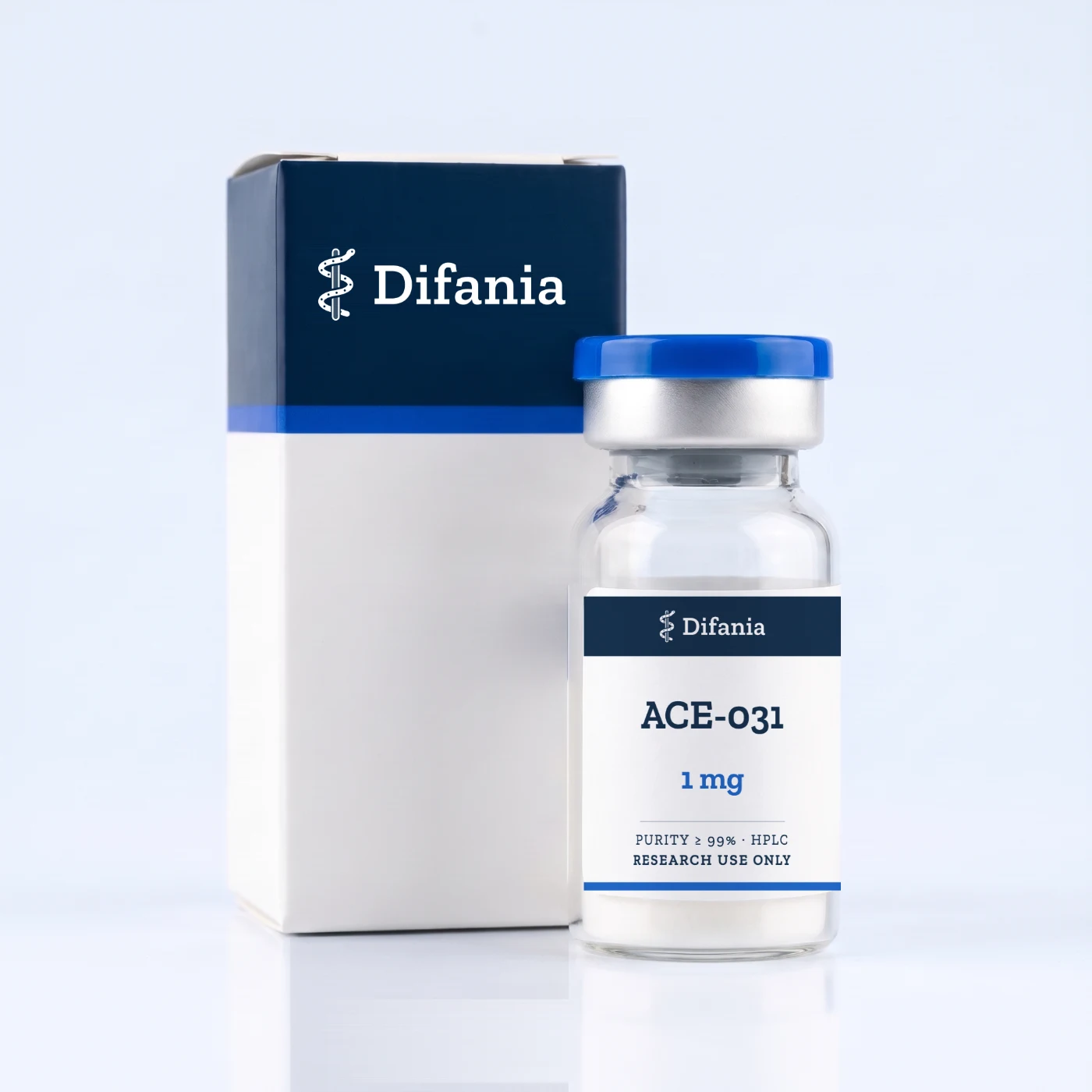
ACE-031 in the laboratory
Identification
ACE-031 is catalogued as a soluble activin receptor type IIB construct. The format is what defines the class: the extracellular portion of a receptor is produced as a free standing, soluble molecule instead of remaining anchored in a membrane, giving a binding domain that exists in solution and can be handled as an ordinary reagent. That structural choice, rather than any particular measurement, is the thing a buyer is identifying when they order under this name.
The catalogue entry itself is deliberately short, and it is worth being plain about what it does and does not hold. It records the name, placement in the GH axis group, the lyophilised form, a purity specification of 99 percent or higher, and a single fill size of 1 mg per vial. No CAS number is entered against this item, and neither a molecular formula nor a molar mass is held. No sequence is listed. Where a method depends on values of that kind, the analytical documentation issued with the lot is the reference, not this page.
The practical consequence of the format is a handling one. A folded, soluble construct is a larger and more delicate object in a vial than a short synthetic peptide, and it responds badly to the things that leave a small peptide untouched: vigorous mixing, foam, a wide air to liquid interface, and stocks that are frozen and thawed more than once. Everything in the sections below follows from that.
Analytical control
Purity is established by reversed phase high performance liquid chromatography, with the main peak integrated against the full chromatogram and read against the specification applied to this item, 99 percent or higher. Identity is confirmed by mass spectrometry. Because the catalogue holds no formula for this entry, the measured mass is read against the record compiled for the lot rather than against a value calculated here, which is one more reason the lot paperwork is the document that genuinely describes a given vial.
Reconstitution and solubility
Nothing should be added until the glass has equilibrated to room temperature. Add the solvent slowly, directing it at the inner wall so that it reaches the cake as a film rather than a jet, then leave the vial to stand and rotate it gently now and then until the liquid runs clear. Do not vortex and do not shake.
| Vial | Solvent added | Resulting concentration |
|---|---|---|
| 1 mg | 1 mL | 1 mg/mL |
| 1 mg | 2 mL | 0.5 mg/mL |
| 1 mg | 5 mL | 0.2 mg/mL |
Storage and stability
Keep the unopened vial at minus 20 degrees Celsius, shielded from light, until the experiment is genuinely ready for it; the dry solid is the stable form and there is nothing to gain from reconstituting early. Let the glass warm to room temperature on the bench before the stopper goes in, so that condensation does not settle on cold powder. Reconstituted material belongs at 2 to 8 degrees Celsius, portioned out as it is made. With a construct of this kind the number of freeze and thaw cycles matters more than the calendar, so one pass from solid to portioned solution is the pattern to aim for.
Use in the laboratory
Difania supplies this item for in vitro work and for use as a reference material, for instance as a characterised comparator while an analytical method is being established. Soluble receptor constructs of this type appear in research on signalling within the transforming growth factor beta superfamily, and the catalogue files the entry under its GH axis section. What Difania provides is the material and the analytical documentation belonging to its lot; the design of experiments, the controls chosen and the interpretation of what comes out of them remain with the laboratory doing the work.
Safety and handling
This is a laboratory chemical with an incompletely characterised hazard profile, and it should be treated as one. Wear gloves and eye protection while the vial is open and while solutions are being transferred, and handle the dry solid where airborne dust can be controlled. Spent vials, rinsings and residues are disposed of under your institution’s waste rules and the local regulations that sit behind them. It is not a medicinal product, a food, a supplement or a cosmetic. Neither consumption nor administration to humans or animals is among its intended uses.
Lot documentation
A lot number is applied at filling and stays on the label for the life of the vial. That number is how the analytical documentation held for the filling is found again, so quoting it in an enquiry is all Difania needs in order to retrieve and send the paperwork. Note it in your own log alongside the date the vial was opened and the solvent used, and a result pulled out of the archive months later can still be matched to the material that produced it.


