
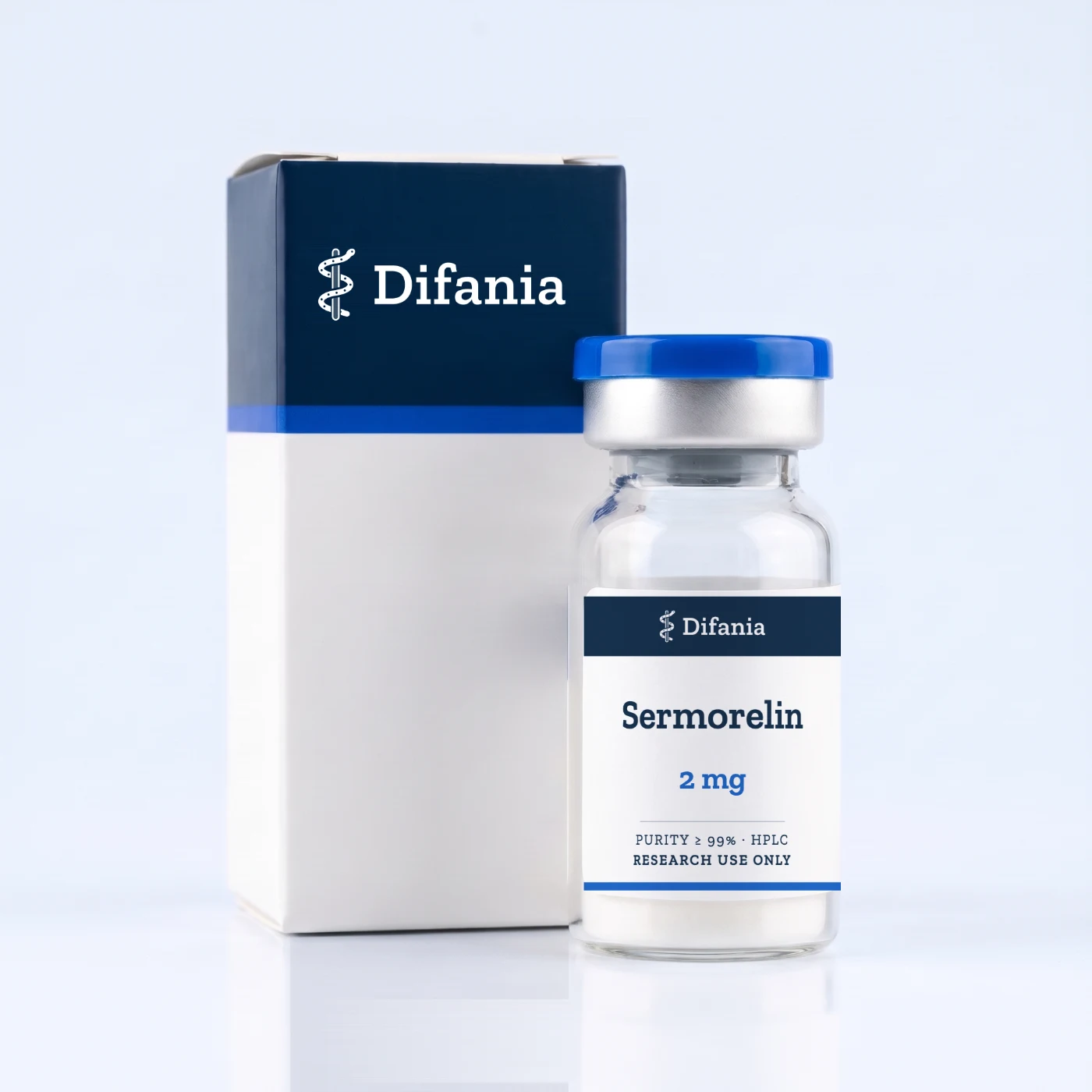
Sermorelin in the laboratory
Identification
Sermorelin is a synthetic peptide held in the GH axis group of the catalogue and supplied as a lyophilised solid. It is registered under CAS 86168-78-7. The molecular formula recorded for this material is C149H246N44O42S, with a molar mass of 3357.9. The single sulphur atom in that formula is worth noting at the bench, since a sulphur bearing residue is the part of a peptide most likely to oxidise if the solid is left exposed to air and light; keeping the vial sealed and cold is therefore not a formality. The catalogue offers the material in 2 mg, 5 mg and 10 mg fills, each released against the same specification.
Analytical control
Identity and purity are both established before a lot is released. Reversed phase HPLC provides the purity figure, which is assessed against the catalogue specification of at least 99 percent, with the main peak compared to related substances separated in the same chromatogram. Mass spectrometry provides identity confirmation, the measured mass being set against the 3357.9 recorded here and against the structure the CAS registration describes. Both results are entered into the lot documentation and remain retrievable afterwards.
Reconstitution and solubility
Bring the vial to room temperature first. Add the solvent slowly so that it runs down the inner wall and reaches the cake from below rather than striking it from above, then swirl gently until the solid has cleared. Shaking produces foam and is best avoided. Bacteriostatic water, sterile water and a dilute acetic acid solution are the solvents in normal use, with the acidified option kept for a cake that dissolves slowly in water.
| Vial | Solvent added | Resulting concentration |
|---|---|---|
| 2 mg | 2 mL | 1 mg/mL |
| 5 mg | 5 mL | 1 mg/mL |
| 10 mg | 5 mL | 2 mg/mL |
Examine the solution against a light background once it has cleared. It should be free of visible particles, and any film left on the glass simply calls for a further gentle swirl.
Storage and stability
A sealed vial of the solid is stored at minus 20 degrees Celsius, in the dark, until it is wanted. Reconstituted material is kept at 2 to 8 degrees Celsius and divided into portions, so that one aliquot can be taken without disturbing the rest. The habit of letting a vial equilibrate to room temperature before the stopper is pierced pays for itself: a cold cake collects condensation the moment the seal is broken, and that water is exactly what the lyophilisation step was there to remove.
Use in the laboratory
The material is intended for in vitro work and for use as a reference substance, for example as a characterised standard when a reversed phase separation is being developed or a mass spectrometry workflow is being verified. Sermorelin appears in published work concerning the growth hormone axis and the chemistry of growth hormone releasing factor analogues. Difania supplies the material and its analytical documentation, and does not advise on experimental design or on the interpretation of results.
Safety and handling
The contents are a laboratory chemical and the sensible precautions apply: gloves and eye protection whenever the vial is open or a solution is being moved, and a work surface that can be wiped down afterwards. Unused solution, rinsings and empty vials are disposed of under your institution’s rules and the local regulations that apply. This is not a medicinal product, a food, a supplement or a cosmetic. It is not for consumption and not for administration to humans or to animals.
Lot documentation
Each vial carries a lot number. Quoting it lets Difania retrieve the analytical documentation held for the filling that vial came from, which is the only reliable route back from a stored result to the material that produced it. Keep the number in your own log, written next to the date on which the vial was first opened.


