
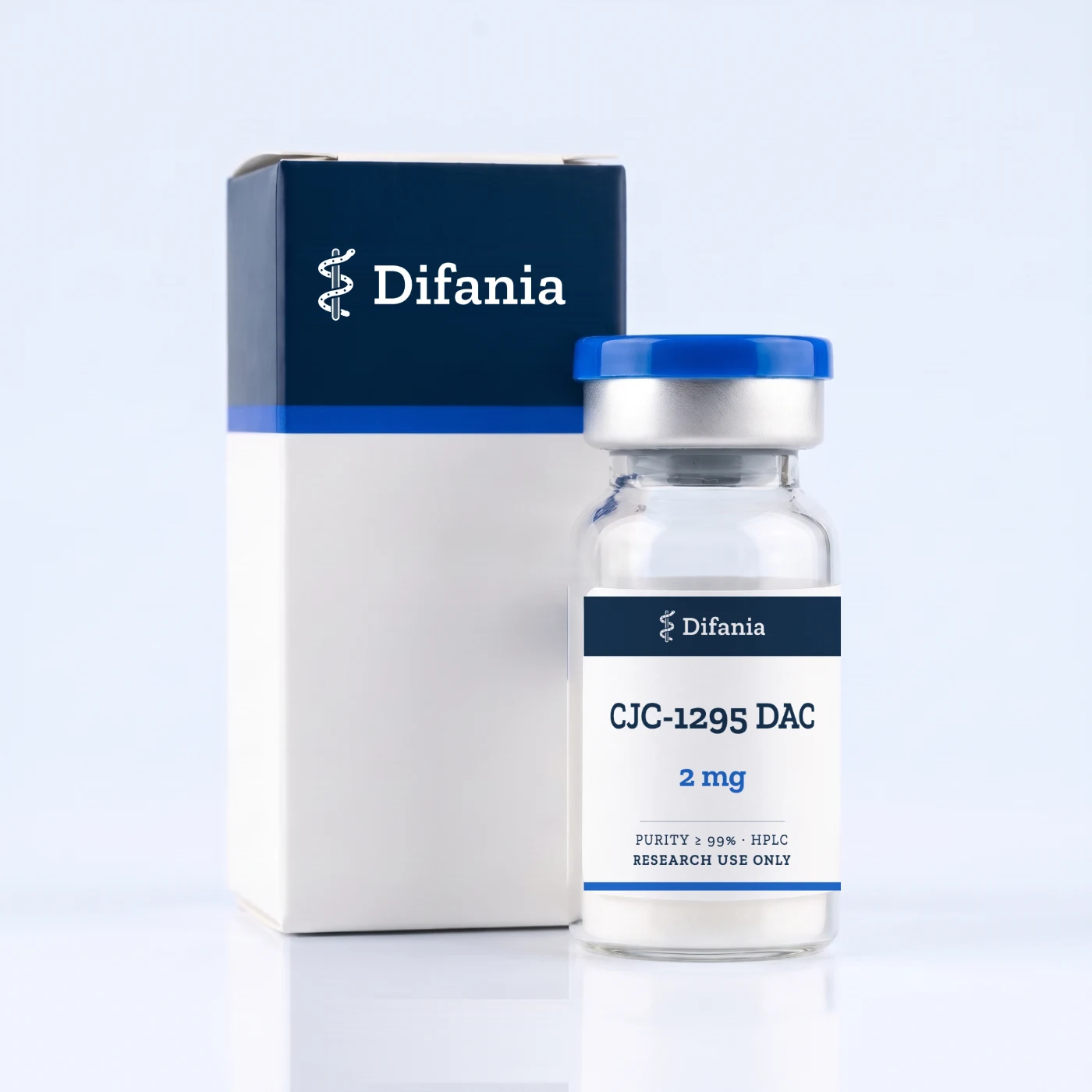
CJC-1295 DAC in the laboratory
Identification
CJC-1295 DAC is the drug affinity complex bearing form of CJC-1295, held in the catalogue under the GH axis group and supplied as a lyophilised solid. It is registered under CAS 863288-34-0. The molecular formula is C165H269N47O46 and the molar mass is 3647.2, both larger than the values held for the form without the complex, which is a separate catalogue entry. The formula contains no sulphur, so there is no free thiol and no disulphide to protect during weighing or reconstitution. Fill sizes are 2 mg, 5 mg and 10 mg of peptide per vial.
Analytical control
Each lot is characterised before release. Purity is established by reversed phase HPLC and judged against the catalogue specification of at least 99 percent, with the main peak compared against related substances resolved in the same run. Identity rests on mass spectrometry, where the measured mass is set against the 3647.2 recorded for this material and the CAS registered structure it corresponds to. Both results are written into the documentation kept for the lot and can be retrieved later against the lot number.
Reconstitution and solubility
Let the vial reach room temperature before the stopper is pierced. Introduce the solvent slowly, aiming the stream at the inner wall so it runs down onto the cake instead of striking it, then swirl rather than shake. Bacteriostatic water suits a vial that will be sampled repeatedly, sterile water a vial prepared for immediate use, and a dilute acetic acid solution a cake that is slow to clear in water alone.
| Vial | Solvent added | Resulting concentration |
|---|---|---|
| 2 mg | 2 mL | 1 mg/mL |
| 5 mg | 5 mL | 1 mg/mL |
| 10 mg | 5 mL | 2 mg/mL |
Hold the finished vial up to a light background and confirm the solution is clear. Material clinging to the shoulder of the vial usually means the solvent has not yet reached it, and a further gentle swirl resolves it.
Storage and stability
The sealed solid is kept at minus 20 degrees Celsius, protected from light, until the day it is needed. After reconstitution the solution is held at 2 to 8 degrees Celsius and divided into single use portions, which keeps the bulk from repeated warming and repeated puncture of the septum. Equilibrating a frozen vial to room temperature before opening is worth the wait, since condensation onto a cold cake adds the very water that lyophilisation removed.
Use in the laboratory
This reagent is supplied for in vitro work and as a reference material in analytical chemistry, for instance as a characterised standard when a reversed phase method is being developed or a mass spectrometer is being checked against a known peptide. It appears in the published literature of the growth hormone axis and of growth hormone releasing factor analogue chemistry. Difania provides the material and the analytical documentation that accompanies it, and does not advise on experimental design or on the interpretation of data generated with it.
Safety and handling
The contents are a laboratory chemical whose hazards are not fully characterised, so handle accordingly: gloves and eye protection while the vial is open, and transfers carried out over a surface that can be wiped down. Spent vials, rinsings and unused solution go to disposal under the rules of your institution and the local regulations in force. The material is not a medicinal product, not a food, not a supplement and not a cosmetic, and it is intended neither for consumption nor for administration to humans or animals.
Lot documentation
Every vial bears a lot number. That number is the key to the analytical documentation Difania holds for the filling it came from, so quote it in any enquiry about a specific vial. Note it in your own records beside the date the vial was first opened, since the two together let a result be traced back to the exact material that produced it.


