
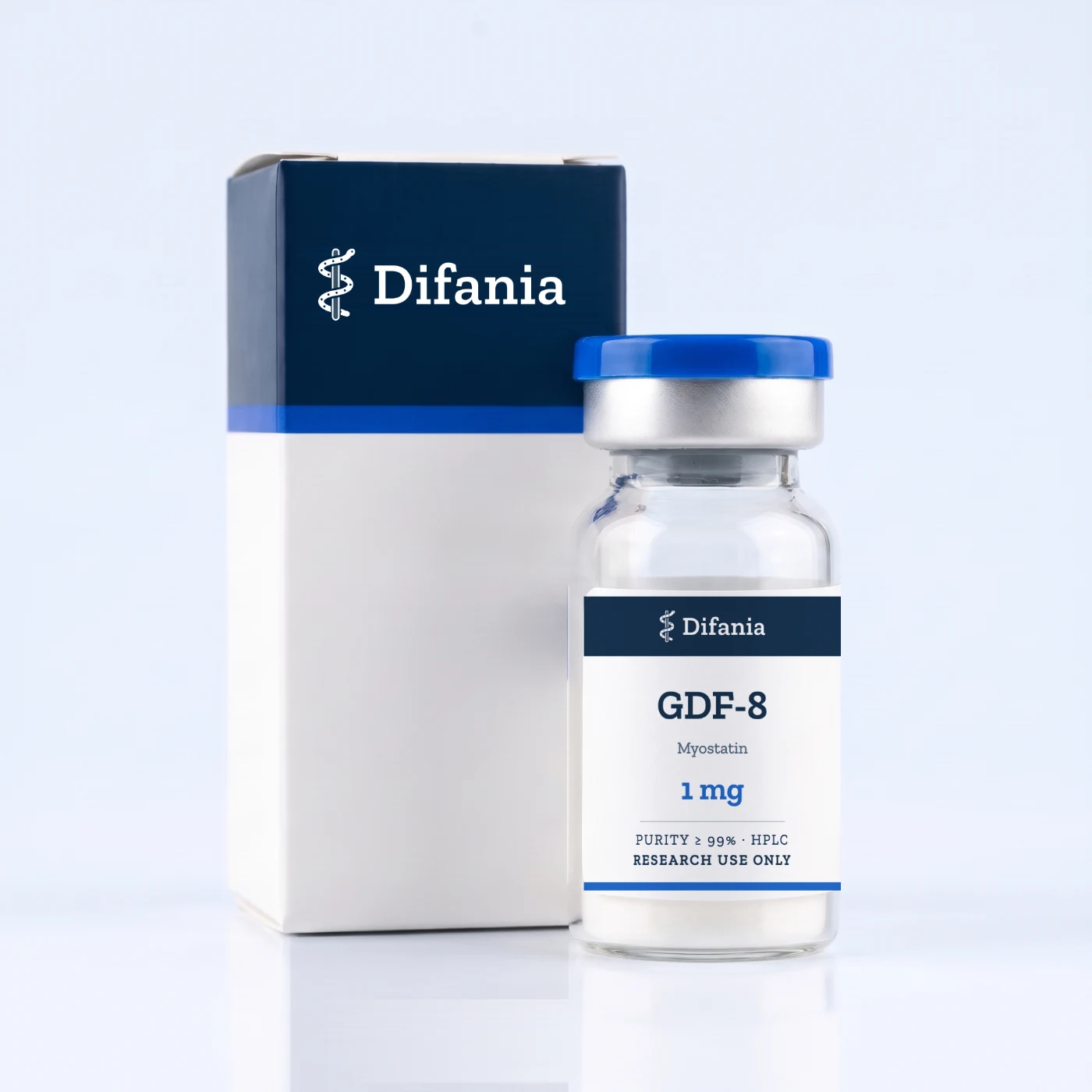
GDF-8 (Myostatin) in the laboratory
Identification
GDF-8 is growth differentiation factor 8, listed in this catalogue with its second and more widely used name, myostatin, printed alongside. One molecule, two names, both searchable. It belongs to the transforming growth factor beta superfamily, the large group of secreted signalling proteins whose members share a characteristic pattern of cysteine residues and a folded, disulphide stabilised architecture. That family membership is the structural fact that matters when the vial reaches the bench, because it says the material in the glass is a folded protein rather than a short synthetic chain.
What the catalogue records for this entry is short enough to state in full: the name, the GH axis grouping, the lyophilised form, a purity specification of 99 percent or higher and a single fill size of 1 mg per vial. No CAS number is held. No molecular formula, no molar mass and no sequence are entered. Nothing about a salt form or counter ion is recorded either. Where a method turns on any of those values, the analytical documentation written up for the lot is the document to request, and it supersedes anything that could be inferred from a product page.
One milligram of freeze dried protein is a very small amount of solid. Expect a thin, almost invisible film rather than a visible heap of powder, and expect the first vial of a new lot to look emptier than it is.
Analytical control
Two methods carry the release of this material. Reversed phase high performance liquid chromatography resolves the main peak from the aggregated and fragmented species that production and freeze drying can leave behind, and the integration of that peak against the whole chromatogram is what the specification of 99 percent or higher is applied to. Mass spectrometry provides the identity confirmation. Since no formula is catalogued against this entry, the measured mass is compared with the reference values recorded for the lot itself, which makes the lot certificate the operative document for any given vial.
Reconstitution and solubility
Let the glass warm to room temperature before it is opened. Add the solvent along the inner wall rather than straight down onto the cake, then leave the vial to stand for a minute and turn it slowly until the solution is clear. Vortexing is not appropriate for a folded protein of this class: swirling achieves the same end without driving material to the air interface.
| Vial | Solvent added | Resulting concentration |
|---|---|---|
| 1 mg | 1 mL | 1 mg/mL |
| 1 mg | 2 mL | 0.5 mg/mL |
| 1 mg | 4 mL | 0.25 mg/mL |
Storage and stability
Until the day of the experiment, the sealed vial stays at minus 20 degrees Celsius with light excluded; the dry solid is the stable form, so there is no benefit in dissolving it in advance. Bring it up to room temperature on the bench before the stopper is pierced, which keeps atmospheric moisture off cold powder. Dissolved material is held at 2 to 8 degrees Celsius and should be divided into single use portions the moment it is made, since for a protein of this kind the count of freeze and thaw cycles tells you more about remaining quality than the number of days elapsed does.
Use in the laboratory
This material is supplied for in vitro experiments and for use as a characterised reference substance in analytical and method development work. Proteins of the transforming growth factor beta superfamily appear across skeletal muscle biology and developmental signalling research, and the catalogue places this entry in its GH axis section. Difania furnishes the reagent and the analytical documentation that belongs to its lot. Experimental design, the selection of controls and conditions, and the reading of whatever results follow are matters for the laboratory running the work.
Safety and handling
Handle the vial as a laboratory chemical whose hazards have not been fully characterised. Gloves and eye protection go on before the vial is opened and stay on while solutions are prepared and moved; fine lyophilised solid is best handled where dust can be contained. Residues, rinsings and used consumables are disposed of according to your institution’s procedures and the waste regulations that apply locally. The contents are not a medicinal product, food, supplement or cosmetic, are not for consumption, and are not for administration to humans or animals.
Lot documentation
Each vial is labelled with the number of the lot it was filled from. That number is the reference Difania uses to find the analytical documentation held for the filling, so an enquiry quoting it is enough to have the paperwork retrieved. Write it into your own records next to the date the vial was opened, the solvent added and the concentration prepared, and the chain from a stored result back to the material behind it stays unbroken.


