
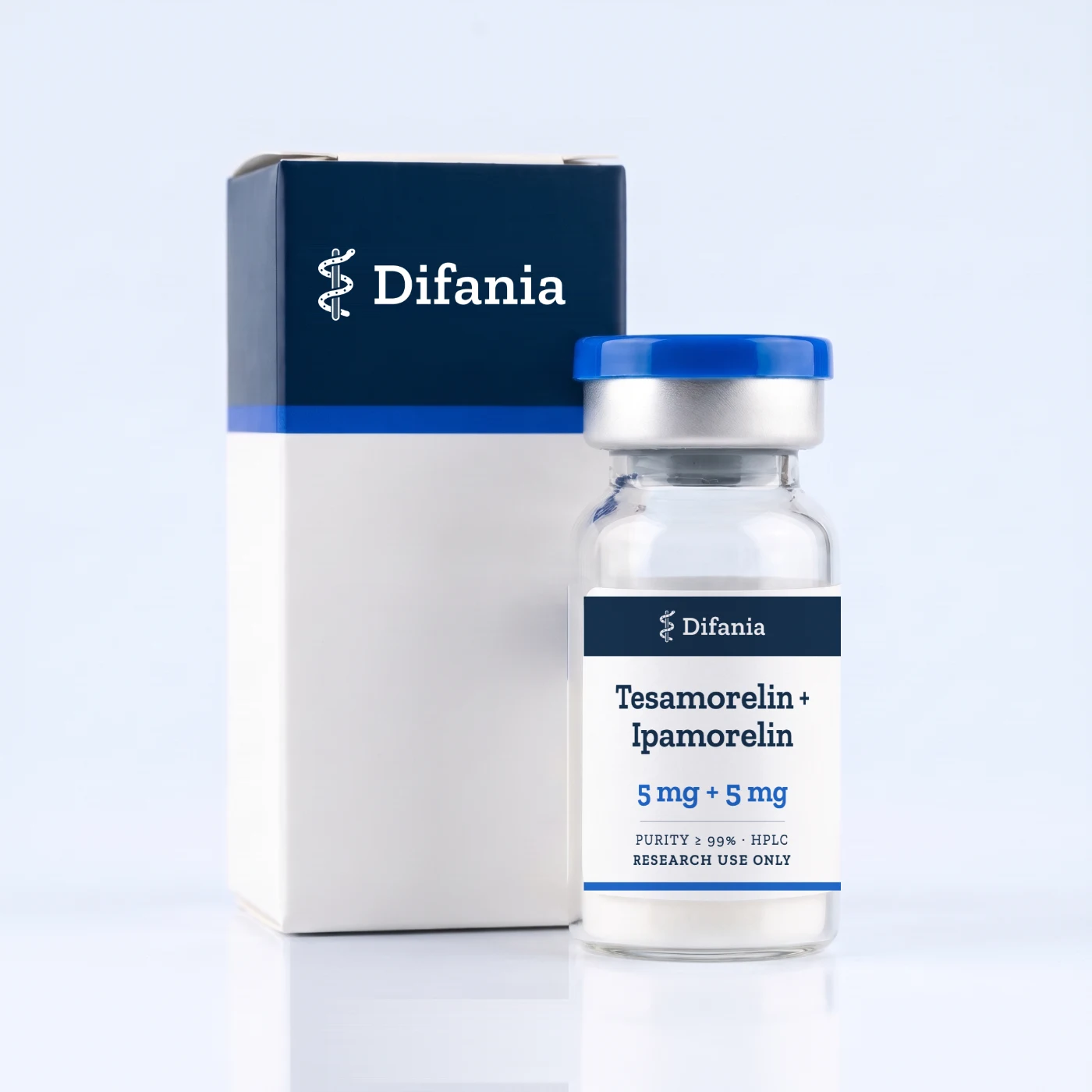
Tesamorelin + Ipamorelin in the laboratory
Composition
This entry is a two component vial from the GH axis group of the catalogue. Tesamorelin and Ipamorelin are lyophilised together, so one cake contains both peptides and the solid dissolves as a unit. The figures quoted in the size are per component and follow the order of the name: the first belongs to Tesamorelin, the second to Ipamorelin. That detail matters here more than on most blends, because the two fills are not in the same proportion. The 5 mg + 5 mg vial holds the components one to one, 10 mg of peptide in total. The 10 mg + 5 mg vial holds twice as much Tesamorelin as Ipamorelin, 15 mg in total. Choosing a size therefore settles the ratio as well as the quantity, and no handling step afterwards changes it, since diluting the vial moves both concentrations by the same factor. Both fills are released against the same purity specification of at least 99 percent. The catalogue holds no CAS number, molecular formula or molar mass against a blend, and none is quoted here, because those values describe single substances rather than mixtures.
Analytical control
Release testing covers both components rather than treating the vial as one substance. Purity is determined by reversed phase HPLC, which resolves the two peptides into separate peaks and allows each to be judged against the catalogue specification of at least 99 percent, measured against the related substances in its own region of the chromatogram. Identity is established by mass spectrometry, each component being confirmed against the mass expected for it. On an unequal fill the chromatogram is also the clearest evidence of the proportion in the vial. All of it is recorded in the documentation retained for the lot.
Reconstitution and solubility
Let the vial come up to room temperature first. Add the solvent slowly down the inner glass wall so the stream never lands on the cake, then roll the vial until the solid has gone. Swirl gently and leave shaking alone: anything stranded on the stopper is lost from both components at once. Bacteriostatic water, sterile water and a dilute acetic acid solution are the usual solvents. The concentrations below are per component.
| Vial | Solvent added | Tesamorelin | Ipamorelin |
|---|---|---|---|
| 5 mg + 5 mg | 5 mL | 1 mg/mL | 1 mg/mL |
| 5 mg + 5 mg | 2 mL | 2.5 mg/mL | 2.5 mg/mL |
| 10 mg + 5 mg | 5 mL | 2 mg/mL | 1 mg/mL |
| 10 mg + 5 mg | 10 mL | 1 mg/mL | 0.5 mg/mL |
Hold the vial up to a light background afterwards: a clear solution with no visible particles indicates that both components have dissolved.
Storage and stability
Before use the sealed blend stays dry at minus 20 degrees Celsius with light kept off it. Warm the vial to room temperature before the stopper is pierced, or moisture from room air settles on the cold cake. Reconstituted material is held at 2 to 8 degrees Celsius, and portioning it at once is particularly worthwhile on a blend: every return of the shared vial to the bench warms both peptides together, and neither can be replaced without replacing the vial.
Use in the laboratory
The vial is supplied for in vitro work and for use as a reference material, including where a method has to resolve two peptides in one sample and a characterised mixture is wanted to demonstrate that it does. The unequal fill is useful in that role, since a method that separates the components well should also report them in the proportion the vial was filled to. Both belong to classes that appear in published chemistry on the growth hormone axis, the field under which the catalogue groups this entry. Difania supplies the material and the analytical documentation belonging to its lot, and offers no guidance on experimental design or on how results should be read.
Safety and handling
The contents are a laboratory chemical and are handled as such. Gloves and eye protection go on before the vial is opened or solution is transferred, and a wipeable surface makes any spill easier to deal with. Unused solution, rinsings and empty vials are disposed of under your institution’s rules and local waste regulations. The blend is not a medicinal product, a food, a supplement or a cosmetic, and it is not for consumption or for administration to humans or animals.
Lot documentation
Every vial carries a lot number, and that number is how Difania locates the analytical documentation held for the filling, including the data for each of the two components. Quote it whenever you raise a question about a particular vial. Noting it beside the date the vial was opened keeps a stored result connected to the exact filling that produced it.


