
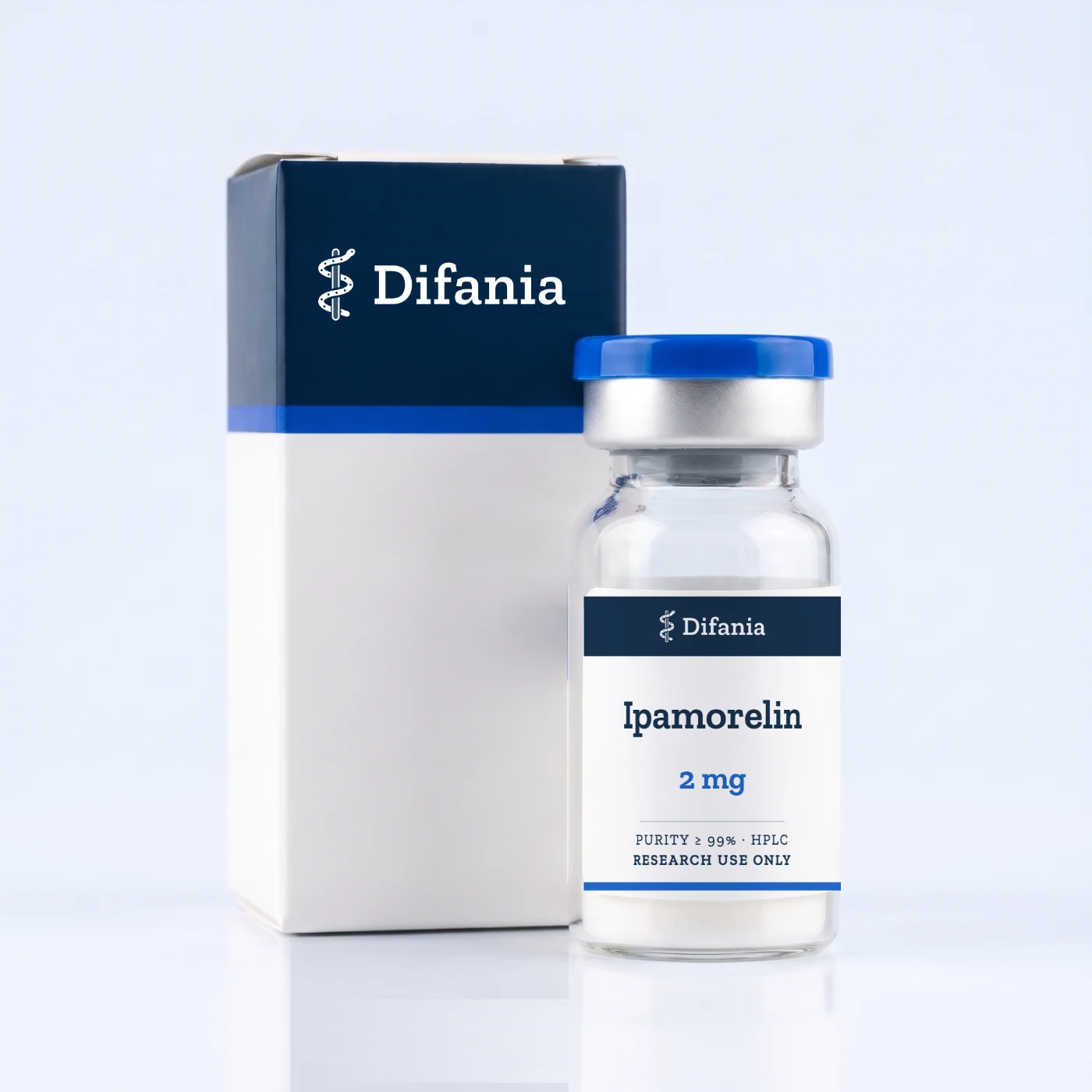
Ipamorelin in the laboratory
Identification
Ipamorelin is a small synthetic peptide held in the GH axis group of the catalogue and supplied as a lyophilised solid. The catalogue records the sequence Aib-His-D-2Nal-D-Phe-Lys-NH2, which is worth reading residue by residue, because almost every position departs from ordinary protein chemistry. Aib is alpha aminoisobutyric acid, a quaternary residue that constrains the backbone instead of leaving it free to rotate. D-2Nal is the D configured naphthylalanine, and D-Phe the D configured phenylalanine, so two of the five positions carry the mirror image stereochemistry rather than the natural one. The terminal NH2 marks a C terminal amide in place of a free acid. Only histidine and lysine are standard residues, and lysine is the source of the basic character of the molecule. The remaining catalogue values follow from that structure: CAS 170851-70-4, molecular formula C38H49N9O5 and a molar mass of 711.9, which is small enough to place the compound closer to a complex small molecule than to a long chain peptide. Three fills are listed, 2 mg, 5 mg and 10 mg. The entry also appears as a component of two catalogue blends, one with CJC-1295 in its form without the drug affinity complex and one with Tesamorelin.
Analytical control
Release rests on two measurements. Reversed phase HPLC resolves the main peak from the by products of synthesis and is the method against which the purity specification of 99 percent or higher is applied; with a peptide this short the separation is also sensitive to the diastereomeric impurities that can arise at the D configured positions. Mass spectrometry confirms identity by comparing the measured mass of the intact molecule with the value calculated from the catalogued formula. The figures that belong to your vial are those recorded for its own lot.
Reconstitution and solubility
Let the vial sit until it is at room temperature, then add solvent slowly against the inner wall of the glass. Rotate it gently until the cake has cleared and the solution is colourless and free of visible particles. Shaking is unnecessary and foams the liquid, which leaves material on the stopper.
| Vial | Solvent added | Resulting concentration |
|---|---|---|
| 2 mg | 1 mL | 2 mg/mL |
| 2 mg | 2 mL | 1 mg/mL |
| 5 mg | 1 mL | 5 mg/mL |
| 5 mg | 5 mL | 1 mg/mL |
| 10 mg | 2 mL | 5 mg/mL |
| 10 mg | 5 mL | 2 mg/mL |
Storage and stability
Unopened vials belong at minus 20 degrees Celsius, sealed and shielded from light, and the solid is best left there until the day it is needed. Once a solvent has been added, hold the solution at 2 to 8 degrees Celsius and divide it into portions immediately, each covering one session, so that a single stock is not warmed and chilled over and over. Bring any vial back to room temperature before opening it, whatever it contains.
Use in the laboratory
Ipamorelin is supplied for in vitro experiments and for use as a reference substance in analytical work, including chromatographic method development and the system suitability checks that a well characterised small peptide is convenient for. It appears in literature concerned with the growth hormone axis and with the chemistry of short synthetic peptide agonists. Difania supplies the material and the analytical documentation that belongs to it, and offers no advice on experimental design or on the interpretation of results.
Safety and handling
The vial contains a laboratory chemical and should be handled as one. Gloves and eye protection go on before the stopper is pierced, and a wipeable surface makes any spill straightforward to clear. Residues, rinsings and spent vials are disposed of under your institution’s rules and the local regulations that govern it. The material is not a medicinal product, a food, a supplement or a cosmetic, and it is not for consumption or for administration to humans or to animals.
Lot documentation
Each vial is marked with a lot number, and that number is how Difania locates the analytical documentation held for the filling it came from. Quote it whenever you ask about a specific vial and the paperwork can be sent to you. Record it in your own log beside the date the vial was opened and the solvent used, because that pair of entries is what links a result stored later to the material standing behind it.


