
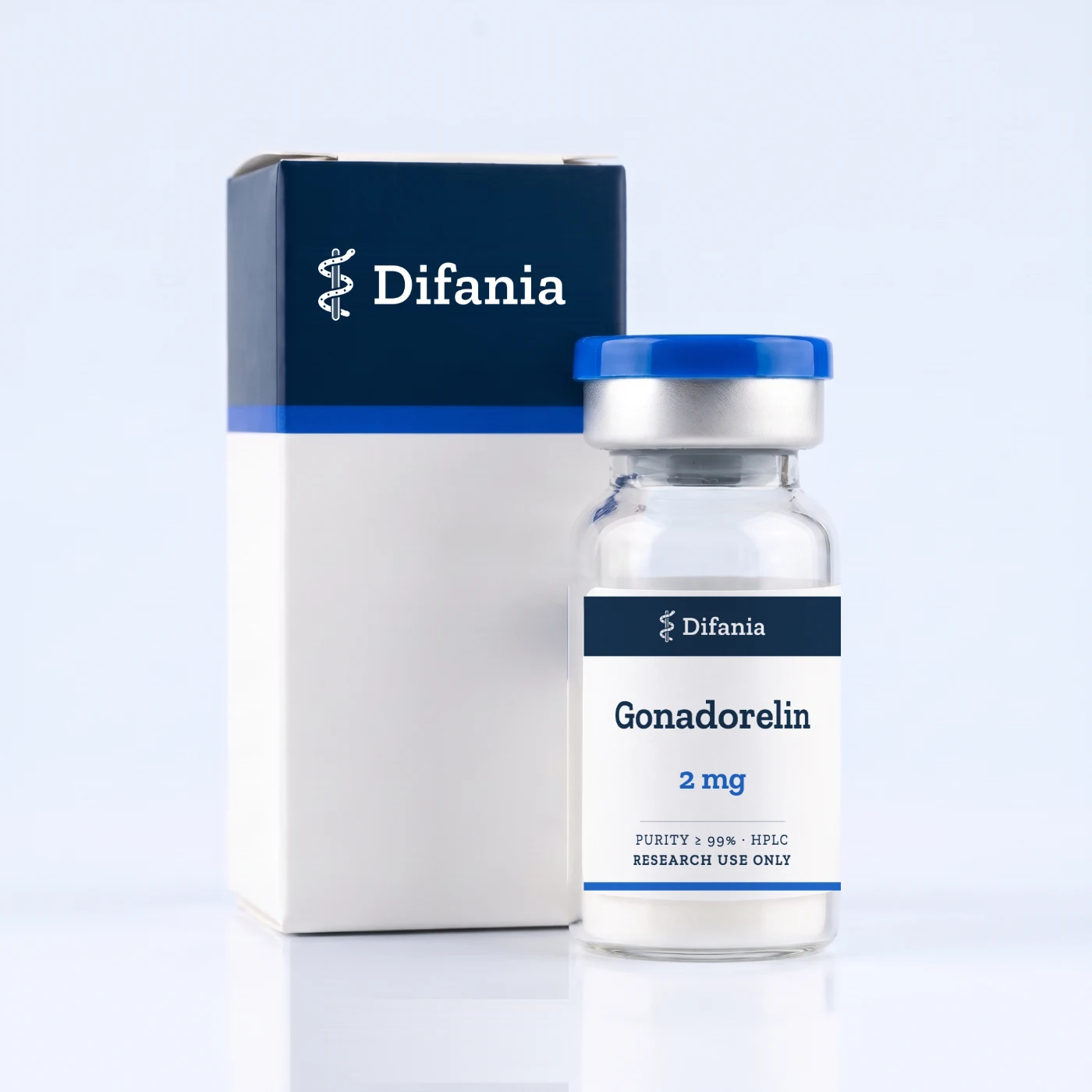
Gonadorelin in the laboratory
Identification
Gonadorelin is a synthetic peptide held in the GH axis section of the catalogue and supplied as a lyophilised solid. It is registered under CAS 33515-09-2, and the molecular formula recorded against that registration is C55H75N17O13, giving a molar mass of 1182.3. That figure makes it one of the smaller peptides in this part of the range, and the composition is worth a second look for a practical reason: there is no sulphur in the formula, so the oxidation of sulphur bearing residues, which is the first thing to worry about with many peptides left open to air, is not a concern here. The seventeen nitrogen atoms against fifty five carbons are what a short chain of amide linked residues looks like on paper. Two fills are catalogued, 2 mg and 5 mg, both released against a purity specification of at least 99 percent.
Analytical control
No lot is released until identity and purity have each been established. Reversed phase HPLC yields the purity result, the main peak being compared with the related substances separated in the same chromatogram and the outcome assessed against the catalogue specification of at least 99 percent. Mass spectrometry yields the identity confirmation, the measured mass being set against the 1182.3 recorded here and against the structure described by the CAS registration. Both findings belong to one filling and are stored under its lot number.
Reconstitution and solubility
Allow the vial to stand until it has reached room temperature. Add the solvent slowly, aiming it at the glass so that it travels down to the cake instead of landing on top of it, and swirl in unhurried turns until the liquid is clear. Shaking is counterproductive, since foam strands material on the upper wall. The solvents in routine use are bacteriostatic water, sterile water and a dilute acetic acid solution, the last of these held in reserve for a cake that is slow to clear in water by itself.
| Vial | Solvent added | Resulting concentration |
|---|---|---|
| 2 mg | 2 mL | 1 mg/mL |
| 5 mg | 2.5 mL | 2 mg/mL |
| 5 mg | 5 mL | 1 mg/mL |
Hold the finished solution up against a pale background and look through it. Nothing should be visible in suspension, and a faint film above the liquid line asks only for another gentle swirl.
Storage and stability
While sealed, the solid rests at minus 20 degrees Celsius, out of the light, and that is where it should stay until the day of use. After reconstitution the solution moves to 2 to 8 degrees Celsius, and portioning it at that stage is worth the extra minute, because every aliquot taken from one shared vial means the whole volume is warmed and the stopper pierced once more. Letting a vial equilibrate before opening is the other habit to keep: break the seal while the cake is still cold and condensation settles onto it at once, reversing the freeze drying that put it in this state.
Use in the laboratory
The material is supplied for in vitro work and for use as a reference substance, for example as a characterised standard while a reversed phase separation is being established or an identity method confirmed. Gonadorelin appears in laboratory literature on hypothalamic releasing factor peptides, and the catalogue files it in the GH axis group on that basis. Difania supplies the material along with its analytical documentation, and does not advise on experimental design or on how results are to be read.
Safety and handling
Treat the vial as the laboratory chemical it is. Gloves and eye protection go on before it is opened and remain on while any solution is being transferred, and the bench should be a surface that can be wiped down afterwards. Unused solution, rinsings and spent vials are disposed of under the rules of your institution and the local regulations in force there. Nothing here is a medicinal product, and nothing here is a food, a supplement or a cosmetic. The contents are not for consumption and not for administration to humans or to animals.
Lot documentation
A lot number appears on every label. It is what Difania works from in order to retrieve the analytical documentation held for the filling a given vial came from, and without it a result recorded months earlier cannot be tied back to its material with any confidence. Write the number into your own log, and record the date the vial was first opened beside it.


