
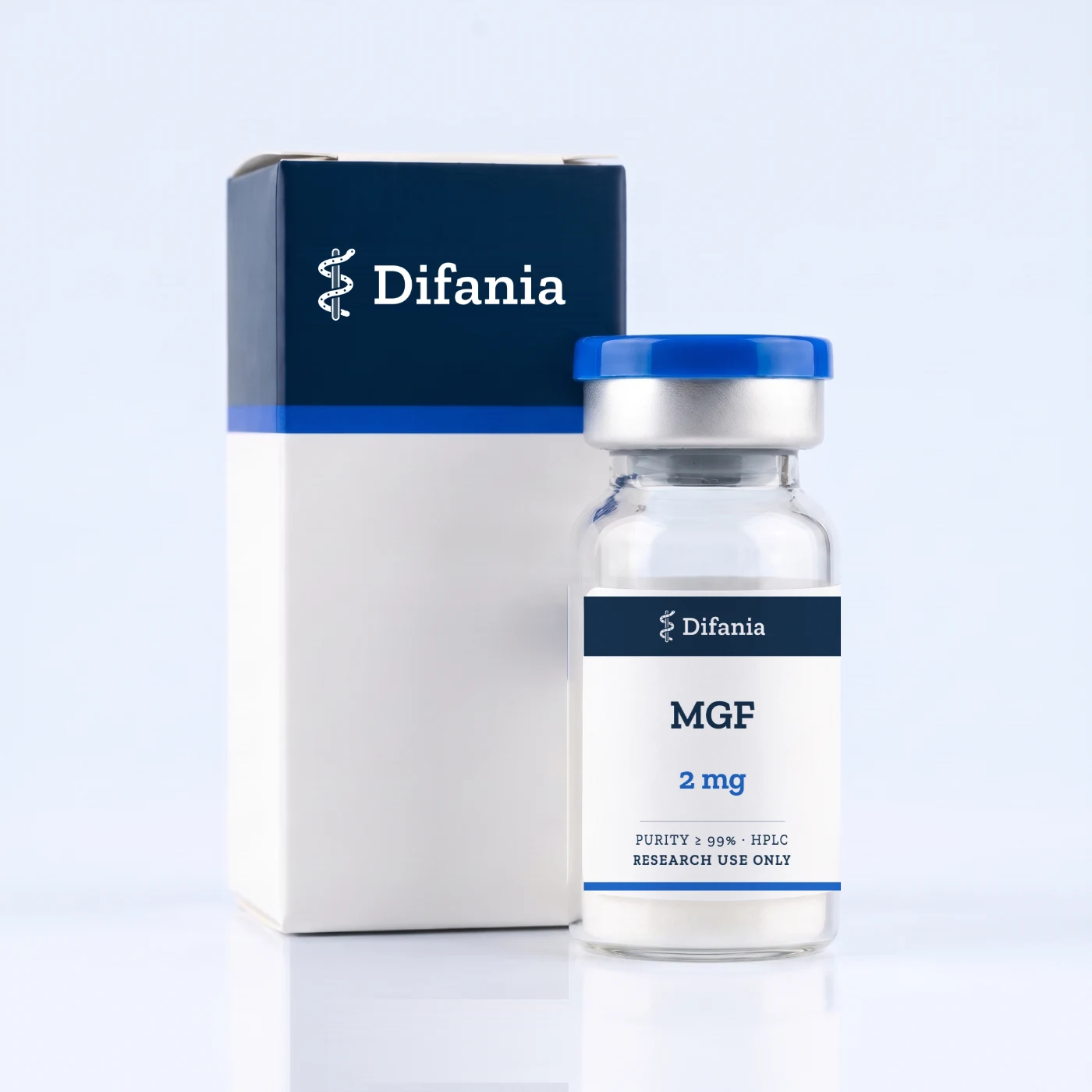
MGF in the laboratory
Identification
MGF is filed in the GH axis section of the catalogue and supplied as a lyophilised solid, which is to say a freeze dried cake from which the solvent has been drawn off under vacuum. A peptide is a chain of amino acid residues linked by amide bonds, and such a chain is a far steadier thing dry than it is in solution; that is the reason the material reaches you as a cake and not as a ready made stock. The catalogue holds one fill for this entry, 2 mg, released against a purity specification of at least 99 percent. A single fill size removes one decision from the order: all that remains is how much solvent the cake meets once it is on the bench.
Analytical control
A lot is released only after identity and purity have both been established. Reversed phase HPLC supplies the purity result, the main peak being measured against the related substances separated alongside it in the same chromatogram, and that result is read against the catalogue specification of at least 99 percent. Mass spectrometry supplies the identity confirmation. Both outcomes are written into the documentation held for the lot, which is what makes the figure attached to your vial retrievable long after the vial itself has gone.
Reconstitution and solubility
Let the vial stand until it has reached room temperature before anything else happens to it. Add the solvent slowly, directing it at the inner wall so that it reaches the cake from the side rather than striking it from above, then swirl until the solution has cleared. Shaking whips up foam and is worth avoiding. Bacteriostatic water, sterile water and a dilute acetic acid solution are the three solvents in ordinary use here, the acidified option reserved for a cake that lingers in water alone.
| Vial | Solvent added | Resulting concentration |
|---|---|---|
| 2 mg | 1 mL | 2 mg/mL |
| 2 mg | 2 mL | 1 mg/mL |
| 2 mg | 4 mL | 0.5 mg/mL |
Hold the cleared solution against a pale background and look through it. It should carry no visible particles, and a trace of film left high on the glass asks for nothing more than another gentle swirl.
Storage and stability
Until it is wanted, the sealed solid sits at minus 20 degrees Celsius with the light kept off it. Reconstituted material moves to 2 to 8 degrees Celsius and is best split into portions, so that one aliquot leaves the rest undisturbed. The habit of letting a vial equilibrate before the stopper is pierced repays itself quickly: break the seal on a cold cake and condensation forms on it at once, and that water is precisely what the lyophilisation step was there to take away.
Use in the laboratory
The material is intended for in vitro work and for service as a reference substance, for instance as a characterised standard while a reversed phase separation is being set up or a mass spectrometry workflow checked. MGF appears in laboratory literature concerning the growth hormone axis, which is the group the catalogue files it under. Difania supplies the material together with its analytical documentation and does not advise on experimental design or on how results should be read.
Safety and handling
Treat the contents as a laboratory chemical. Gloves and eye protection belong on whenever the vial is open or a solution is being moved, and the work surface should be one that can be wiped down afterwards. Residues, rinsings and spent vials go to disposal under your institution’s rules and whatever local regulations apply. This is not a medicinal product, a food, a supplement or a cosmetic. It is not for consumption and not for administration to humans or to animals.
Lot documentation
A lot number is printed on every vial. Quote it and Difania can retrieve the analytical documentation held for the filling that vial came from, which is the one dependable route from a stored result back to the material that produced it. Copy the number into your own log and write the date the vial was first opened beside it.


