
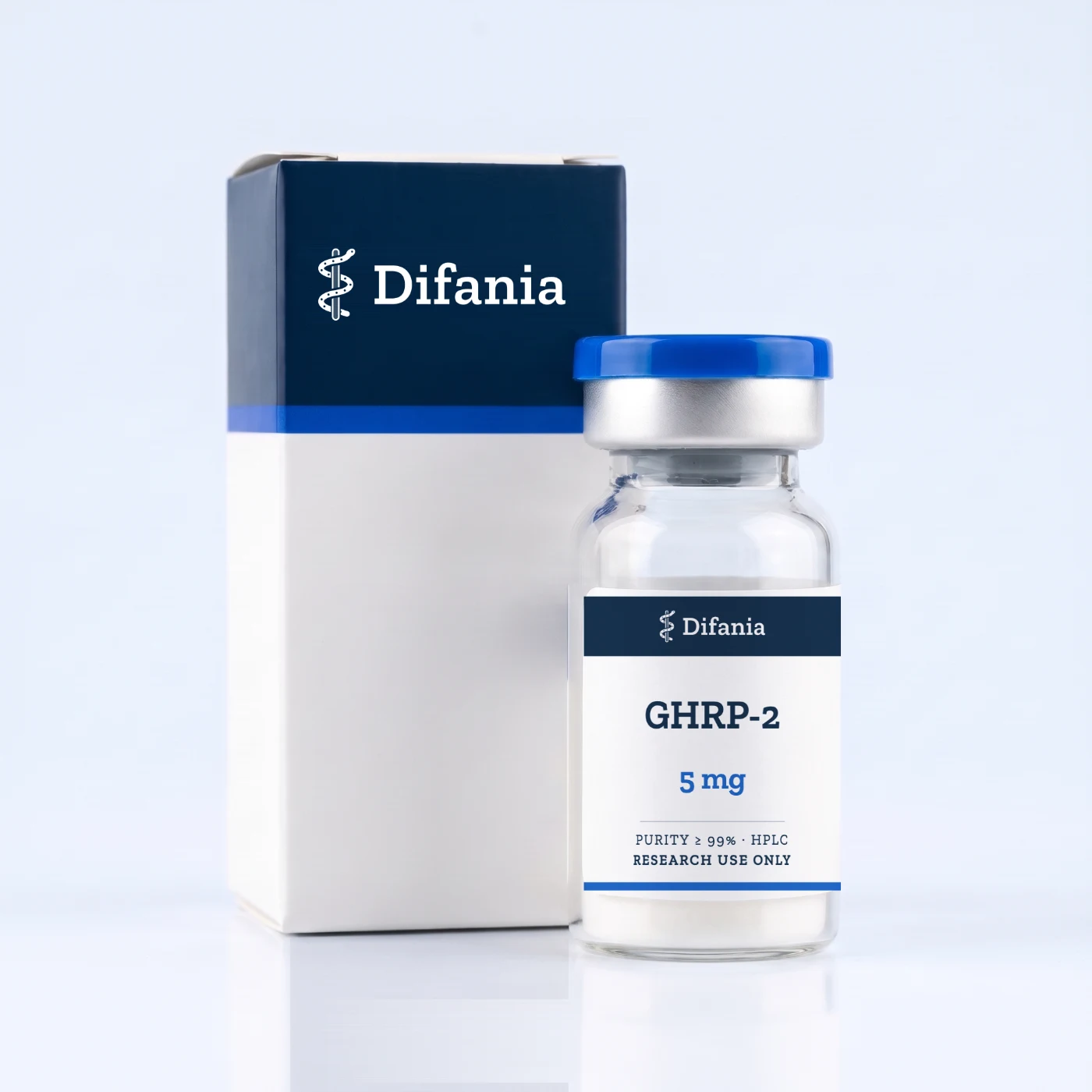
GHRP-2 in the laboratory
Identification
GHRP-2 is a synthetic peptide filed in the GH axis group of the catalogue and supplied as a lyophilised solid. The record carries the CAS registry number 158861-67-7, the molecular formula C45H55N9O6 and a molar mass of 817.9. Read off that formula, the molecule is assembled from 45 carbon, 55 hydrogen, 9 nitrogen and 6 oxygen atoms, with no sulphur in it, which rules out the disulphide chemistry that complicates the storage of cysteine containing peptides. Against the recorded mass, a 5 mg fill corresponds to roughly 6.1 micromoles, the figure to start from whenever a protocol is written in molar rather than mass terms. Three fills are catalogued, 5 mg, 10 mg and 15 mg, each released against one purity specification of at least 99 percent. No amino acid sequence is entered against this record, so none is reproduced here.
Analytical control
Two measurements stand behind a released lot. Reversed phase HPLC supplies the purity figure: a gradient draws related substances away from the main peak, the peaks are integrated, and the share taken by the main component is set against the catalogue specification of at least 99 percent. Mass spectrometry supplies identity, the measured value being read against the 817.9 recorded for the molecule. A peptide of this size is straightforward to interpret, producing a short charge series rather than the broad envelope a large chain gives. Both sets of data stay filed against the lot.
Reconstitution and solubility
Take the vial out of the cold and leave it until it has reached room temperature. Run the solvent down the inner wall of the glass so that it works under the cake instead of striking it from above, then roll the vial slowly until nothing solid remains. Swirl rather than shake, because foam carries peptide onto the stopper and the neck, where it is lost. Bacteriostatic water, sterile water and a dilute acetic acid solution are the solvents in ordinary use.
| Vial | Solvent added | Resulting concentration |
|---|---|---|
| 5 mg | 5 mL | 1 mg/mL |
| 5 mg | 2 mL | 2.5 mg/mL |
| 10 mg | 10 mL | 1 mg/mL |
| 10 mg | 5 mL | 2 mg/mL |
| 15 mg | 15 mL | 1 mg/mL |
| 15 mg | 5 mL | 3 mg/mL |
Hold the finished solution against a pale background and look through it. It should be clear and free of visible particles before anything is drawn off.
Storage and stability
Sealed and dry, the solid belongs at minus 20 degrees Celsius with the light kept off it, and nothing is gained by moving it before the day it is wanted. In solution the material is held at 2 to 8 degrees Celsius, divided into single session portions as soon as it has dissolved, so the whole stock is not warmed every time a small volume is needed. Letting a vial equilibrate on the bench before it is opened is not fussiness: room air meeting cold glass leaves moisture on the cake, and moisture is what lyophilisation was carried out to remove.
Use in the laboratory
The material is supplied for in vitro experiments and for use as a reference substance, for instance as a characterised standard while a reversed phase method is being set up. The abbreviation GHRP is conventionally expanded as growth hormone releasing peptide, and the compound appears under that heading in published chemistry on the growth hormone axis, the group the catalogue files it under. Difania supplies the reagent together with the analytical documentation belonging to its lot, and does not advise on experimental design or interpret results obtained with the material.
Safety and handling
Work with the contents as you would with any laboratory chemical. Gloves and eye protection go on before the vial is opened or solution is moved between containers. Residues, rinsings and spent labware leave by the waste route your institution specifies, under the regulations in force where you work. It is not a medicinal product, and not a food, a supplement or a cosmetic either, nor is any part of it intended for consumption or for administration to humans or to animals.
Lot documentation
A lot number is printed on every vial. Quote it and Difania can pull up the analytical documentation held for that filling. Copy it into your own notes beside the date the seal was broken, and a result written up months later can still be traced back to the material behind it.


