
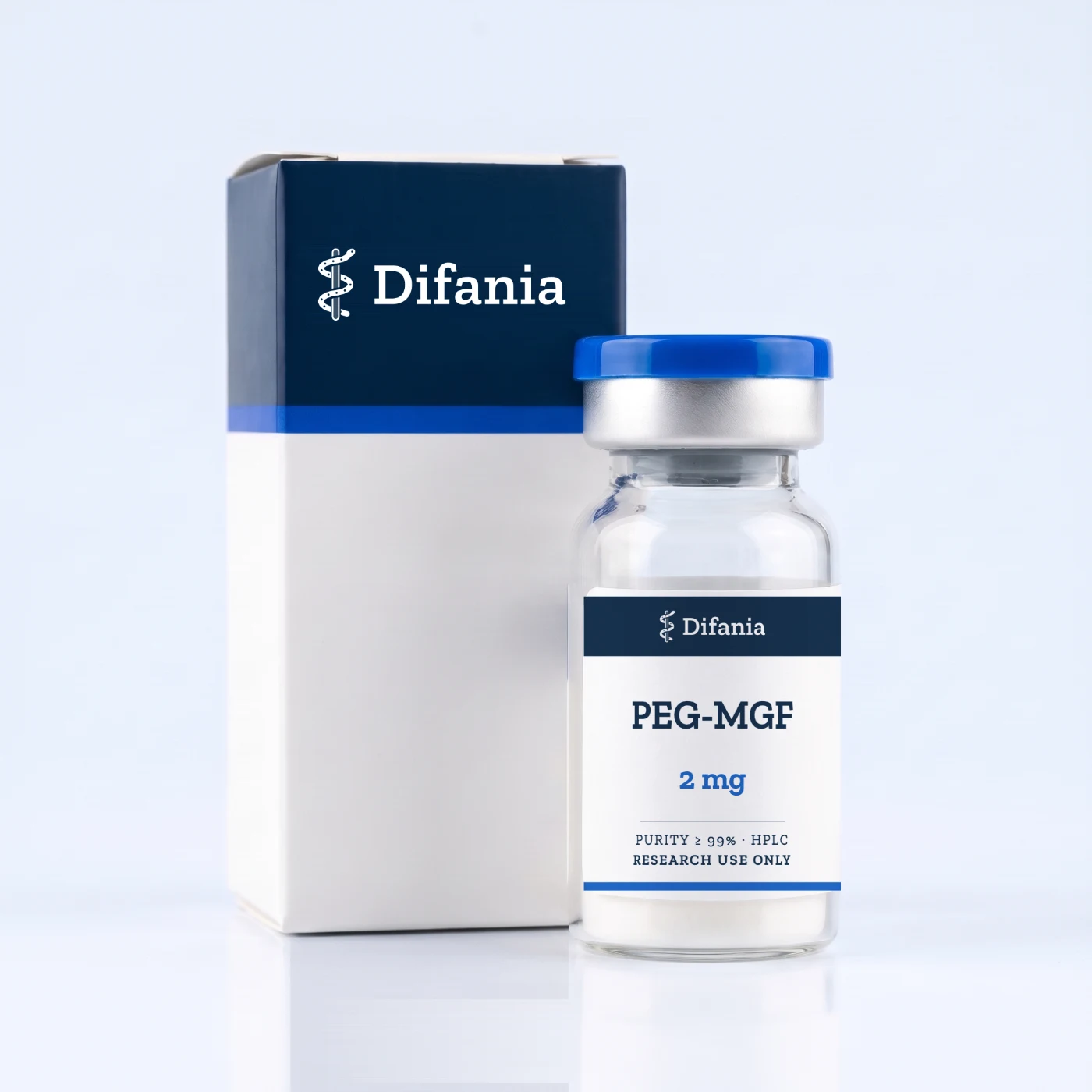
PEG-MGF in the laboratory
Identification
PEG-MGF sits in the GH axis group of the catalogue and is supplied as a lyophilised solid. The prefix on the name follows ordinary chemical shorthand: PEG stands for polyethylene glycol, and a PEGylated peptide is one to which one or more polyethylene glycol chains have been attached. That modification is why the catalogue carries this entry in its own right rather than as a variant of the MGF listing, and why the two should not be treated as interchangeable material on the bench. The fill offered here is 2 mg, a single size, released against a purity specification of at least 99 percent. As with any freeze dried peptide, the cake is the stable form and the solution is not, which is the whole reason the material travels dry.
Analytical control
Purity and identity are both settled before a lot leaves. The purity figure comes from reversed phase HPLC, where the main peak is compared with the related substances resolved beside it, and the result is judged against the catalogue specification of at least 99 percent. Identity is confirmed by mass spectrometry. Neither result is a generic statement about the product line: both belong to one filling, and both are stored under that filling’s lot number so they can be produced again on request.
Reconstitution and solubility
Begin by letting the vial come up to room temperature on the bench. Introduce the solvent gently, aimed at the glass wall so that it creeps down to the cake instead of landing on it, and then swirl, pausing between turns, until nothing solid remains. Resist the urge to shake. The usual solvents are bacteriostatic water, sterile water and a dilute acetic acid solution, the last of these kept back for a cake that dissolves reluctantly in water on its own.
| Vial | Solvent added | Resulting concentration |
|---|---|---|
| 2 mg | 1 mL | 2 mg/mL |
| 2 mg | 2 mL | 1 mg/mL |
| 2 mg | 4 mL | 0.5 mg/mL |
Inspect the finished solution in good light before it is used. Clear and particle free is what you are looking for; a faint ring of material on the upper glass simply needs another swirl to take it into solution.
Storage and stability
Sealed solid, minus 20 degrees Celsius, dark: that is the resting state, and the vial should stay in it until the day of use. Reconstituted solution goes to 2 to 8 degrees Celsius and is better kept as several small portions than as one large one, since each portion can then be taken without exposing the remainder to warmth and another puncture of the stopper. Warming the vial to room temperature before opening is not a nicety either. A cold cake meeting room air draws condensation straight onto itself, undoing in seconds what freeze drying was performed to achieve.
Use in the laboratory
This material is for in vitro work and for use as a reference substance, for example as a characterised standard when a chromatographic method is being established or an analytical workflow verified. PEG-MGF appears in laboratory literature on the growth hormone axis, the field under which the catalogue groups it, and in work on PEGylated peptides as a class. Difania supplies the material and the analytical documentation that belongs to it, and does not advise on experimental design or on the interpretation of findings.
Safety and handling
The contents are a laboratory chemical and want the precautions any laboratory chemical gets: gloves and eye protection while the vial is open or a solution is in transit between vessels, and a surface that can be cleaned down afterwards. Leftover solution, rinsings and empty vials are disposed of according to your institution’s rules and the local regulations in force. The material is not a medicinal product, not a food, not a supplement and not a cosmetic, and it is intended neither for consumption nor for administration to humans or animals.
Lot documentation
Every vial is labelled with a lot number. It is the key to the analytical documentation Difania holds for that filling, and quoting it is how a result recorded months ago can still be tied to the material that produced it. Write the number into your log at the moment the vial is first opened, with that date beside it.


