
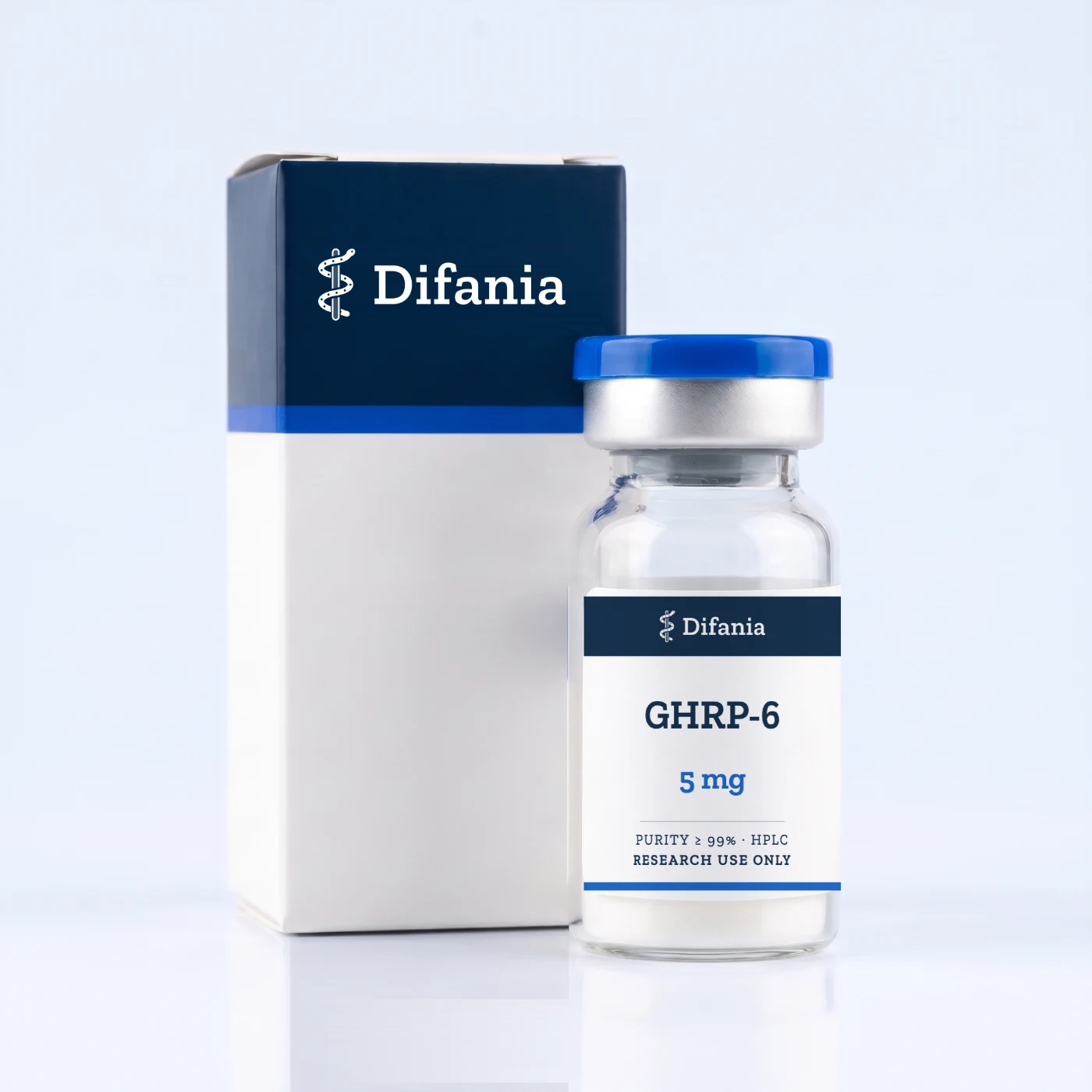
GHRP-6 in the laboratory
Identification
This entry covers GHRP-6, a synthetic peptide held in the GH axis group of the catalogue and supplied as a lyophilised solid. Three identifiers are recorded against it: the CAS registry number 87616-84-0, the molecular formula C46H56N12O6 and a molar mass of 873. The formula resolves into 46 carbon, 56 hydrogen, 12 nitrogen and 6 oxygen atoms, and no sulphur appears in it, so there is no disulphide chemistry to watch during storage. Taken against the recorded mass, a 5 mg fill works out at approximately 5.7 micromoles, the conversion to keep at hand when a method is specified molar rather than by weight. Two fills are listed, 5 mg and 10 mg, both released to the same purity specification of at least 99 percent. The catalogue holds no amino acid sequence for this record, and none is invented here.
Analytical control
Release rests on identity and purity being demonstrated separately. Purity comes from reversed phase HPLC: a gradient moves closely related substances away from the main component, every peak is integrated, and the proportion carried by the main peak is compared with the specification of at least 99 percent that the catalogue states. Identity comes from mass spectrometry, where the mass found is checked against the 873 recorded for the molecule. Both results are kept in the documentation retained for the lot, so a question raised about a vial long after it was opened can still be answered from the file.
Reconstitution and solubility
Let the vial stand on the bench until it is no longer cold to the touch. Add the solvent in a slow stream directed at the inner glass wall, so that it spreads beneath the cake rather than driving into it, then turn the vial over gently until the solid has gone. Resist the urge to shake it: peptide stranded on the stopper and in the neck never reaches the solution you are measuring.
| Vial | Solvent added | Resulting concentration |
|---|---|---|
| 5 mg | 5 mL | 1 mg/mL |
| 5 mg | 2 mL | 2.5 mg/mL |
| 10 mg | 10 mL | 1 mg/mL |
| 10 mg | 5 mL | 2 mg/mL |
| 10 mg | 2 mL | 5 mg/mL |
Inspect the result against a light background before use: a clear solution with nothing visible suspended in it is the sign to proceed.
Storage and stability
Dry solid, sealed vial, minus 20 degrees Celsius, light excluded. Those four conditions cover the material until the day it is needed. After reconstitution the solution is held at 2 to 8 degrees Celsius, and portioning it straight away is worth the few minutes it costs, because each return of the shared vial to room temperature warms the whole of your stock rather than the fraction you are about to use. Bringing a vial to room temperature before the stopper is pierced prevents condensation settling onto a cold cake.
Use in the laboratory
GHRP-6 is supplied for in vitro experiments and for use as a reference material, such as a characterised standard during method development on a reversed phase column. The name follows the convention by which GHRP is read as growth hormone releasing peptide, and the compound appears under that description in published chemistry concerning the growth hormone axis, the field under which the catalogue groups it. What Difania provides is the material itself and the analytical documentation attached to its lot. Experimental design, and the reading of any result, remain with the laboratory.
Safety and handling
The vial contains a laboratory chemical and is handled accordingly. Put on gloves and eye protection before the seal is broken or solution is transferred, and keep the work to a surface that can be cleaned down afterwards. Leftover solution, rinsings and used consumables are disposed of under your institution’s rules and the waste regulations that apply locally. Nothing in the vial is a medicinal product, a food, a supplement or a cosmetic, and the material is meant neither for consumption nor for administration to humans or animals.
Lot documentation
Each vial leaves marked with its lot number. That number is the key to the analytical documentation Difania holds for the filling, so quote it in any enquiry about a specific vial and the file can be located without guesswork. Writing it into your own records next to the date the vial was first opened keeps a stored result connected to the exact material that produced it.


