
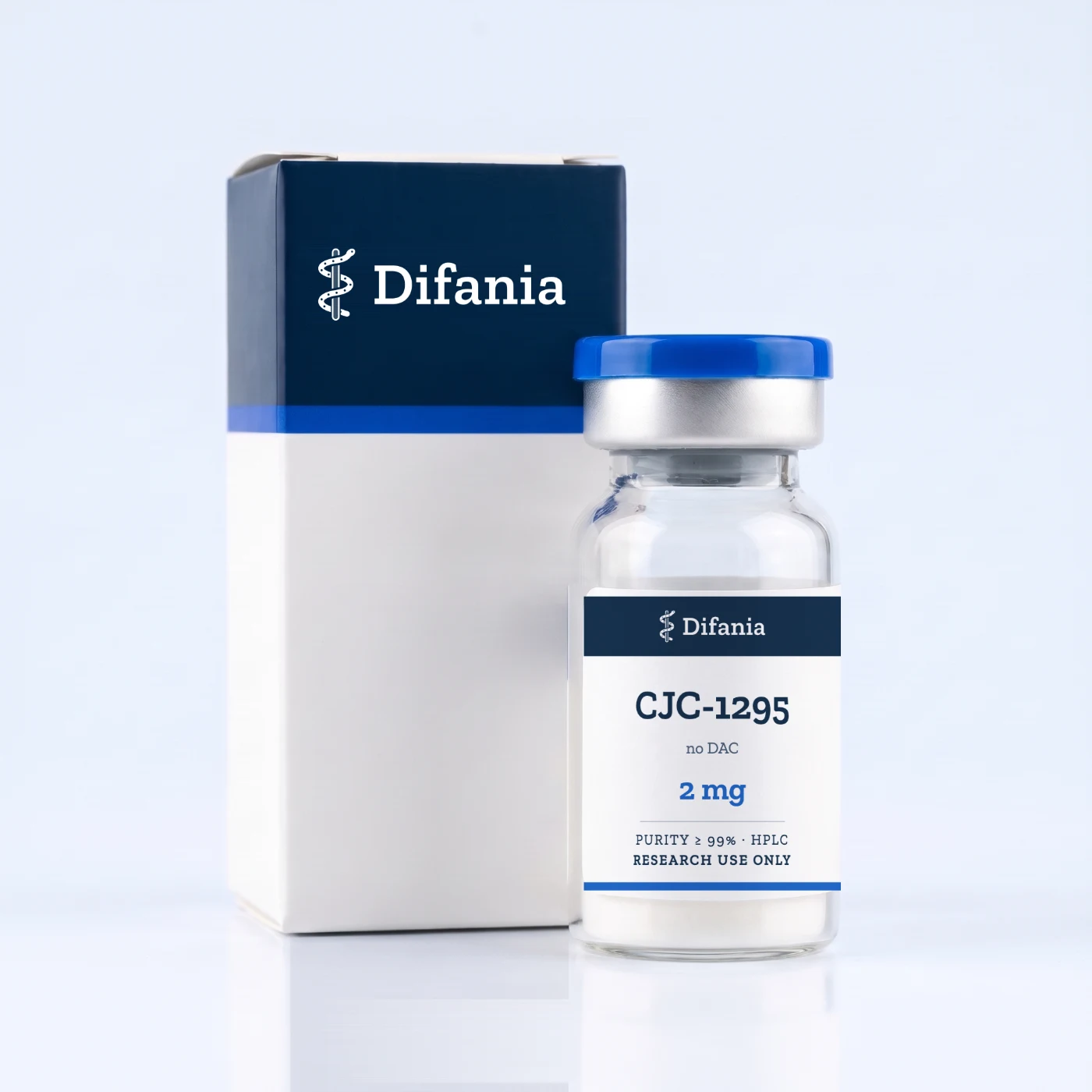
CJC-1295 (no DAC) in the laboratory
Identification
CJC-1295 (no DAC) is a synthetic peptide catalogued under the GH axis group and supplied as a lyophilised solid. The molecular formula held for this material is C152H252N44O42, with a molar mass of 3367.9. The formula contains no sulphur, so the solid carries neither a free thiol nor a disulphide bridge, and reconstitution needs no reducing agent and no inert atmosphere. The designation “no DAC” separates this entry from the drug affinity complex bearing analogue, which is catalogued separately and has its own formula and mass. The catalogue does not hold a CAS number for this entry, so none appears on the label or in the release paperwork. Vials are filled at 2 mg, 5 mg and 10 mg of peptide, and the same material is also offered in a combined vial with Ipamorelin.
Analytical control
Release testing is performed on the lyophilised solid. Purity is determined by reversed phase HPLC against the catalogue specification of at least 99 percent, with the main peak assessed against related substances in the same chromatogram. Identity is confirmed by mass spectrometry, the measured mass being compared with the 3367.9 held for this material. A lot is released only once both results are in hand, and both are recorded in the documentation retained for that lot.
Reconstitution and solubility
Bring the vial to room temperature, then add the solvent slowly against the inner wall so that the stream does not strike the cake directly. Swirl gently and let the solid dissolve on its own rather than shaking, since agitation drives foaming at the air to liquid interface. Bacteriostatic water, sterile water and a dilute acetic acid solution are the solvents normally used, the last of these where part of the cake dissolves slowly in water alone.
| Vial | Solvent added | Resulting concentration |
|---|---|---|
| 2 mg | 2 mL | 1 mg/mL |
| 5 mg | 5 mL | 1 mg/mL |
| 10 mg | 5 mL | 2 mg/mL |
Inspect the finished solution against a light background. It should be clear and free of visible particles, and any residue on the glass points to incomplete dissolution rather than to a fault in the fill.
Storage and stability
Unopened, the solid belongs at minus 20 degrees Celsius in the dark, with the stopper seal intact. Once the vial has been reconstituted, keep the solution at 2 to 8 degrees Celsius and split it into working portions so that the bulk is not repeatedly warmed and cooled. Always allow a frozen vial to equilibrate to room temperature before the seal is broken, because condensation onto a cold cake introduces water that the lyophilisation step was designed to remove.
Use in the laboratory
The material is intended for in vitro work and for use as a reference substance in analytical method development, including HPLC system suitability checks and mass spectrometry calibration against a characterised peptide. It appears in literature concerned with the growth hormone axis and with the chemistry of growth hormone releasing factor analogues. Difania supplies the material together with its analytical documentation and does not advise on experimental design, protocol selection or the interpretation of results.
Safety and handling
Treat the contents as a laboratory chemical of incompletely characterised hazard. Gloves and eye protection are appropriate whenever the vial is open or a solution is being transferred, and work is best carried out on a wipeable surface. Residues, rinsings and spent vials are disposed of under the rules of your institution and the local regulations that apply to it. This reagent is not a medicinal product, a food, a supplement or a cosmetic. It is not for consumption and not for administration to humans or to animals.
Lot documentation
A lot number is printed on every vial that leaves the catalogue. Quote that number in any enquiry and Difania can retrieve the analytical documentation held for the lot in question. Record the number in your own log next to the date the vial was opened, since the pair of entries is what links a later result back to a specific filling.


