
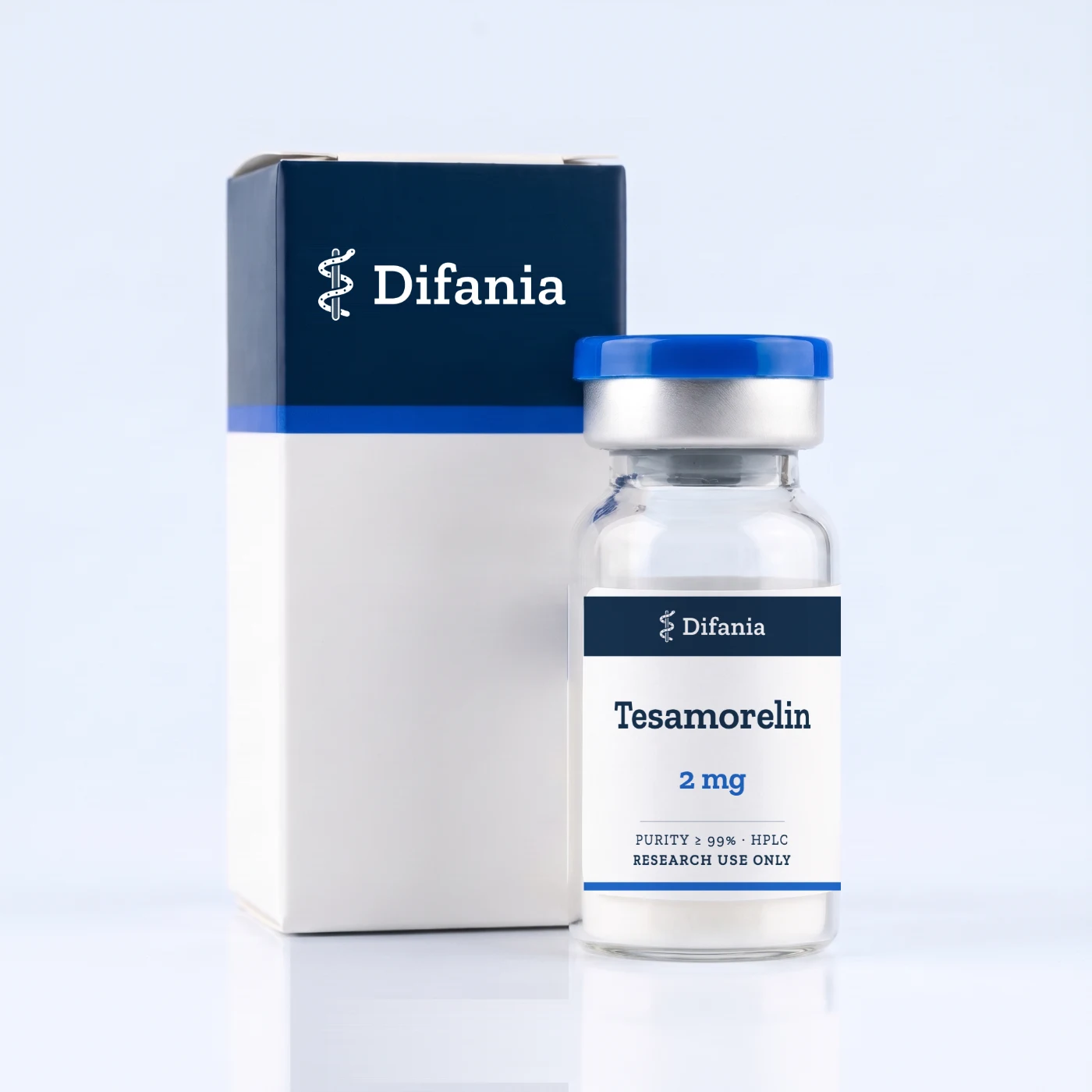
Tesamorelin in the laboratory
Identification
Tesamorelin is a synthetic peptide held in the GH axis group of the catalogue and supplied as a lyophilised solid. It carries the CAS registry number 218949-48-5. The molecular formula recorded against this material is C221H366N72O67S and the molar mass entered beside it is 5135.9, which makes it a decidedly larger molecule than the short chain reagents it sits next to; a vial of a given weight therefore holds proportionally fewer moles, which matters once a stock is expressed in molar rather than mass terms. The formula carries a single sulphur atom. Four fills are offered, 2 mg, 5 mg, 10 mg and 20 mg, all released against one purity specification of at least 99 percent. The catalogue also lists the peptide as a component of a two part vial with Ipamorelin, a separate entry rather than a variant of this one. No sequence is recorded here, so none is reproduced.
Analytical control
A lot is released on two pieces of evidence. Reversed phase HPLC gives the purity figure: the main peak is integrated against the related substances the gradient pulls away from it, and the result is set against the catalogue specification of at least 99 percent. Mass spectrometry gives identity, the measured value being compared with the 5135.9 recorded for the molecule. At this size the instrument works from a charge envelope rather than one ion, so the figure quoted in the paperwork is a reconstructed mass. Both results are filed with the lot and stay retrievable afterwards.
Reconstitution and solubility
Take the vial out of the cold and leave it alone until it is at room temperature. Introduce the solvent slowly, letting it run down the inner wall so that it creeps under the cake rather than landing on top of it, then turn the vial on its side until the solid has gone. Swirling is enough; shaking raises foam, and foam strands peptide on the stopper and the neck. Bacteriostatic water, sterile water and a dilute acetic acid solution are the solvents in normal use.
| Vial | Solvent added | Resulting concentration |
|---|---|---|
| 2 mg | 2 mL | 1 mg/mL |
| 5 mg | 5 mL | 1 mg/mL |
| 10 mg | 5 mL | 2 mg/mL |
| 20 mg | 10 mL | 2 mg/mL |
| 20 mg | 5 mL | 4 mg/mL |
Hold the finished solution up against a light background. It should be clear and free of visible particles before any of it is drawn off.
Storage and stability
The sealed solid belongs at minus 20 degrees Celsius, shielded from light, and there is nothing to gain by moving it before the day it is needed. Solution, once made, is held at 2 to 8 degrees Celsius and is best divided straight away into portions sized for a single session, sparing the bulk of the stock the repeated warming a shared vial collects. Equilibrating a vial to room temperature before the seal is broken is not a nicety: a cold cake meeting room air draws in the moisture that lyophilisation was performed to remove.
Use in the laboratory
The material is supplied for in vitro experiments and for use as a reference substance, for instance as a characterised standard while a reversed phase method is being developed or a mass spectrometry workflow checked for system suitability. Tesamorelin appears in published work on the growth hormone axis and on the chemistry of growth hormone releasing factor analogues. Difania provides the reagent together with the analytical documentation belonging to its lot, and offers no advice on experimental design or on how results obtained with it should be read.
Safety and handling
Treat the contents as a laboratory chemical. Gloves and eye protection go on before the vial is opened or solution is transferred, and the work is easier on a surface that can be wiped down afterwards. Unused solution, rinsings and spent labware are disposed of under the rules of your institution and the waste regulations in force locally. The material is not a medicinal product, not a food, not a supplement and not a cosmetic; it is not for consumption, and it is not for administration to humans or to animals.
Lot documentation
Every vial leaves marked with a lot number, and that number is the thread back to the analytical documentation Difania keeps for the filling. Quote it in any enquiry about a particular vial and the paperwork can be sent over. Copy it into your own record next to the date the vial was first opened, so a result stored months later can still be tied to the material behind it.


