
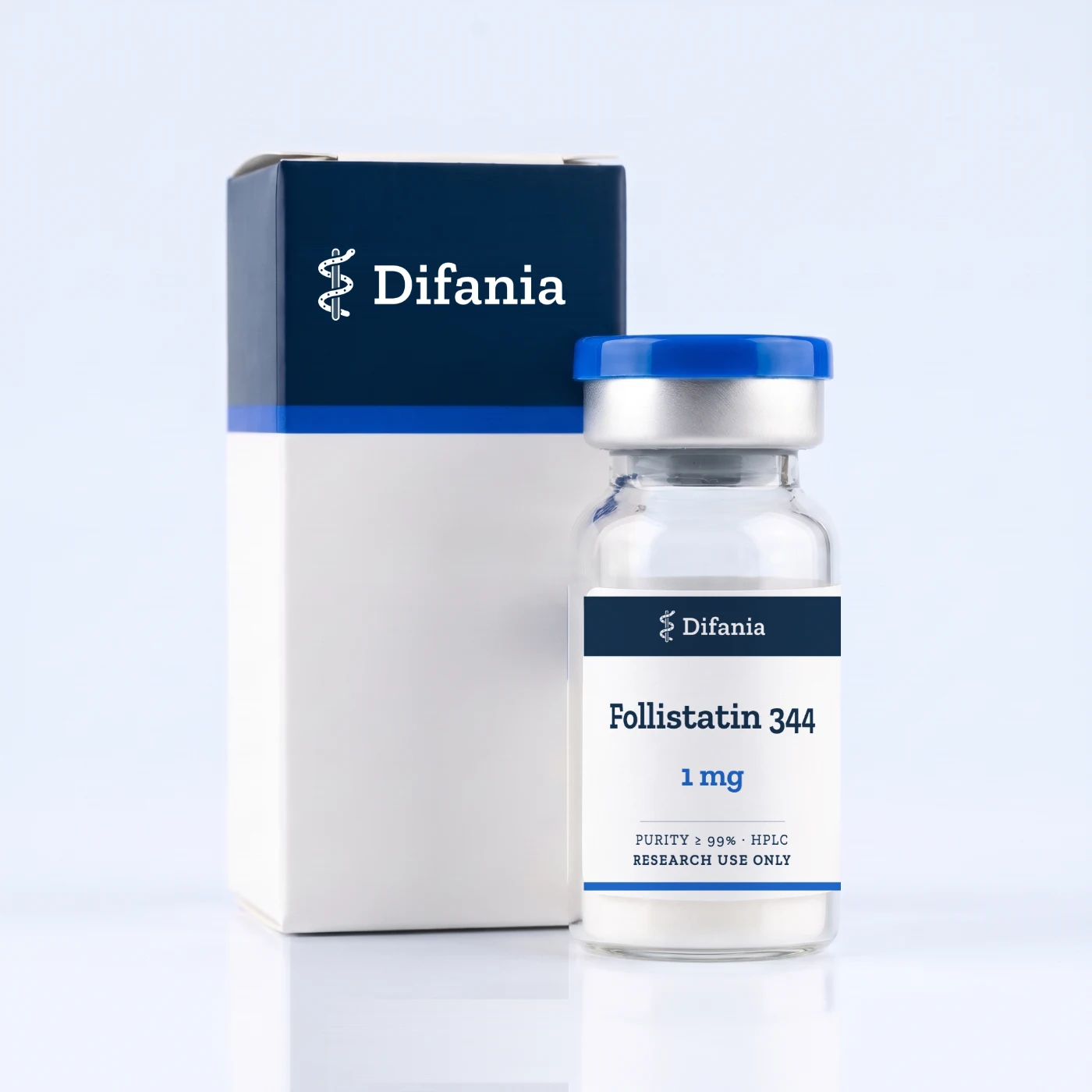
Follistatin 344 in the laboratory
Identification
Follistatin 344 is one of the named isoforms of follistatin, the secreted protein that binds members of the activin branch of the transforming growth factor beta superfamily. The numeral in the name is the isoform designation: follistatin exists in more than one form, and the number is the conventional way of distinguishing between them in both catalogues and literature. Structurally the molecule belongs to the family of cysteine rich, disulphide stabilised binding proteins, which is the detail that governs how it should be treated once it is out of the freezer.
The catalogue record for this entry is a short one. It holds the name, the GH axis grouping, the lyophilised form, a purity specification of 99 percent or higher and a single fill size, 1 mg per vial. It does not hold a CAS number. It does not hold a molecular formula, a molar mass or a sequence, and no salt form or counter ion figure is entered. Anything beyond the specification belongs to the analytical documentation prepared for the individual lot, which is available on request and remains the authoritative description of a particular vial.
A 1 mg fill of freeze dried protein makes very little solid. The cake is typically a thin film across the base of the glass rather than a visible quantity of powder, and a vial that looks empty on first inspection almost always is not.
Analytical control
Release rests on two complementary techniques. Reversed phase high performance liquid chromatography separates the main species from aggregates and fragments, and the area of that peak measured against the full chromatogram is what the 99 percent or higher specification governs. Mass spectrometry establishes identity. With no formula held in the catalogue for this item, the measured values are read against the reference data compiled for the lot, so the lot paperwork is where an analyst should go for the numbers that describe their own material.
Reconstitution and solubility
Allow the vial to reach room temperature on the bench first. Direct the solvent at the inner wall of the glass so it spreads across the cake rather than striking it, then let the vial rest briefly and rotate it slowly until the liquid is clear. Shaking and vortexing have no place here.
| Vial | Solvent added | Resulting concentration |
|---|---|---|
| 1 mg | 1 mL | 1 mg/mL |
| 1 mg | 2 mL | 0.5 mg/mL |
| 1 mg | 4 mL | 0.25 mg/mL |
Storage and stability
The dry solid is the stable form of this material, so leave it sealed at minus 20 degrees Celsius, out of the light, and reconstitute only when the experiment is ready to proceed. A vial taken straight from the freezer should stand until it is at room temperature before the stopper is pierced, which prevents atmospheric moisture condensing onto cold powder. Solution goes to 2 to 8 degrees Celsius and is best portioned out while it is being made, because with a folded protein it is the repetition of freezing and thawing, not elapsed time alone, that does the damage. Label every portion with the date it was prepared.
Use in the laboratory
Difania supplies this material for in vitro experiments and for use as a reference substance, for example as a characterised comparator in method development or a system suitability check. Binding proteins of this family appear in research on activin signalling and in muscle and reproductive biology, and the catalogue lists the entry under GH axis. The reagent and the analytical documentation belonging to its lot are what Difania provides; decisions on experimental design, on controls and conditions, and on how results are interpreted stay with the laboratory carrying out the work.
Safety and handling
Regard the contents as a laboratory chemical with an incompletely characterised hazard profile. Gloves and eye protection are worn from the moment the vial is opened through to the end of solution handling, and the dry solid is best manipulated where airborne dust is controlled. Waste, including rinsings and spent glassware, is dealt with under your institution’s rules and the regulations in force locally. The material is not a medicinal product, a food, a supplement or a cosmetic. It is not for consumption, nor for administration to humans or animals.
Lot documentation
The label of every vial carries a lot number, and that number is what lets Difania locate the analytical documentation held for the filling it came from. Quote it in any enquiry and the paperwork can be sent. The useful habit at your end is to copy it into the notebook next to the date of opening, the solvent used and the concentration prepared, so that a result examined much later can still be connected to the exact material that produced it.


