
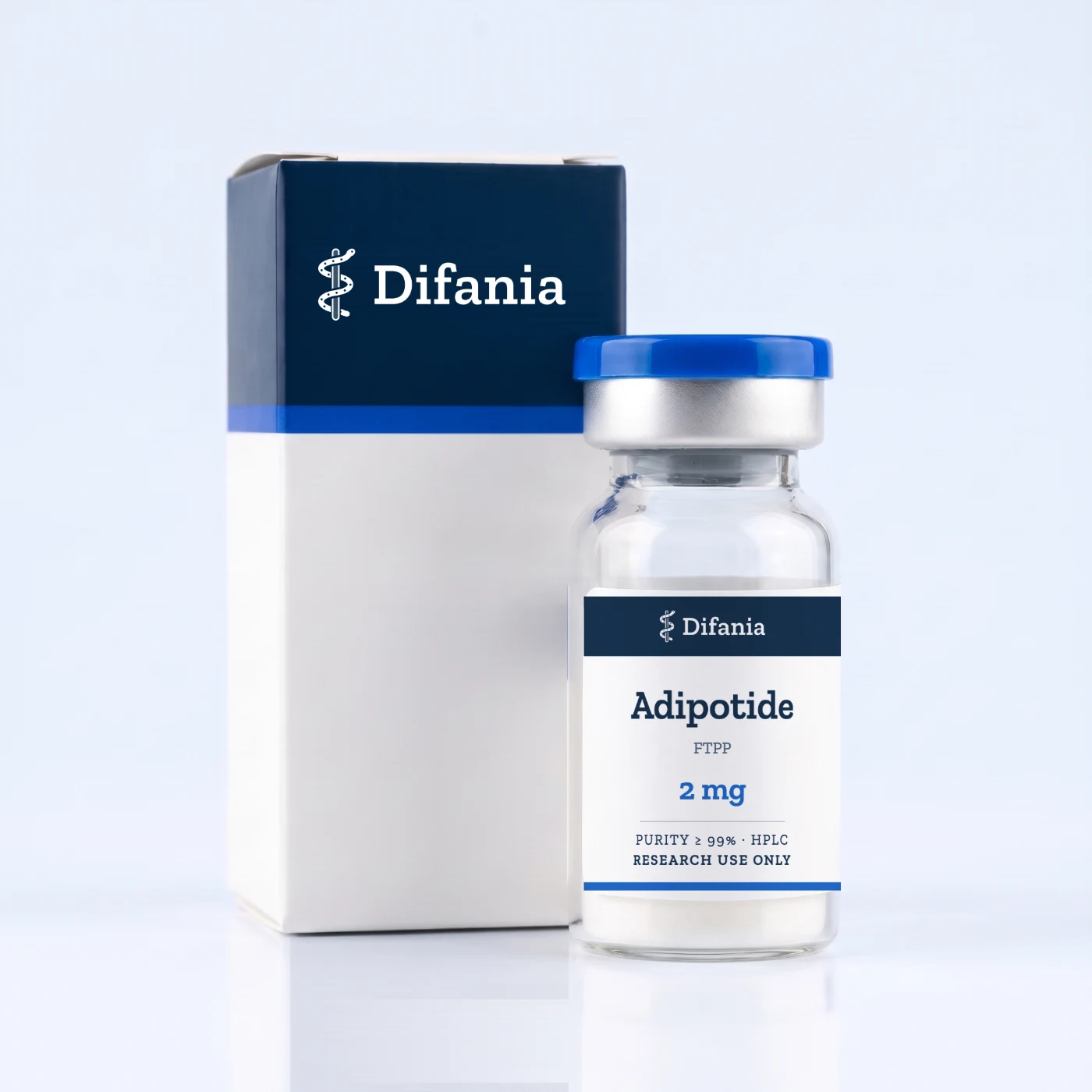
Adipotide (FTPP) in the laboratory
Identification
The catalogue records this item under the name Adipotide with the designation FTPP, and supplies it as a lyophilised solid: freeze dried under vacuum, sealed under a stopper, and reaching the laboratory as a dry cake. It is listed in the metabolic research section and carried as a single component item, which means it is not offered inside any blend and the quantity stated on the vial is all of what that vial holds. The specification applied on release is a purity of 99 percent or higher, while the identity and purity figures for a particular vial are set out in the analytical documentation held for its lot.
Three vial sizes are offered: 2 mg, 5 mg and 10 mg. The 2 mg vial deserves a word of its own, because the smallest quantities are where most handling errors happen. Two milligrams of freeze dried material is a film rather than a powder, barely visible against the glass, and a new user who expects to see a substantial cake sometimes concludes a vial is empty when it is correctly filled. Look along the base against a dark background before you decide anything is wrong.
The same point governs how the vial is opened. A small cake is light enough to be displaced by a jet of solvent, so the liquid goes down the wall of the glass and never straight onto the solid. It also shapes the reconstitution volume: with 2 mg in the vial, a slightly larger volume of solvent gives a lower concentration but a far more accurate pipetting step downstream, and the accuracy is usually worth more than the concentration.
Analytical control
Purity is determined by reversed phase high performance liquid chromatography. The principal peak is integrated against the whole chromatogram, which separates the intended material from truncated sequences and other synthesis related substances, and the specification applied is 99 percent or higher. Identity is confirmed by mass spectrometry on the same batch. Because every figure belongs to one lot, the lot documentation is the only record that describes an individual vial.
Reconstitution and solubility
Bring the vial to room temperature before breaking the seal. Add the solvent slowly against the inner wall, then swirl gently until the solution is clear; shaking raises foam and strands peptide on the stopper. Hold the vial to a light and confirm there is nothing undissolved before drawing from it. Bacteriostatic water, sterile water and a dilute acetic acid solution are the solvents in normal use.
| Vial | Solvent added | Resulting concentration |
|---|---|---|
| 2 mg | 1 mL | 2 mg/mL |
| 2 mg | 2 mL | 1 mg/mL |
| 5 mg | 1 mL | 5 mg/mL |
| 10 mg | 2 mL | 5 mg/mL |
Storage and stability
Until the day the work is scheduled, the sealed vial stays in a freezer at minus 20 degrees Celsius, protected from light; repeated journeys between freezer and bench do the material no favours. Let the glass warm to room temperature before the stopper is pierced, so moisture does not condense on cold solid. After reconstitution the solution sits at 2 to 8 degrees Celsius and is best divided into single use portions at the moment it is made up, each one labelled with the date, rather than returning to one tube that is opened daily.
Use in the laboratory
Difania supplies this material for in vitro work and for use as a reference standard in analytical method development, including calibration and system suitability runs. The catalogue places it in metabolic research, and that is the field in which it appears. What the company provides is the reagent and the analytical documentation belonging to its lot; it does not advise on experimental design, and the conditions, controls and endpoints are chosen by the laboratory running the work.
Safety and handling
Gloves and eye protection are worn whenever the vial is open or solutions are being made up, and the dry material is handled where airborne dust can be controlled, because its hazards are not fully characterised. Residues, rinses and contaminated consumables go for disposal under the rules of your institution and the waste regulations in force locally. This is a laboratory chemical. It is not a medicinal product, a food, a supplement or a cosmetic, it is not for consumption, and it must not be administered to humans or animals.
Lot documentation
Each vial carries a lot number on its label. Quote that number and Difania can retrieve the analytical documentation held for the batch it belongs to. Write it into the notebook beside the date the vial was opened, so that a result revisited much later can still be tied without argument to the material that produced it.


