
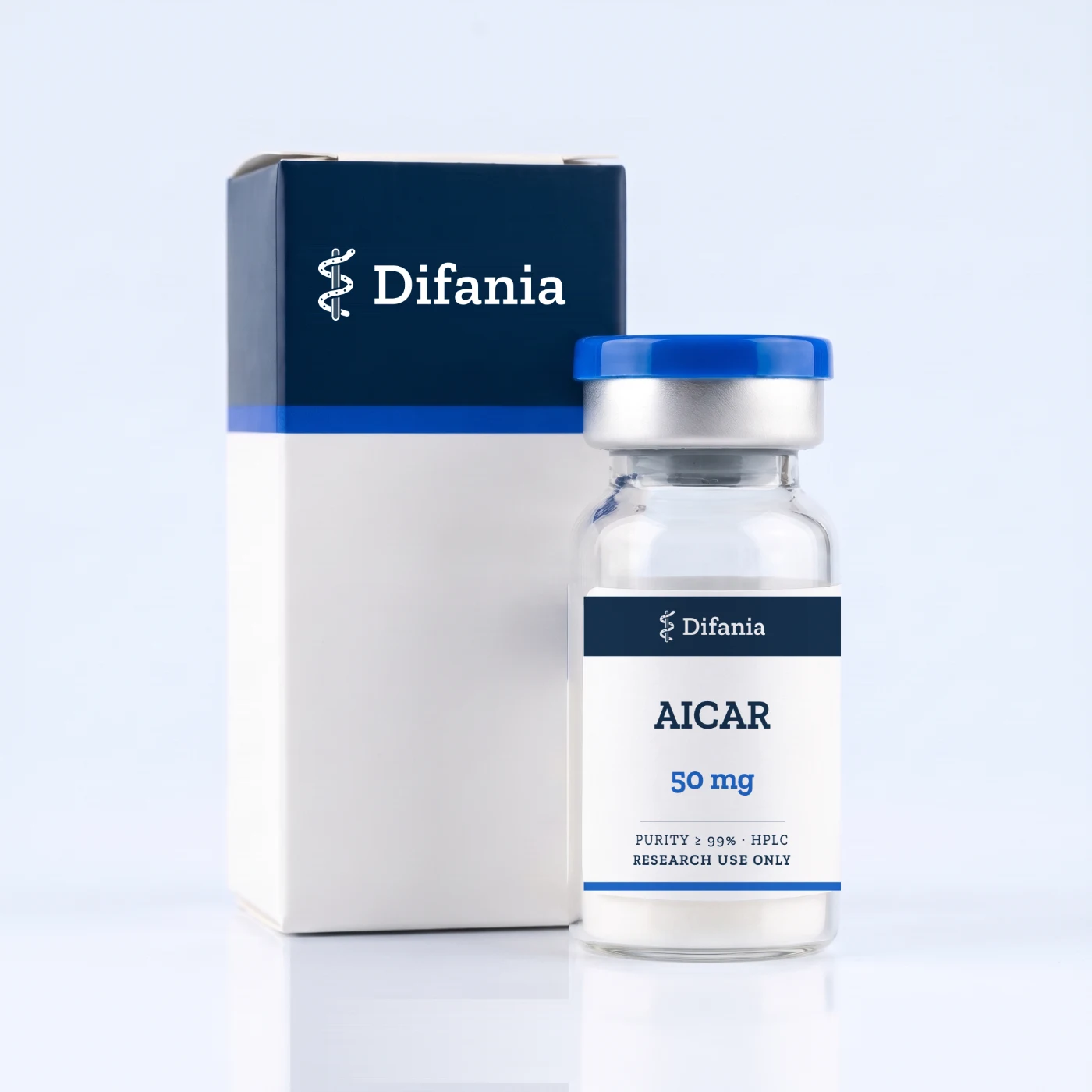
AICAR in the laboratory
Identification
AICAR is a small molecule, not a peptide, and the catalogue carries the full set of identifiers: CAS 2627-69-2, the molecular formula C9H14N4O5 and a molar mass of 258.2. The composition is the most informative thing on this page. Nine carbon atoms carry four nitrogens and five oxygens, a ratio that marks the molecule out as distinctly polar and nitrogen rich rather than hydrocarbon in character, and there is no sulphur, no phosphorus and no halogen in the formula at all. Fourteen hydrogens against nine carbons and four nitrogens leaves five degrees of unsaturation, so rings and multiple bonds account for a good part of the structure rather than a saturated open chain.
Difania supplies the material as a lyophilised solid in two vial sizes, 50 mg and 100 mg. These are large vials by the standards of the catalogue, and the quantities reflect the fact that a molar mass of 258.2 is low: a stock made from 100 mg of this material reaches a molar concentration that would need a far heavier weighing of a long chain peptide. Run the arithmetic before the first vial is opened, because an error of a factor of ten is easier to make here than anywhere else in the catalogue.
The item is listed under metabolic research and is carried as a single component: it is not offered inside a blend, so the figure on the vial is the figure you work with. The purity specification applied on release is 99 percent or higher.
Analytical control
Each lot is released on two determinations. Purity is measured by reversed phase high performance liquid chromatography, the principal peak integrated against the full chromatogram so that related substances and residues from synthesis are resolved from the intended material, against a specification of 99 percent or higher. Identity is confirmed by mass spectrometry, the measured mass compared with the 258.2 calculated from C9H14N4O5. Those results describe one batch, which is why the lot documentation, not this page, is the record for a given vial.
Reconstitution and solubility
Let the vial reach room temperature before the seal is broken. Add the solvent slowly, running it down the inner wall of the glass rather than onto the solid directly, and swirl until the liquid is clear; shaking produces foam and leaves material in the neck and on the stopper. Check the vial against a light before drawing anything from it. Sterile water, bacteriostatic water and a dilute acetic acid solution are the solvents in routine use. With vials this size, confirm that the volume you intend to add actually fits before you start.
| Vial | Solvent added | Resulting concentration |
|---|---|---|
| 50 mg | 5 mL | 10 mg/mL |
| 50 mg | 10 mL | 5 mg/mL |
| 100 mg | 10 mL | 10 mg/mL |
| 100 mg | 20 mL | 5 mg/mL |
Storage and stability
The sealed solid belongs at minus 20 degrees Celsius, shielded from light, and should stay there until the day of the work rather than being moved in and out of the freezer. Warming the vial to room temperature on the bench before the stopper is pierced keeps atmospheric moisture from condensing onto cold material. Reconstituted solution is held at 2 to 8 degrees Celsius, portioned out at the time it is made up, and labelled with that date so its age is never a matter of memory.
Use in the laboratory
The material is supplied for in vitro work and as a reference standard in analytical method development, including calibration and system suitability runs. Metabolic research is the field in which it appears, and that is where the catalogue lists it. Difania provides the reagent together with the analytical documentation belonging to its lot, and does not advise on experimental design: the conditions, controls and endpoints are set by the laboratory doing the work.
Safety and handling
Treat this as a laboratory chemical whose hazards are not fully characterised. Gloves and eye protection go on before the vial is opened and stay on while solutions are prepared, and dry solid is best handled where airborne dust can be controlled, which matters more with 50 mg and 100 mg quantities than with a milligram cake. Residues and contaminated consumables are disposed of under your institution’s rules and the local waste regulations. The material is not a medicinal product, a food, a supplement or a cosmetic; it is not for consumption and not for administration to humans or animals.
Lot documentation
The label of each vial carries a lot number, and quoting that number allows Difania to retrieve the analytical documentation held for the batch it came from. Note it in the laboratory record next to the date the vial was opened. That single line is what connects a result read back months later to the exact material that produced it.


