
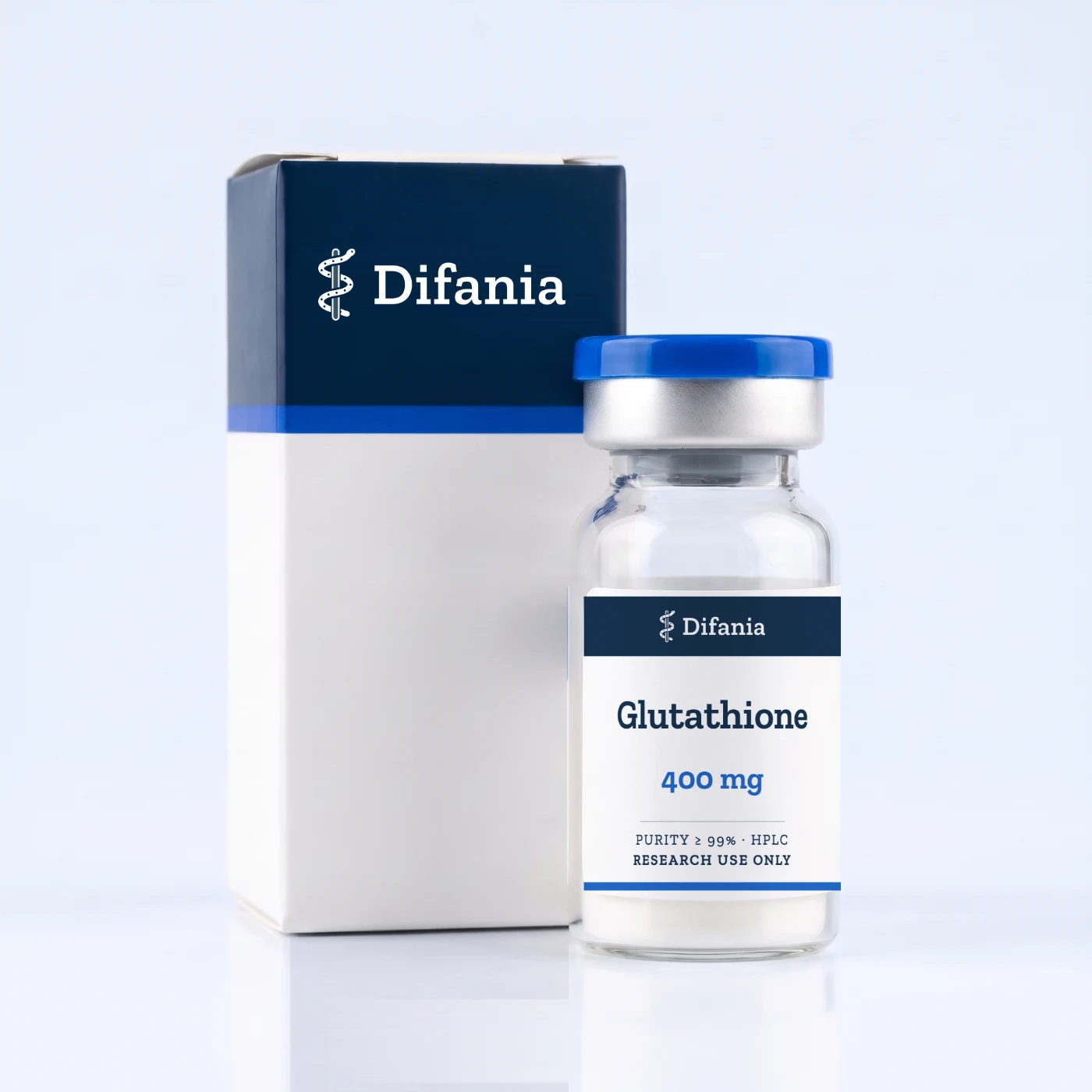
Glutathione in the laboratory
Identification
Glutathione is held in the catalogue under CAS 70-18-8, with the molecular formula C10H17N3O6S and a molar mass of 307.3. The formula is the most informative line in that record: ten carbon atoms, three nitrogen atoms, six oxygen atoms and one sulphur atom. That single sulphur sets the item apart from most of what sits beside it in the metabolic research section of the catalogue, and it is why the notes below put more weight than usual on keeping the container closed and the exposure to air brief.
Difania supplies it as a lyophilised solid in three vial sizes, 400 mg, 600 mg and 1500 mg. Those quantities sit an order of magnitude above the milligram vials used for synthetic peptides, which changes the practical picture in two ways. Solvent volumes are larger, measured with a cylinder or a volumetric flask rather than a syringe, and a 1500 mg vial is better treated as a stock of dry solid drawn on over time than as something dissolved in one operation. The catalogue records no salt form and no sequence for this item, so neither is stated here.
Analytical control
Purity is established on a reversed phase high performance liquid chromatography system, where the main peak is integrated against the whole chromatogram and compared with the specification applied to this item, 99 percent or higher. Identity is established by mass spectrometry, the measured mass being read against the mass calculated from the catalogued formula, 307.3. Both determinations belong to one lot and describe that lot alone, which is why the lot number is the reference point for any later query.
Reconstitution and solubility
Let the vial stand until it has reached room temperature, then add the solvent down the inner wall of the glass rather than directly onto the solid. Swirl gently until the liquid runs clear, since shaking raises foam and strands material on the stopper. Bacteriostatic water, sterile water and a dilute acetic acid solution are the solvents in normal use.
| Vial | Solvent added | Resulting concentration |
|---|---|---|
| 400 mg | 4 mL | 100 mg/mL |
| 400 mg | 10 mL | 40 mg/mL |
| 600 mg | 6 mL | 100 mg/mL |
| 600 mg | 20 mL | 30 mg/mL |
| 1500 mg | 15 mL | 100 mg/mL |
| 1500 mg | 50 mL | 30 mg/mL |
Where only part of a vial is needed, weigh out that portion and reseal the rest as dry solid. With a molar mass of 307.3 on the label, the conversion from a mass concentration to a molar one is a single arithmetic step.
Storage and stability
Dry and sealed, the vial belongs at minus 20 degrees Celsius, shielded from light, and should stay there until the day the work is scheduled. Let it warm to room temperature before the stopper comes out, because a cold vial opened in a warm room draws moisture into the powder. Once in solution the material moves to 2 to 8 degrees Celsius, split into working portions at the moment of dissolution rather than entered again and again. Write the date of reconstitution on the label, since the solution carries no other record of its own age.
Use in the laboratory
The material is supplied for in vitro work and for use as a reference material in analytical method development, including calibration and system suitability runs. Glutathione appears in redox biology and oxidative stress research, and the catalogue files it under metabolic research. Difania provides the reagent and the analytical documentation belonging to its lot. Experimental design, choice of controls and conditions of use remain with the laboratory doing the work.
Safety and handling
Handle this as a laboratory chemical from the moment the outer packaging is opened. Gloves and eye protection are worn while the vial is open and solutions are prepared, and dry powder where airborne dust can be controlled. Residues, rinses and contaminated consumables go to waste under the rules of your institution and the regulations in force locally. This is not a medicinal product, a food, a supplement or a cosmetic. It is not for consumption and not for administration to humans or animals.
Lot documentation
A lot number appears on the label of every vial. It is the key that lets Difania retrieve the analytical documentation held for the batch that vial came from. Copy it into the notebook together with the date of opening, so that a result reviewed months later can still be traced back to the exact material behind it.


