
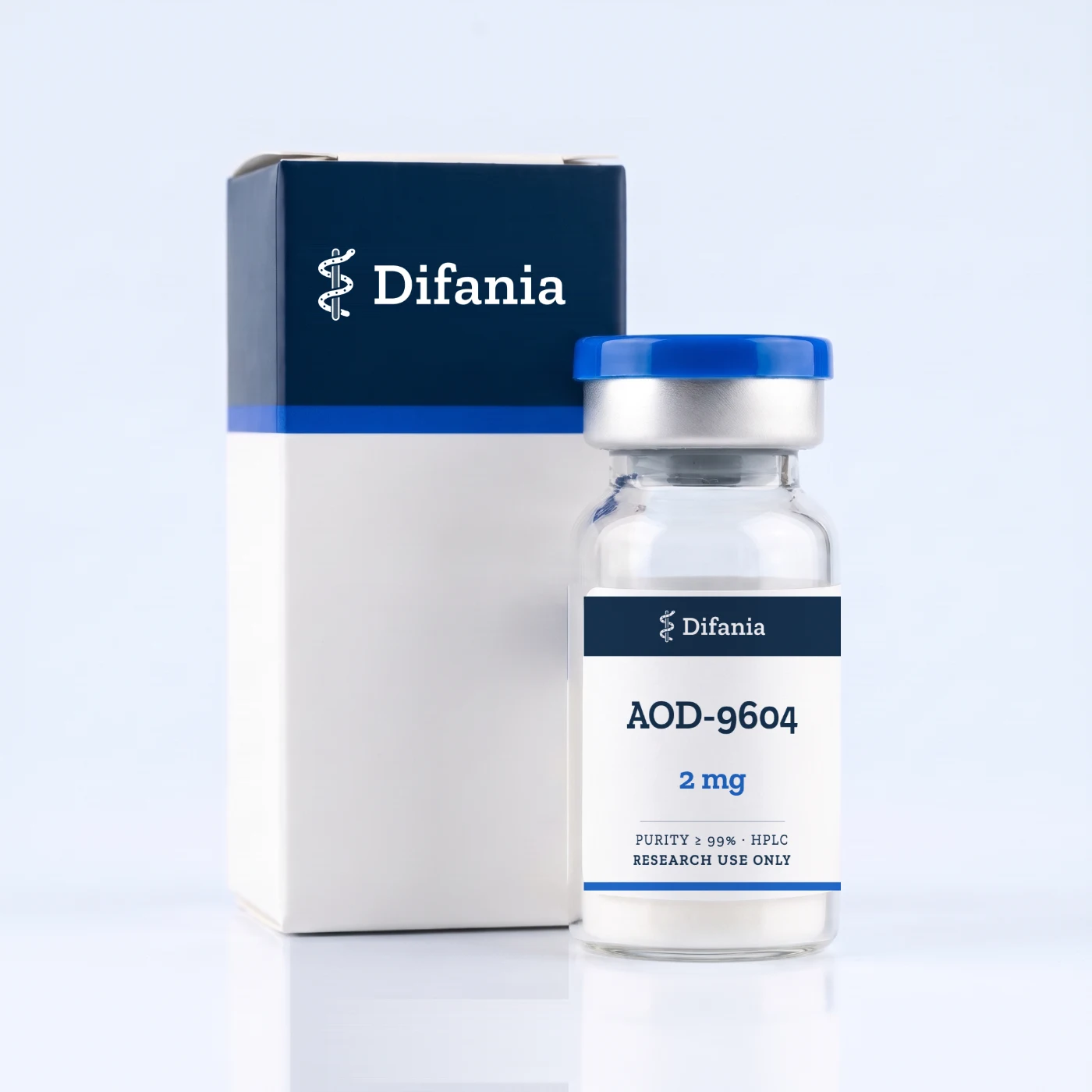
AOD-9604 in the laboratory
Identification
AOD-9604 is a synthetic peptide listed in the metabolic research section of the catalogue and supplied as a lyophilised solid. It is registered under CAS 221231-10-3. The molecular formula recorded against it is C78H123N23O23S2, with a molar mass of 1815.1, which places it among the shorter peptides in this part of the range. Two features of that formula are worth carrying to the bench. The twenty three nitrogen atoms are what you would expect of a chain of amide linked residues, and the two sulphur atoms mark the presence of sulphur bearing residues, which are the sites in any peptide most prone to oxidation. Three fills are offered, 2 mg, 5 mg and 10 mg, each released against a purity specification of at least 99 percent.
Analytical control
Identity and purity are both determined before a lot is released. The purity result comes from reversed phase HPLC, where the main peak is measured against the related substances separated alongside it, and is assessed against the catalogue specification of at least 99 percent. Identity is confirmed by mass spectrometry, the measured mass being read against the 1815.1 recorded here and against the structure to which the CAS registration refers. Both results are entered in the documentation held for that lot and can be retrieved afterwards.
Reconstitution and solubility
Let the vial warm to room temperature before the stopper is touched. Introduce the solvent slowly and against the inner wall, so that it works down to the cake rather than striking it from above, then swirl steadily until the solution clears. Shaking only generates foam. Bacteriostatic water, sterile water and a dilute acetic acid solution are the solvents in ordinary use, with the acidified choice kept back for a cake that dissolves slowly in water on its own.
| Vial | Solvent added | Resulting concentration |
|---|---|---|
| 2 mg | 2 mL | 1 mg/mL |
| 5 mg | 2.5 mL | 2 mg/mL |
| 10 mg | 5 mL | 2 mg/mL |
Look through the cleared solution against a light background before use. Visible particles mean something is wrong; a thin film left high on the glass means nothing more than that another swirl is wanted.
Storage and stability
The sealed solid is kept at minus 20 degrees Celsius with light excluded, and given the sulphur in the formula that darkness and that seal are doing real work. Once reconstituted, the solution is held at 2 to 8 degrees Celsius and divided into portions, so that a single aliquot can be drawn without the remainder being warmed and pierced along with it. Bringing a vial to room temperature before opening prevents the condensation that forms the instant a cold cake meets room air, which is the one thing the lyophilisation step was carried out to avoid.
Use in the laboratory
This material is intended for in vitro work and for use as a reference substance, for example as a characterised standard when a chromatographic method is being developed or a mass spectrometry workflow verified. AOD-9604 appears in laboratory literature belonging to the field of metabolic research, the group under which the catalogue lists it. Difania supplies the material and its analytical documentation, and does not advise on experimental design or on the interpretation of results.
Safety and handling
What is in the vial is a laboratory chemical and the usual precautions hold. Wear gloves and eye protection whenever the vial is open or a solution is being moved between vessels, and work on a surface that can be wiped down when you are finished. Residual solution, rinsings and empty vials go for disposal under your institution’s rules together with the local regulations that apply. This is not a medicinal product, a food, a supplement or a cosmetic, and it is intended neither for consumption nor for administration to humans or animals.
Lot documentation
Each vial is labelled with a lot number. Quoting that number allows Difania to retrieve the analytical documentation held for the filling the vial came from, which is the only dependable way to connect a stored result back to the material behind it. Note the number in your own log at the point of first opening and record that date next to it.


