
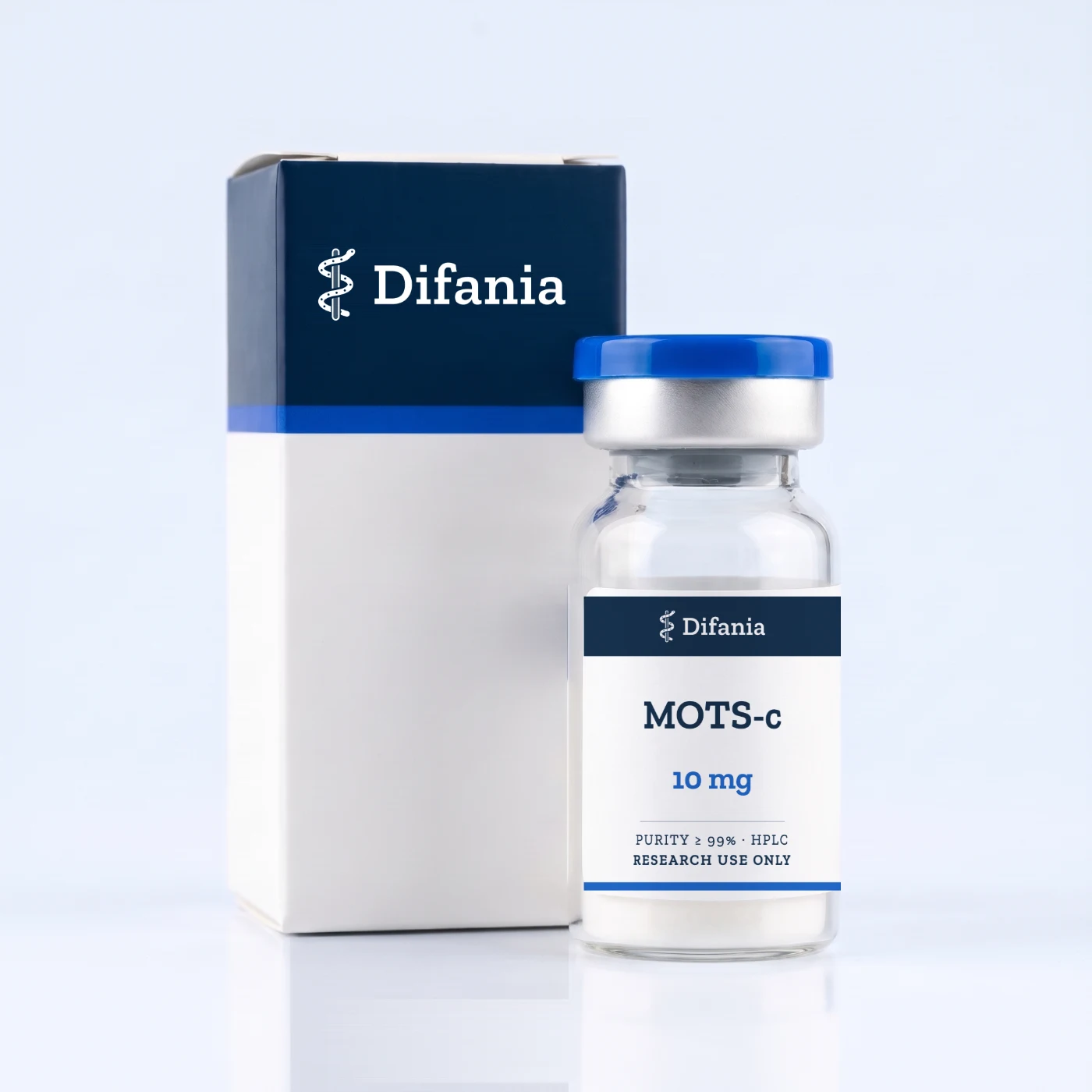
MOTS-c in the laboratory
Identification
MOTS-c is a mitochondrial derived peptide, one of the short peptides whose coding sequence sits within the mitochondrial genome rather than the nuclear one. That origin is what the class name records, and it is the reason the compound is grouped with metabolic research rather than with the hormone analogues elsewhere in the catalogue.
The catalogue holds it under CAS 1627580-64-6, with the molecular formula C101H152N28O22S2 and a molar mass of 2174.6. Two details in that formula are worth drawing out. The chain is short, which is why the material dissolves readily and why no complicated solvent strategy is needed. And it carries two sulphur atoms, meaning sulphur bearing residues are present. Those residues are the ones most readily oxidised at an air to liquid interface, which is the practical reason the reconstitution advice below leans so hard on gentle mixing and small headspace.
Difania supplies the peptide as a synthetic, lyophilised solid in three fill sizes: 10 mg, 20 mg and 40 mg per vial. The material is identical across all three, and nothing in the handling changes between them beyond the solvent volume. No sequence listing, salt form or counter ion figure is entered against this item, so where a method depends on one of those, the lot documentation is the reference.
Analytical control
Purity for this item is measured by reversed phase high performance liquid chromatography. The main peak is integrated against the complete chromatogram, which separates the intended peptide from the deletion sequences and truncated chains that synthesis can leave behind, and the specification applied to this item is 99 percent or higher. Identity comes from mass spectrometry, where the measured mass of the peptide is set against the value calculated from the catalogued formula, 2174.6. Both figures are tied to one lot, and it is the record for that lot which describes the vial actually on your bench.
Reconstitution and solubility
Warm the vial to room temperature before breaking the seal, then introduce the solvent slowly down the inside wall of the glass rather than onto the cake directly. Swirl until clear. Shaking generates foam, and foam both strands peptide on the stopper and widens the air interface that sulphur bearing residues are least tolerant of.
| Vial | Solvent added | Resulting concentration |
|---|---|---|
| 10 mg | 1 mL | 10 mg/mL |
| 10 mg | 2 mL | 5 mg/mL |
| 20 mg | 2 mL | 10 mg/mL |
| 20 mg | 4 mL | 5 mg/mL |
| 40 mg | 4 mL | 10 mg/mL |
| 40 mg | 8 mL | 5 mg/mL |
Storage and stability
Sealed vials live at minus 20 degrees Celsius in the dark, and they should stay there until the day of the experiment rather than being dissolved ahead of time. Let the glass reach room temperature on the bench before it is opened, so that moisture does not condense out of the air onto chilled powder. Once a solvent has gone in, the solution is kept at 2 to 8 degrees Celsius and split into working portions immediately, which matters more for this peptide than for most: every reopening of a shared tube is another exposure to air for the sulphur bearing residues. Larger fills repay a little planning here, since a 40 mg vial portioned sensibly at the outset can serve a long run of work without ever being reopened as a bulk stock.
Use in the laboratory
The peptide is supplied for in vitro experiments and as a characterised reference material, for instance while a chromatographic method is being developed or a mass spectrometry workflow is checked for system suitability. Mitochondrial derived peptides appear in mitochondrial biology and in metabolic research, and the catalogue files this entry under metabolic research accordingly. Difania supplies the material and the analytical documentation held for its lot, and does not advise on experimental design, the choice of conditions or the interpretation of results.
Safety and handling
The contents are a laboratory chemical whose hazards are not fully characterised, and the ordinary precautions apply. Gloves and eye protection stay on while the vial is open and while solutions are transferred. Handle the dry solid where airborne dust can be controlled. Residues, rinsings and spent consumables go to waste under your institution’s rules and the local regulations behind them. This is not a medicinal product, food, supplement or cosmetic, it is not for consumption, and it is not to be administered to humans or animals.
Lot documentation
Each vial is labelled with a lot number, and that number is the route back to the analytical documentation Difania holds for the filling. An enquiry quoting it is all that is needed for the paperwork to be retrieved and sent. Record the same number in your own notes with the date the vial was opened, the solvent chosen and the concentration made up, so that work revisited long afterwards can still be traced to the material it was built on.


