
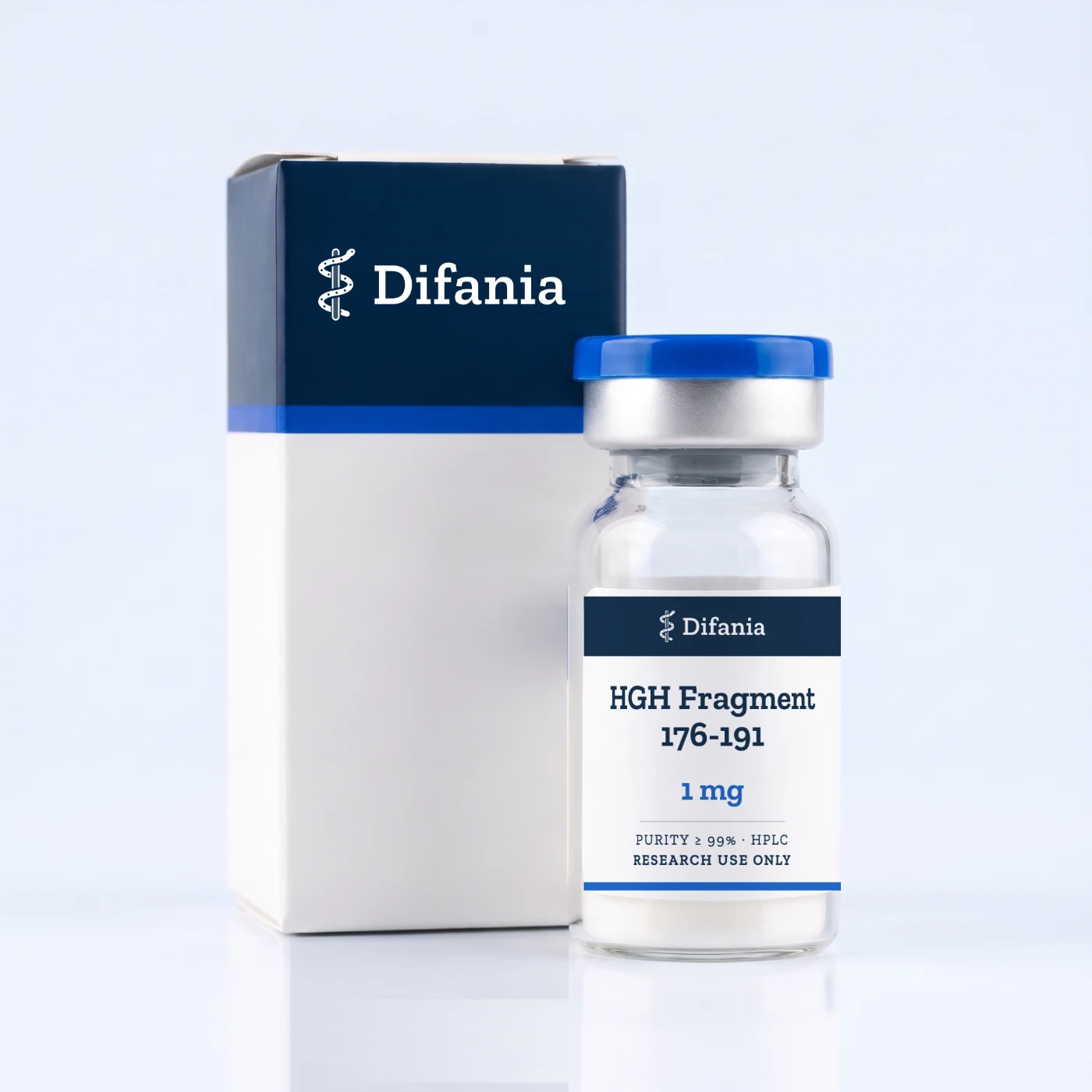
HGH Fragment 176-191 in the laboratory
Identification
HGH Fragment 176-191 is a synthetic peptide held in the metabolic research section of the catalogue and supplied as a lyophilised solid. The name is read the way any fragment name is read: the figures mark the stretch of the parent chain the material corresponds to, residues 176 to 191 of the growth hormone sequence abbreviated HGH, so the molecule is a short peptide rather than a whole protein. Of the entries in this part of the catalogue, it carries the widest choice of fills, 1 mg, 2 mg, 5 mg, 10 mg and 15 mg, all released against a purity specification of at least 99 percent. The spread exists for a practical reason: a short peptide in solution has a working life measured in days rather than months, so buying the fill that matches the scale of the work is better practice than buying the largest one available.
Analytical control
Each lot is released against two determinations. Reversed phase HPLC establishes purity, with the main peak set against the related substances resolved in the same run and the outcome compared to the catalogue specification of at least 99 percent. Mass spectrometry establishes identity. Both results are tied to the lot rather than to the product line as a whole, and both stay on file so the figures behind a particular vial remain recoverable.
Reconstitution and solubility
Take the vial out and leave it to reach room temperature before touching the seal. Add solvent slowly against the inner glass so it reaches the cake from the side, then swirl in short turns until the liquid runs clear. Do not shake: foam traps material on the upper wall and makes the concentration harder to trust. Bacteriostatic water, sterile water and a dilute acetic acid solution are the solvents in routine use, the acidified one reserved for a cake that is slow to go into water alone.
| Vial | Solvent added | Resulting concentration |
|---|---|---|
| 1 mg | 1 mL | 1 mg/mL |
| 2 mg | 2 mL | 1 mg/mL |
| 5 mg | 2.5 mL | 2 mg/mL |
| 10 mg | 5 mL | 2 mg/mL |
| 15 mg | 5 mL | 3 mg/mL |
Check the cleared solution against a plain background. It should be free of visible particles; a film clinging above the liquid line is normal and goes in with another gentle swirl.
Storage and stability
Unopened, the solid keeps at minus 20 degrees Celsius in the dark, and there is no reason to move it from there until the day it is needed. Once in solution, the material belongs at 2 to 8 degrees Celsius, and dividing it into aliquots at that point is the single most useful habit: every portion drawn from one shared vial means another warming and another puncture of the stopper. Equilibration before opening matters for the same reason the cake was dried in the first place, since a cold surface meeting room air collects water almost immediately.
Use in the laboratory
The material is supplied for in vitro work and for use as a reference substance, for instance as a characterised standard while a separation is being developed or an identity method checked. HGH Fragment 176-191 appears in laboratory literature within the field of metabolic research, which is the group the catalogue assigns it to. Difania provides the material and the analytical documentation that accompanies it, and offers no guidance on experimental design or on how results should be interpreted.
Safety and handling
Handle the contents as a laboratory chemical throughout. Gloves and eye protection go on before the vial is opened and stay on while solutions are being transferred, and the bench should be one that wipes clean. Surplus solution, rinsings and used vials are disposed of under the rules of your institution and the local regulations that apply to it. The material is not a medicinal product, a food, a supplement or a cosmetic, and it is not for consumption or for administration to humans or to animals.
Lot documentation
The label on each vial carries a lot number, and that number is what Difania needs in order to retrieve the analytical documentation held for the filling it came from. Keep it in your own records, written beside the date the vial was first opened, so a result set aside today can still be matched to its material later.


