
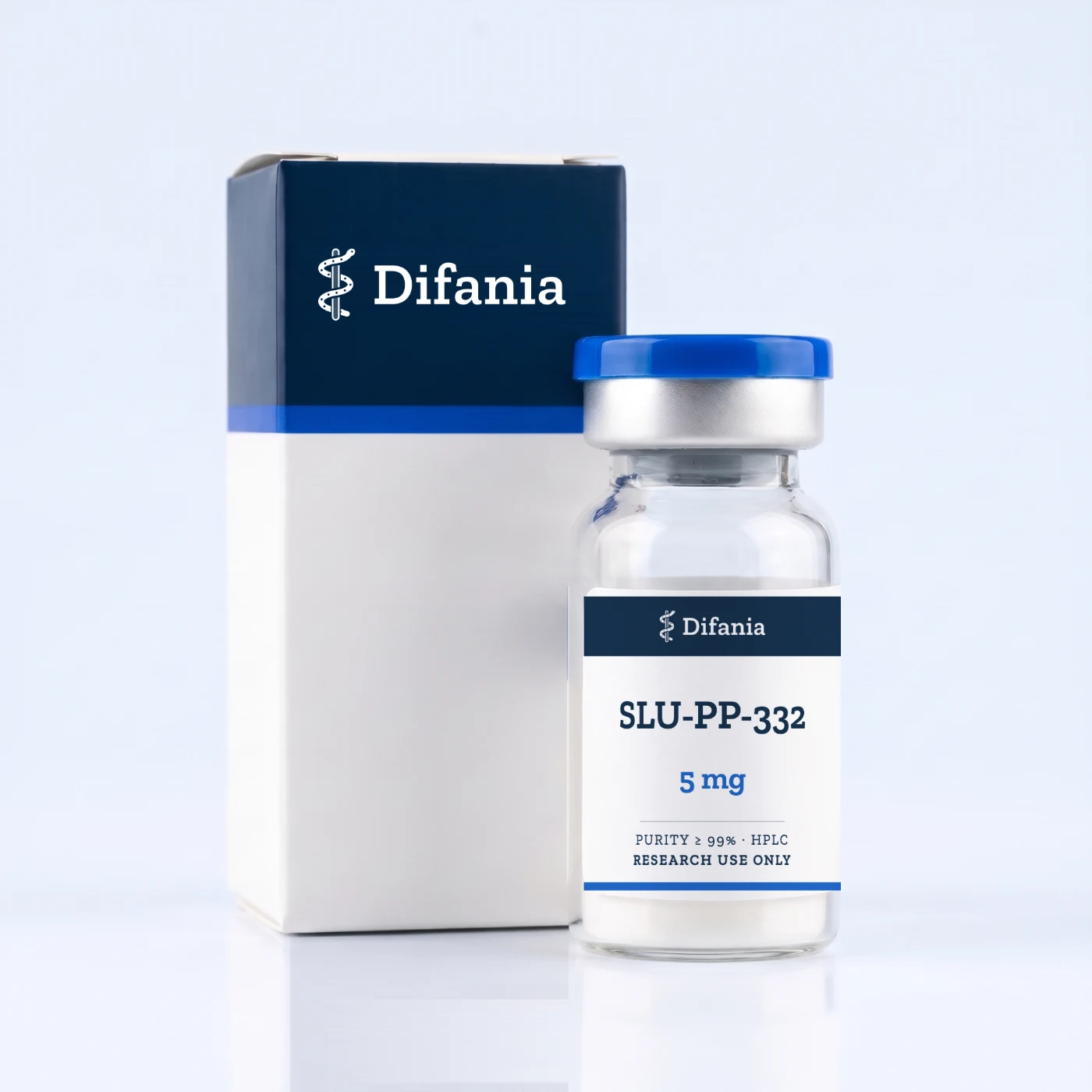
SLU-PP-332 in the laboratory
Identification
SLU-PP-332 is a small synthetic organic compound rather than a peptide, and the catalogue holds a complete set of identifiers for it: CAS 303760-60-3, the molecular formula C18H14N2O2 and a molar mass of 290.3. That formula repays a close reading, because it describes the material more usefully than any label does. Eighteen carbon atoms carry only fourteen hydrogens, alongside two nitrogens and two oxygens, with no sulphur, no phosphorus and no halogen anywhere in the molecule. A hydrogen count that lean against eighteen carbons leaves thirteen degrees of unsaturation, so what you are handling is a compact framework of rings and multiple bonds rather than a flexible open chain.
Difania supplies the compound as a lyophilised solid in three vial sizes, 5 mg, 10 mg and 20 mg, and lists it in the metabolic research section of the catalogue. It is carried as a single component item and is not offered within any blend, so the quantity printed on the vial is the quantity of compound in your hands.
A molar mass of 290.3 has a practical consequence worth stating plainly. One milligram of this solid represents a far larger number of moles than one milligram of a peptide, so molar concentrations climb fast and an arithmetic slip made in the head is easy. Work the figures on paper before the vial is opened. A rigid, strongly unsaturated framework of this kind also need not dissolve in water the way a freeze dried peptide does, so treat the first vial from a new lot as the one that teaches you how the material behaves.
Analytical control
Purity is established by reversed phase high performance liquid chromatography, with the main peak integrated against the whole chromatogram so that process residues and related substances are separated from the intended compound. The specification applied to this item is 99 percent or higher. Identity is established by mass spectrometry, the measured mass being compared against the value calculated from C18H14N2O2, namely 290.3. Both determinations belong to one lot, which is why the lot paperwork, rather than this page, describes any individual vial.
Reconstitution and solubility
Let the vial stand until it reaches room temperature, then add solvent slowly down the inner wall of the glass rather than straight onto the solid. Swirl gently; shaking raises foam and strands material on the stopper. Give the solution a minute to settle, then hold the vial against a light and check that nothing remains undissolved before anything is drawn from it. Bacteriostatic water, sterile water and a dilute acetic acid solution are the solvents in routine use.
| Vial | Solvent added | Resulting concentration |
|---|---|---|
| 5 mg | 1 mL | 5 mg/mL |
| 10 mg | 2 mL | 5 mg/mL |
| 20 mg | 4 mL | 5 mg/mL |
| 20 mg | 10 mL | 2 mg/mL |
Storage and stability
Keep the sealed vial at minus 20 degrees Celsius and shielded from light until the day the work is actually scheduled; a freezer is a better home for it than a bench drawer. Allow time for the glass to warm to room temperature before the seal is broken, so that moisture from the air does not condense onto cold solid. Once in solution, the material belongs at 2 to 8 degrees Celsius, split into portions at the time of dissolution so that one tube is not opened and closed day after day. Write the date of reconstitution on the label, since a solution carries no other record of its own age.
Use in the laboratory
The compound is supplied for in vitro work and for use as a reference material in analytical method development, including calibration and system suitability runs. The catalogue groups it under metabolic research, which is the field in which molecules of this class appear. Difania provides the reagent and the analytical documentation belonging to its lot, and does not advise on experimental design, controls or conditions; those decisions rest with the laboratory doing the work.
Safety and handling
The hazards of this compound are not fully characterised, so handle it as a laboratory chemical from the moment the vial leaves the freezer. Gloves and eye protection are expected while the vial is open and while solutions are prepared, and dry solid is best weighed or transferred where airborne dust can be controlled. Residues, rinses and contaminated consumables go to disposal under the rules of your institution and the waste regulations in force locally. This material is not a medicinal product, a food, a supplement or a cosmetic, must not be consumed, and must not be administered to humans or animals.
Lot documentation
A lot number is printed on the label of every vial. Quote it and Difania can retrieve the analytical documentation held for that batch. Copy it into the notebook alongside the date the vial was first opened, so that a result reviewed months later can still be tied to the exact material that produced it.


