
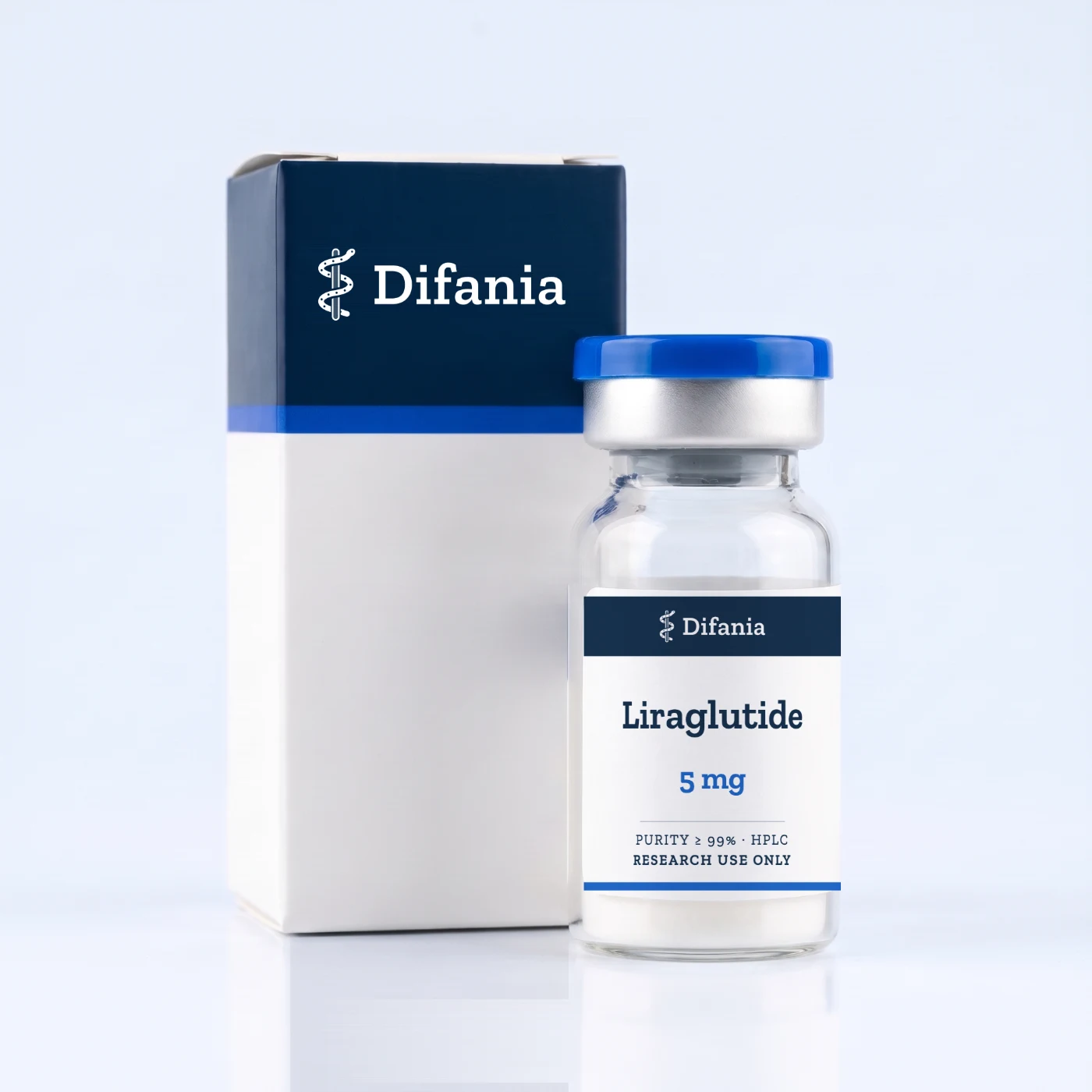
Liraglutide in the laboratory
Identification
Liraglutide is a synthetic peptide catalogued under incretin analogues and supplied as a lyophilised solid. Three identifiers sit in the record: CAS number 204656-20-2, the molecular formula C172H265N43O51 and a molar mass of 3751.2 g/mol. Together they settle the three questions a buyer asks of a peptide reagent. The CAS number fixes which substance was ordered, independently of how any supplier spells the name. The formula fixes the elemental composition. The molar mass is the number the identity measurement is read against.
The formula also tells you something about handling before any method is written. Forty three nitrogen atoms mark out a long chain of amide bonds with further nitrogen in the side chains, and fifty one oxygen atoms make the molecule strongly polar, which is why aqueous solvents are reached for first. No sulphur appears in it, so there is no cysteine residue and no disulfide bridge to preserve, and reducing agents play no part in working with this material.
Three fill weights are catalogued: 5 mg, 10 mg and 30 mg. In the dry state the peptide is far less sensitive to handling than in solution, which is why it is stored as a solid and dissolved only at the point of use.
Analytical control
Purity is measured by reversed phase high performance liquid chromatography. The sample is separated on the column, the main peak is integrated against the full chromatogram and the result is read against the catalogue specification of 99% or higher. What falls outside the main peak is a profile of related species rather than an unknown, which is why the chromatogram repays reading in full.
Identity is confirmed by mass spectrometry, with the measured mass compared against the 3751.2 g/mol expected from the stated formula. For a chain of this size there is little room for ambiguity: one residue more or fewer shifts the result far beyond the error of the measurement.
Reconstitution and solubility
Let the vial equilibrate to room temperature, then run the solvent down the inner wall rather than onto the cake itself. Swirl gently until the solution is clear. Foam on the surface is a sign the peptide has been shaken rather than dissolved.
| Vial | Solvent added | Resulting concentration |
|---|---|---|
| 5 mg | 2 mL | 2.5 mg/mL |
| 10 mg | 2 mL | 5 mg/mL |
| 30 mg | 3 mL | 10 mg/mL |
The rows are division, not instruction. Bacteriostatic water is the common solvent where a vial will be entered more than once, sterile water where no additive is permitted, and a dilute acetic acid solution where a stubborn cake needs help before further dilution.
Storage and stability
Unopened, the solid belongs at minus 20 degrees Celsius, in the dark and with the seal intact. Once dissolved, keep the solution at 2 to 8 degrees Celsius and split it into working portions instead of returning to a single vial again and again, since every return cycle carries the entire volume through another warming and chilling. Label the vial with the reconstitution date at the moment you make it up, and bring it to room temperature before each opening.
Use in the laboratory
The peptide is supplied for in vitro work and as a reference material where methods are developed or calibrated against a solid of known identity. Incretin analogues as a group are a subject of metabolic and endocrine research, and the catalogue places this peptide there. Difania supplies the material together with the analytical documentation held for its lot and does not advise on experimental design, which remains with the laboratory running the work.
Safety and handling
Gloves and eye protection, a clean bench and no draught across an open vial of light dry solid. Residues, spent solutions and used glass are disposed of under the rules of your institution and the local regulations covering chemical waste. The vial holds a laboratory chemical. It is not a medicinal product, a food, a food supplement or a cosmetic, nor is it for consumption or for administration to humans or animals.
Lot documentation
A lot number is printed on each vial, and quoting it lets Difania retrieve the analytical documentation held for that lot. Record the same number in your notebook beside the date the vial was opened and the solvent used, so that a result produced months later still points back to a defined material.


